Showing posts with label uk umrah packages 2016. Show all posts

Wednesday, 31 August 2016

Follow the Idol Breaker

Follow the Idol Breaker

Follow the Idol Breaker


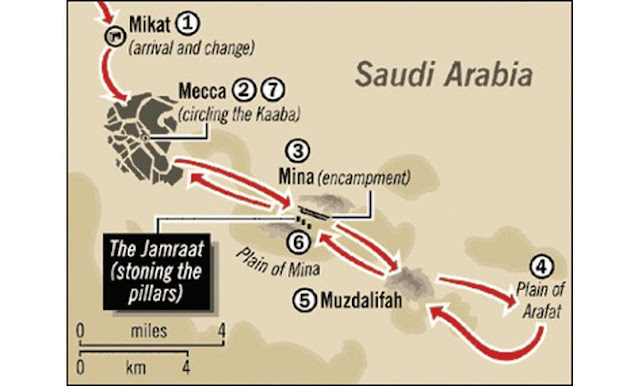
One of the rituals of Hajj is the throwing of pebbles at the three pillars of temptation that symbolizes Satan, when he tried to dissuade Prophet Ibrahim from carrying out the command of God.

The pile of broken umbrellas, huge rocks, and of course, rubber slip-ons of all hue piled around the pillars of temptation tell more than a story. The minor story of course is that some people come to Hajj unprepared and thus unaware what to hurl at Satan. The major story is that why only small pebbles are needed. The questions, what to hurl and why only small pebbles are closely connected.

The completion of the rites of Hajj, as we know them, was executed by Prophet Muhammad after he removed all idols from the Kabah. The objects that needed major demolition equipment had been done away and what now remain are fresh idols that keep cropping up at all times. The need for heavy demolition equipment does exist, but the heavy-duty stuff that needs to be removed are not big rocks of idols, but the rocks of corruption, greed, power, vanity and self-indulgence. The equipment needed to remove these rocks, are sincere doses of God Consciousness (Taqwa).

Prophet Ibrahim (Abraham), perhaps, the foremost idol breaker, launched a mission against idolatry when it was the absolute norm – he stood firm against the tide of idol worship and challenged this deep-rooted social norm. Today, we live amidst a tide of idols, however, these idols, although man-made like their predecessors, enjoy a form that is far more deceptive than the word idol usually conjures up for us. The modern day idols of the love for power or recognition is taking many forms, and most often these idols in the guise of current-day social norm are not only hurtful to the individual but indeed the community.

Prophet Ibrahim was confronted by the same psychological and emotional challenges that confront us: making and worshipping idols was the norm, and in his case the family’s livelihood too. This is where his greatness lies that he was able to break from these barriers and demolish the idols. Yes, there was opposition, but none from within him. He felt no fear, no hesitancy in undoing his family’s source of income. He was driven by a desire to break the shekels of idolatry and establish the worship of One true God.

The jihad (struggle) of Prophet Ibrahim is as relevant for us today, as it was thousands of years ago. Today, although it seems that no physical idols need be broken, but many idols confront us: there are still billions who are worshipping man-made idols, there are many who, drunk with power, are devastating human rights at will, and above all human beings live with false notions of wealth.

The popular ditty goes: "What a tangled web we weave, when first we practice to deceive." Humanity is held in deception and awaiting Muslims to break psychological and emotional idols and free themselves and the rest from this temporal world.
Source: islamicity.org

Friday, 26 August 2016

Preparations for the big day

Preparations for the big dayarabnews.com

Preparations for the big day


IN this life people are usually aware of two kinds of journeys; those made to earn a livelihood and those undertaken for pleasure and sightseeing. The Haj however is unique from these journeys, since it is made solely for the purpose of pleasing Allah, the Exalted. For over 1,400 years, Muslim from around the world, men and women had been traveling to the Holy city of Makkah.

Haj is a trip of lifetime; it is only required once from a Muslim and it is only the first one that counts as the fulfillment of the obligation.

All other performances of Haj are voluntary and cannot replace the compulsory Haj. Therefore, it is imperative that it is performed sincerely and correctly for the first time.

Though Haj can be quite a journey, a little preparation and planning will, Insha’Allah make your journey much easier. This planning should not be limited to the logistics, but should also include spiritual, financial, physical and mental preparations. Following are a few points to help you prepare for your Haj:

1. Purify your creed (Aqeedah) from all aspects of Shirk, major or minor. No deed is acceptable to Allah however noble it is, without such purification: “If you associate (with Allah), your deeds will be ruined and verily you will be among the losers.” (Qur’an, 39: 65)

2. Devote your Haj purely and sincerely for Allah. This is a spiritual preparation; the acceptance and reward of your Haj largely depends on your intention and piety.

3. Acquire thorough knowledge about the rites of Haj and Umrah from start to finish, because knowledge differentiates right from wrong. Haj education can be sought through various means, reading books which explain in detail the subject, computer programs which precisely demonstrate the rituals of Haj using the multimedia format, attending regular Haj classes offered by Islamic centers, etc.

4. Use Halal means to support your journey. “Allah is pure and He does not accept but pure only.” (Saheeh Muslim) Take everything what you will require (do not depend on others or ask them to fulfill your needs). Make sure you have enough money to suffice yourself during the journey and secure the needs of your family members whom you may leave behind.

Nowadays, people try their best to take along all things of comfort for Haj. They take all kinds of precautions but the best precaution is piety, fear of Allah and righteousness. Allah says: “Take a provision (with you) for the journey, but the best provision is At-Taqwa (piety). So fear Me, O men of understanding!” (Qur’an, 2:197)

5. At the end of this verse, Allah orders us to be righteous and fear Him, this is for two major reasons, one because the Haji need piety before going to Haj. He should remind himself to fear Allah because he will face many difficulties and hardships, which he should accept and endure, in order to please His Lord. The second reason is that Haj itself is a means to achieve Taqwa, the Haji increases in faith by obeying Allah and his Messenger (peace be upon him) all throughout his Haj.

6. The intense exertion coupled with harsh desert climate of Makkah can take serious toll on your body. Therefore, be sure to carry along vaccines and drugs. Avoid all unnecessary hardships and take adequate precautions to avoid problems.

7. The journey of Haj involves a great deal of physical activities and thus you must be fully prepared to face this physical challenge. The experts recommend that people who intend to perform Haj must initiate a walking routine one or two months prior to the journey. This will increase physical stamina and help the Haji to keep up with the long walks and long standings. Indeed, Haj involves a lot of labor and struggle but the reward for this great act is also great in amount.

8. Also from the preparations for Haj is the mental preparations. Know that the Haji (pilgrim) is bound to experience intense heat, pushing, standing in long lines, uncomfortable lodging, etc. due to the large crowd of people trying to accommodate in a particularly small area.

9. Relieve yourself from any injustice, which you may have inflicted upon others. Fulfill any obligation, which you owe to other before the journey. Prepare a Waseeyah (will) before you depart and make peace with those with whom you have a dispute, pay your debts, and advise your family not to be extravagant, Allah says: “… and eat and drink but waste not by extravagance…” (Qur’an, 7:31)

10. Accompany the knowledgeable and righteous Muslims and stay away from the innovators. Keep away from all prohibited acts, men should not shave their beard for the Haj and it is prohibited for them to wear gold.

11. Safeguard your tongue from all vain talk, backbiting, arguing and complaining. This is against the morals of Islam in general and especially against the rules of Haj. Such talks and actions will make one’s Haj incomplete and reduce the reward. Haj is a long journey and one is likely to behave immorally, therefore guard and control yourself from any misconduct: “So during Haj there should not be obscenity, nor wickedness, nor wrangling.” (Qur’an, 2:197) Remember, Shaytan is at his best to cause mischief!

British haj travel announced 3,4 and 5 star hajj Packages 2016 visit our website & select your own hajj packages 2016. www.britishhajtravel.com/hajj-packages

VIP Hajj Package        Platinum Hajj Package        Golden Hajj Package        Deluxe Hajj Package

Source: arabnews.com

Friday, 12 August 2016

The greatest chapter in the Qur’an


The greatest chapter in the Qur’an

The greatest chapter in the Qur’an

The greatest chapter in the Holy Qur’an is the one that we recite every day in our five daily prayers; it is Al-Fatiha or The Opening. Studying its meanings will help us appreciate the value of this chapter and will be the key that opens the door to a heightened level of mental awareness and nearness to our Lord in prayer as we recite it.

Al-Fatiha is the opening to the Holy Book and it is the chapter with which we begin our prayers. Other titles that refer to Al-Fatiha include Umm ul-Kitab and Umm ul-Qur’an, which mean the mother of the Book or the mother of the Qur’an. It is also called Saba’ Al-Mathani, or the seven repeated verses, and Al-Shifaa (The Healing), Al-Hamd (The Praise), As-Salat (The Prayer), and Al-Kanz (The Treasure).      

In the following narration, the Prophet (peace be upon him) informed us that Al-Fatiha is indeed the greatest chapter of the Holy Qur’an.

Ahmad records on the authority of Abu Sa’ad ibn Al-Mu’alla who said that the Prophet (peace be upon him) said,“…I will teach you a Surah which is the greatest Surah in the Qur’an before you leave the masjid.’”

The Prophet (peace be upon him) told his companion, “It is [the Surah commencing with], {All praise and thanks are due to Allah.} It is the Seven Oft-Repeated verses and the Great Qur’an that has been given to me.”

{In the name of Allah, the Most Beneficent, the Most Merciful.}
The Surah starts with mentioning the name of Allah, Ar-Rahman, Ar-Raheem, which are two names of Allah derived from the word mercy. In Arabic grammar, both are intensive forms of merciful. Rahman is an attribute of Allah alone, above the human level, it means intensely merciful.

{All praise is due to Allah, Lord of the worlds} 

You start your prayer by offering praise, deep gratitude, and boundless thanks to Allah for the blessings that He has bestowed upon us that we cannot even enumerate. We rarely pause to think about how grateful we should be to Allah. Each breath, each heartbeat, each muscle movement, and each blink of an eye is a blessing that we should be thankful for. 
 
When referring to Allah, the Arabic term “Rabb” translated as “Lord” includes all of the following meanings: owner, master, ruler, controller, sustainer, provider, guardian, and caretaker.

{The Most Beneficent,
the Most Merciful}

The believer must keep in mind that Allah is the Lord and the Master and Sustainer, which is awe inspiring, but we must also keep in mind that Allah is also merciful and forgiving. A sound heart resonates with both fear of Allah, and also love and hope for Allah’s mercy and forgiveness.

{Sovereign of the Day of Recompense}

Allah will bring us to account on that day for whatever we earned of good or evil during life on this earth. Each person will be given rewards for the good, and punishment for the bad, except for that which Allah forgives.

{It is You we worship and You we ask for help}

It is Allah alone that we worship, associating no partners with Him, and Allah alone that we turn to for help. We must purify our acts of worship from any desire to impress people; the intention behind our prayers, supplication, fasting, and reading the Qur’an should be to please Allah alone.

After establishing our obedience and submission to Allah, we ask Allah to give us what we desire, and the greatest gift we can receive from Allah is guidance.

{Guide us to the straight path}  

These verses teach us the proper decorum with our Creator, first we mention the names of Allah, we praise our Lord and establish that we worship only Allah and depend on Him. Then we ask for what we need; to be guided to the correct path, which is Islam. The final destination and goal for staying on this straight path is Paradise.

{The path of those upon You have bestowed favor, not of those who have earned [Your] anger or of those who are astray} 

Making supplication to Allah is actually a form of worship. When we repeat this verse in our prayers every day, we urge Allah to keep us on the path of those whom Allah has bestowed upon them the blessing of firm faith. We aspire to be on the same path as the prophets, the companions of the Prophet (peace be upon him), the righteous, and the truthful and faithful people. 

The most beautiful aspect about this chapter is that when we read it in our prayers, we are engaging in a private conversation between ourselves and our Lord. If we keep this in mind, we will be able to focus more during our prayers and it will be a soothing, calming, and spiritually healing experience.

Allah responds to the believers when they recite this chapter.

Sahih Muslim records on the authority of Abu Hurayrah who said that Prophet Muhammad (peace be upon him) said, “Allah, the Glorious and Exalted said, “I have divided the prayer between Myself and my servant equally and My servant shall be granted what he asked for.” Therefore, when the servant says, ‘All praises and thanks are due to Allah, the Lord of the worlds’, Allah says, ‘My servant has praised Me.’ When he says, ‘The All-Merciful, the Most Merciful,’ Allah says, ‘My servant has extolled Me.’ When he says, ‘Master of the Day of Judgment,’ Allah says, ‘My servant has glorified Me.’

When he says, ‘You Alone we worship and Your aid alone do we seek,’ Allah says, ‘This is between Me and My servant and My servant shall have what he requested.’ When he says, ‘Guide us to the Straight Path, the Path of those whom You have favored, not [the path] of those who have earned [Your] anger, nor of those who have gone astray,’ Allah says, ‘This is for My servant and My servant shall have what he asked for.’”

British haj travel announced 3,4 and 5* star hajj Packages 2016 Visit our website & select your cheap Hajj package: www.britishhajtravel.com/hajj-packages 

VIP Hajj Package      Platinum Hajj Package      Golden Hajj Package       Deluxe Hajj Package

Source: saudigazette.com.sa