Showing posts with label hajj Packages 2016. Show all posts

Thursday, 1 September 2016

Seven Reasons to Perform Hajj While Young

hajj packages 2016-7

Seven Reasons to Perform Hajj While Young

“The feet of man will not slip on the Day of Resurrection until he is asked of five things: of his life as to how he spent it, his youth as to how he used it, his wealth as to where he got it and how he spent it, and of his knowledge as to what he did with it.” (Tirmithi)


“That they may witness benefits for themselves…” (Qur’an, 22:28)

From a young age, many of us dream of going to Hajj – to see the Ka`bah in person, the Station of Ibrahim, drink ZamZam, perform tawaaf (circling the Ka`bah), wear the white garments of Hajj, and be with brothers and sisters from around the world in the greatest international gathering in the history of humanity. It is a rare opportunity for forgiveness, for change, for turning to the Creator, and for Paradise, insha’Allah.

But it can sometimes feel out of reach and far away. This is especially the case with the youth.

But as a person moves on in life, high school and university finish. There may be money left over, or loans that finally get paid off, and a person is in a position to perform Hajj. At the same time, there are many options in life. It could be marriage, travel or vacation – one has to choose. For the young, with all of life’s possibilities tugging at the heart, here are a few reasons to put one’s heart, efforts, and resources into making that life-long dream a reality: the journey of Hajj.


1. If the Door is Open, It May Never Open Again

The dream has finally had its means made easy – will you fulfill it? Life is so short on earth; we never know if this opportunity will come again. In fact, Allah tells us how short life on earth is:


“You stayed not but a little – if only you had known,” (Qur’an, 23:114)

“You stayed not but a little – if only you had known,” (Qur’an, 23:114)

If the door for performing Hajj is finally open, a person should jump at the chance to perform it.

Ibn `Umar , said, “When evening comes, do not expect (to live till) morning, and when morning comes, do not expect (to live till) evening. Take from your health (a preparation) for your illness, and from your life for your death.” (Bukhari)


2. Hasten Toward Hajj

“Expedite the performance of Hajj. For nobody knows what may obstruct one.” (Ibn Majah, Ahmad)
Along with not knowing what may obstruct one if one does not take the open opportunity to perform Hajj, the Prophet told us to expedite the performance of Hajj. We are told to get it done, not put it on the backburner or be lax concerning its performance, or to put other things as a priority above it. It is a duty to be fulfilled for Allah a pillar of Islam. For someone who has had the means to perform Hajj for some time and does not go, the Prophet http://www.islamicity.com/global/images/photo/Islam/SAWS_sm__14x12.JPGinformed us of the state of loss of such a person: “Allah said: ‘Any of My slaves who is healthy and are of the means for five years, and did not visit My house, he is mahroom.” (Ibn Hibban & Musnad Abu Ya’laa: 3703:1031) The direct translation of mahroom is “deprive,” meaning a person who is able to go to Hajj and does not, has deprived themselves of something good and of benefits that cannot be imagined that will be regretted on the Day of Judgment.


3. Hajj Decreases Poverty

The Prophet http://www.islamicity.com/global/images/photo/Islam/SAWS_sm__14x12.JPGsaid, “Keep on doing Hajj and Umrah, because they both eliminate poverty and sins just like a furnace eliminates the dirty impurities of iron, gold and silver. And an accepted Hajj has no reward less than Paradise!” (Tirmithi, Nisaa’i, Ahmad) It is important that we do not let our worries stop us from going, if we have the means. If we are concerned for our sustenance, one should perform Hajj with the expectation of improving its state, however Allah

4. The Supplication

One of the most prominent features of Hajj is supplication to Allah http://www.islamicity.com/global/images/photo/IC-Articles/Allah_swt%5b14x13%5d.GIF. One does it so much on Hajj. But what is more, the supplication of Hajj is answered insha’Allah; and the best supplication is that of Arafah during Hajj.

“The warrior in the path of Allah, the one performing Hajj and the one performing Umrah are the delegations of Allah. If they call on Allah they are answered and if they ask Him for anything it is given to them.” (Ibn Maajah, Ibn Hibban)

“The best supplication is the supplication on the day of Arafah […]” (Tirmithi, Malik)

“There is no other day when Allah sets free more slaves from the Fire than the day of Arafah, for that day He comes nearer to them and says proudly to the angels: What do these people seek?” (Muslim)

Now for the youth looking to improve their lives – to get that nice job, get into that school, improve their relationship with Allah http://www.islamicity.com/global/images/photo/IC-Articles/Allah_swt%5b14x13%5d.GIFand draw near to Him, marry that wonderful man or woman, have that a family member come to Islam or get back on the straight path, Hajj is the place to be. Hajj is where it’s at. Think of having supplicated during Hajj and living life from now on benefitting from those supplications insha’Allah.


5. The Release from Sin

Not only is Hajj a priceless opportunity for supplication, it is a chance to wipe clean the slate of one’s mistakes and shortcomings of the past. “One who comes to this House for Hajj and avoids all lewdness and sins, he returns as he was on the day his mother gave birth to him.” (Bukhari & Muslim) Imagine having all of one’s mistakes wiped away, and having a clean and healthy conscience, mind and heart and a purified soul insha’Allah. Imagine experiencing this rebirth of sorts from a young age. It is a dream; it is priceless. But by Allah’s Mercy and Compassion, it is insha’Allah within reach for those who make Hajj. Hajj is a great way of for young person to get a head start in cleaning up the shortcomings and mistakes of the past, and thereafter look towards a much brighter future insha’Allah. Hajj is also a chance for Paradise: “An `umrah to another `umrah expiates what is in between them, and the accepted Hajj receives nothing except Paradise.” (Bukhari & Muslim) `Umrah is a like Hajj except it is shorter and can be performed at any time of the year.


6. Utilize Your Youth

Not only is Hajj a chance to be reborn in terms of one’s past mistakes and shortcomings in life, it is also a chance for the youth to take advantage of the fresh health they are often given by Allah http://www.islamicity.com/global/images/photo/IC-Articles/Allah_swt%5b14x13%5d.GIF, the Most Generous. “There are two blessings which many people do not make the most of and thus lose out: good health and free time.” (Bukhari) Take advantage of this great blessing that is guaranteed for no one. Hajj is not only a spiritual, emotional, and intellectual experience, but also a very physical one. No matter how young or in-shape you are, you will stand to benefit from every last bit of youthful energy and physical health Allah http://www.islamicity.com/global/images/photo/IC-Articles/Allah_swt%5b14x13%5d.GIFhas blessed you with during Hajj.


7. Experience the World

As a young person, valuable life lessons taken from an early age are precious and can leave a lasting impression. One of the greatest life lessons anyone can learn and experience most vividly on Hajj is that human beings are equal to each other. Equal, that is, except in terms of taqwa, or God consciousness and reverence. On Hajj this is not an ideal of the mind or on the tongue, but is something put into practice, witnessed and experienced. During the Hajj itself, in part of what is known as the Farewell Sermon, the Prophet http://www.islamicity.com/global/images/photo/Islam/SAWS_sm__14x12.JPGsaid, “All mankind is from Adam and Eve, an Arab has no superiority over a non-Arab, nor a non-Arab any superiority over an Arab; also a white has no superiority over a black nor a black any superiority over a white, except by piety and good action. Learn that every Muslim is a brother to every Muslim and that the Muslims constitute one brotherhood.” (Excerpt from Khutbatul Wada’, amongst collections of Bukhari, Muslim, Tirmithi, Ahmad)

From virtually every nook and corner of the Earth, men and women gather together in unity and submission to God during Hajj. Men all wear the same simple, white cloth garments; men and women perform the same acts of worship; young and old and even children participate; the rich and the poor mix. Everyone is equal before God and their piety is ultimately only known to Him, and He is their final Judge. Going through such an experience on a large scale with millions of people, insha’Allah, will open up the mind, heart, and soul to what it really means to be a human being amongst everyone on earth, much less what it truly means to be a Muslim in peaceful surrender to God.
Source: islamicity.org 


Wednesday, 31 August 2016

Follow the Idol Breaker

Follow the Idol Breaker

Follow the Idol Breaker


One of the rituals of Hajj is the throwing of pebbles at the three pillars of temptation that symbolizes Satan, when he tried to dissuade Prophet Ibrahim from carrying out the command of God.

The pile of broken umbrellas, huge rocks, and of course, rubber slip-ons of all hue piled around the pillars of temptation tell more than a story. The minor story of course is that some people come to Hajj unprepared and thus unaware what to hurl at Satan. The major story is that why only small pebbles are needed. The questions, what to hurl and why only small pebbles are closely connected.

The completion of the rites of Hajj, as we know them, was executed by Prophet Muhammad after he removed all idols from the Kabah. The objects that needed major demolition equipment had been done away and what now remain are fresh idols that keep cropping up at all times. The need for heavy demolition equipment does exist, but the heavy-duty stuff that needs to be removed are not big rocks of idols, but the rocks of corruption, greed, power, vanity and self-indulgence. The equipment needed to remove these rocks, are sincere doses of God Consciousness (Taqwa).

Prophet Ibrahim (Abraham), perhaps, the foremost idol breaker, launched a mission against idolatry when it was the absolute norm – he stood firm against the tide of idol worship and challenged this deep-rooted social norm. Today, we live amidst a tide of idols, however, these idols, although man-made like their predecessors, enjoy a form that is far more deceptive than the word idol usually conjures up for us. The modern day idols of the love for power or recognition is taking many forms, and most often these idols in the guise of current-day social norm are not only hurtful to the individual but indeed the community.

Prophet Ibrahim was confronted by the same psychological and emotional challenges that confront us: making and worshipping idols was the norm, and in his case the family’s livelihood too. This is where his greatness lies that he was able to break from these barriers and demolish the idols. Yes, there was opposition, but none from within him. He felt no fear, no hesitancy in undoing his family’s source of income. He was driven by a desire to break the shekels of idolatry and establish the worship of One true God.

The jihad (struggle) of Prophet Ibrahim is as relevant for us today, as it was thousands of years ago. Today, although it seems that no physical idols need be broken, but many idols confront us: there are still billions who are worshipping man-made idols, there are many who, drunk with power, are devastating human rights at will, and above all human beings live with false notions of wealth.

The popular ditty goes: "What a tangled web we weave, when first we practice to deceive." Humanity is held in deception and awaiting Muslims to break psychological and emotional idols and free themselves and the rest from this temporal world.
Source: islamicity.org

Tuesday, 30 August 2016

The Soul of Hajj

The Soul of Hajj
nativepakistan.com

The Soul of Hajj

It is a human show of Islamic unity, it is a show of universal brotherhood. The bodies were left in Miqat and the souls are motivated here.


No annual event on the face of the globe, religious or non-religious, compares to hajj in terms of the sheer number of participants, duration of the event and the breadth of agenda. In spite of this fact, it has always remained equally fascinating and mysterious to not only non-Muslims, who are barred from entering the holy city, but also to millions of Muslims, who had not performed hajj.

What then is hajj? In essence, hajj is man’s evolution toward Allah; his return to Him. It is a symbolic demonstration of the philosophy of creation of Adam , the first man. To further illustrate this, it may be stated that the performance of hajj is a simultaneous show or exhibit of many things. It is a show of creation. It is a show of history. It is a show of unity. It is a show of Islamic ideology. It is a show of Ummah, the community of Muslims. That is why, it is said in the Quran: “And proclaim unto mankind the hajj. … That they may witness things that are of benefit to them.” (Quran 22:27-8)

Just as in any other good show or movie or theatre-play, the following conditions prevail in hajj. Allah is the stage Manager. The theme portrayed is the actions of these main characters – Adam, Haw’a (Eve), Ibrahim, Hajera, Isma’il , and Shaytan. The main scenes are – Masjid al-Haram, ‘Arafat, Mas’a (space between the mountains – Safa and Marwa), Mash’ar (area between ‘Arafat and Mina) and Mina. Important symbols are – Kaba, Safa, Marwa, day, night, sunshine, sunset, idols and rituals of sacrifice. The dress and make-up are – ‘Ihram, halq and taqseer (part of ceremonies of hajj involving cutting of hair and nails, afterward). Lastly, the player of the show is – YOU – the Hajji. You are the main feature of the performance. The role of Adam, Ibrahim, Isma’il and Hajera in confrontation between Allah and Satan is all played by you. As a result, you are the hero of the show!

Hajj is a duty unto Allah for mankind, for him or her who can find a way or means to get there (Quran 3:97). It is not a tax on your wealth, but a duty. Thus, to qualify, you must be sane and wise to understand what you are getting into, and able-bodied to go through this task, and lastly, have the means or resources to perform hajj.

The pillars of hajj are five

(1) ‘Ihram, (2) waiting at ‘Arafat, (3) Tawaf of the Ka’ba, (4) sa’iy or running between the Safa and the Marwa and (5) cutting or trimming of hair.

Others are not pillars, although some may require kaffara or penalty, if not done. The person who puts on the ‘Ihram or cloth for either ‘Umrah (lesser pilgrimage) or hajj (greater pilgrimage) is called a Muhrim.

The months of hajj are the three.

These are the Arabic months of Shawwal, Dhul-Qadah and first ten days of Dhul Hijjah. Thus, one cannot put on Ihram before Shawwal. Hajj and ‘Umrah are performed in three ways – ifrad, tamattu and qiran.

    Ifrad involves first performing hajj and then Umrah.
    Tamattu is when one first performs Umrah and then hajj, both in the same year with some break in between the two.
    Qiran is when one puts on the ‘Ihram with the intention of combining both hajj and ‘Umrah without any break in between the two.

There are ten etiquettes of hajj. These are:

    Requite all wrongdoings and satisfy all adversaries.
    Make provision for hajj from one’s lawful wealth.
    Learn the pillars of hajj and its ceremonies.
    Be kind and forbearing with others, lest the reward be nullified.
    Observe the obligations of prayers and its statutes.
    Be open-handed, maintain the poor and spend as much as he/she is able to.
    At the station of ‘Arafat, remember the Day of Judgment (Yawmil Qiamat).
    Should not miss visitation of the Prophet’s grave in Madinah.
    After return from hajj, one should turn toward Akhirat (Hereafter).
    One should remember his parents and other close relatives who have passed away with pious prayers and make-up for them if they could not fulfill their obligations for hajj.

The steps of hajj are the following:

Miqat – putting on ‘Ihram at designated places with wudhu.

The show of hajj begins with Miqat. At this point, the participant must change his/her clothes. Clothes show individuality, status, preference and distinction. They create superficial barriers that separate man from man. The concept of “I” (and not “We”) emerges which gives birth to discrimination. At Miqat you assume your original shape as a “man”, just one of “children of Adam” who will die one day. The cloth of ‘Ihram is, therefore, the anti-thesis to that “individualism”, it is the kafan (or burial shroud). You wear the kafan, the two pieces of cloth, just like everyone else. You join the mass, the multitude and become nothing or just a drop of water in the ocean that has no special identity of its own. An atmosphere of genuine unity prevails everywhere. It is a human show of Islamic unity, it is a show of universal brotherhood. The bodies were left in Miqat and the souls are motivated here. This is the beginning of your journey, your voyage to nothingness. There is no sex, no perfume, no shoes, no sewn clothes and head covers for men, no face mask, no cutting of hair or nails, i.e., absolutely no signs of aristocracy or distinction. In the state of Muhrim, you don’t even look in a mirror to see your own image. You don’t hunt any animal, you don’t uproot any plant. So you kill the tendencies of aggression by being peaceful to nature. You cease to remain or behave as somebody. Hajj is a movement to returning to Allah, just as Allah says in the Quran: Wa ilal-lahil maseer (24:42), meaning, “Unto Allah is the journeying.” All your selfish egos must be buried at Miqat. You witness your own dead body and visit your own grave. By sacrificing your individuality, you focus on reality, the basic purpose for which you were created – that being a slave unto Allah. Just as when you would be buried in two pieces of cloth, leaving behind all your wealth and worldly belongings, here in Miqat you practice a dress rehearsal for that inevitable event.

It is preferable that you enter Makkah during the daytime.

Each step you take toward Ka’ba, your heart pounds. The weight of being close to Allah’s house seems to get heavier and heavier. You are endowed with a mixed feeling of love and fear. Love, because you have waited this long to get here. Fear, because you don’t know whether you can endure the strain of rituals of hajj, fulfill your duty unto Allah and be born again as an innocent human being.

Make du’a (supplication) for Ka’ba upon seeing it.

Remember this is the Baital Haram – the Sacred House – appointed by Allah (Quran 5:97). This is the first house of worship on the face of the globe. It is to this house that you face while praying. It is also the direction in which your face would be turned when you are buried as dead. It is the center of existence, faith, love, unity and life. It has its own history. It is called Baitil Masabatal-lin-nass wa amana, i.e., the House of resort for mankind and a sanctuary (Quran 2:125). It is also called Baitul Atiq – the Ancient House – in the Quran (22:29). Ibrahim prayed for its security and blessings.

You perform Tawaf (circumambulation) of Ka’ba seven times, unless it is time for a regular prayer led by an Imam, which you need to join in.

Just as planets of our solar system orbit around the sun, you orbit around the world’s sun – the Ka’ba, and become part of a universal system. You demonstrate your love for Allah by making Tawaf around His house. Tawaf should be started from the corner stone – the Black stone, Hajr al-Aswad – with Ka’ba on the left. This is where you make a contract to join all the tribes of the earth, and become like a drop of water entering the ocean. The moment of truth has come and you must select your path, distinct from those who had rejected their Creator. Three of the seven Tawafs must be at a faster pace than normal walking. You should try to touch the stone with hand, and put your forehead on it and then kiss it. By touching the stone, you have shown your allegiance to your Creator, who had sent this very stone from the heaven, so that He could know your love for Him. By touching the stone, you have cut off all forms of allegiance to anything other than Allah, you have become free again from servitude of men and this world. During Tawaf, you become part of the cosmos. You forget about yourself. You are in love with the symbol of unity and servitude to Allah. You see nothing but His symbols, the Ka’ba and the Black Stone, Hajr al-Aswad. By denying yourself you have become a lover of Him just like Hajera who migrated to this land, barren and rugged, without vegetation, without any forms of subsistence, but with complete reliance in Her Lord, Allah Subhana Wa ta’Ala (SWT). And Allah did not neglect either her or her infant son. He brought out the Jamjam well and let people settle there, making it the most important place in the Arabian peninsula. Remember that some rituals of hajj are, in reality, a memory of Hajera. Hijrah or migration is what Hajera did. Any migration like hers is a move toward civilization.

During Tawaf, everyone encircles the Ka’ba collectively. The movement is of one unit and there is no individual identification of men or women, black or white, red or yellow. The movement has transformed one person into the totality of a “people.” All of the “I’s” have transformed into “We,” establishing the universality of ummah with the goal of approaching Allah. Likewise, all your self-centeredness must go and transform into self-denial or ummah-centered activities. Allah’s way is the way of the people. In other words, to approach Allah, you must first approach people. That is why, individual activities in Islam are less meritorious than collective actions. You step out of the Tawaf cycle at the same place you started after completion of the seven orbits. This is just like being resurrected from the same spot where you would be buried.

After Tawaf, perform two rakah of prayer behind Maqam-e Ibrahim in which you pray Surah al-Kafirun in the first rakat and Surah al-Ikhlas in the second.

Maqam is a very blessed place for praying (Quran 2:125). It is the nearest point to Allah. As a matter of fact, there is no place in this entire earth where you get more reward than this place for praying. The stone has the footprint of Ibrahim , the rebel against the established despot of his time, Nimrod. He stood over this stone to lay the corner stone – Hajr al-Aswad and to re-construct the Ka’ba and to pray (Quran 2:125). Do you now understand where you are standing? By standing on the same stone, you vow to become like Ibrahim Hanifah wa Khalil-Allah, the upright friend of Allah, who was uncompromising in his conviction of Tawhid. In Maqam, symbolically, you shake hands with Ibrahim by pledging the same dedication to Allah – i.e., to be like Ibrahim and Isma’il , his son.

Run between the mountains – Safa and Marwa – seven times, starting with the Safa and ending with the Marwa.

This is called Sa’iy. Literally it means search, a movement with an aim. It is depicted by running and hurrying. Here you act like Hajera, the mother of infant Isma’il. She had no food, no water, no shelter, neither for herself nor for her child, but only uncompromising, relentless faith that the God of Ibrahim will not leave her and her only son without sustenance. Remember, when Ibrahim left her and their only son, Isma’il near the valley of Makkah, Hajera asked him: “O Ibrahim, where are you leaving us, while there is no habitation of men nor any provision for food and drink? Who is going to look after us?” Ibrahim replied, “Ilal-lah (to Allah’s protection only).” She said, “Raditu billah (I am fully satisfied with Allah?” She also asked, “Have you done this to fulfill Allah’s command?” When Ibrahim confirmed that by saying, “Yes,” she simply said, “Well in that case, we have no fear, for Allah will not let us die without providing any provision [i.e., He will definitely provide for us in the middle of this desolate, barren desert].” [Bukhari] Do you see the strength of her trust in Allah? Away from the view of his wife and son, Ibrahim prayed, “Our Lord: Lo! I have settled some of my posterity in an uncultivable valley near unto Thy Holy House (Ka’ba), Our Lord! that they may establish proper worship. So, incline some hearts of men that they may yearn toward them, and You provide them with fruits in order that they may be thankful.” (Quran 14: 37). Soon, however, Hajera’s water and food were all gone, there was no milk or water or any food either for herself or for her child. She started looking out for water, running to the top of the mountain, Safa. No, there is no water anywhere. Then she comes down and looks at her infant to check if he is fine. She then goes to the top of the other mountain, Marwa, and takes a deep long look to fetch water. She was searching water, why? Because it is needed for physical salvation, for life to continue. So, should man work for livelihood, trusting in Allah. She searches again and again. After running seven times between these two mountains, she comes down from Marwa to see the condition of her infant son. She hears the sound of gushing water coming from near her son and is surprised to see an angel (Jibril) dig a well near the heel of her infant son. The gushing water from the well was making all that sound. She quickly puts a barrier around it so that water could be stored and that it did not overflow. And this well came to be known as the Jamjam. Muhammad said, “May Allah bless the mother of Isma’il . If she had not put that barrier around the Jamjam, instead of a well, the gushing water would have continued to flow like a spring [and flooded the entire valley].” It was a gift from Allah to the mother and son, and all those who came later. It is a mineral water rich with nutritional and medicinal power to cure man of many diseases. The Safa and the Marwa, thus, became among the signs, indications of Allah (Quran 2:158).

On the seventh day of Dhul-Hijjah, after the Zuhr prayer, Imam explains the meaning of hajj and exhorts people to go to the valley of Mina (nearly six miles north of Makkah) next morning after Fajr prayer.

Visit and stay at Mina on the eighth day (after arriving there in the morning) till the next Fajr (dawn prayer).

Go to ‘Arafat after sun has risen on the ninth, stopping on the way at Namirah and listening to khutbah before Zuhr (mid-day prayer).

Proceed to ‘Arafat (five miles further north) and seek Allah’s forgiveness there till Maghrib (prayer after sunset).

‘Arafat literally means knowledge and science. ‘Arafat represents the beginning of man’s creation, that of our forefather Adam. It was shaytan who misled our forefather by whispering to him saying: “O Adam! Shall I show you the tree of immortality and power that wastes not away?” (Quran 20:120) He caused the downfall of Adam and Haw’a (Eve). For years, they were separated from each other having descended at different places. It was in ‘Arafat that they met again. It was in a small rocky hill of Jabal al-Rahma in the center of ‘Arafat that their sins were forgiven by Allah. So, here in ‘Arafat, you act like Adam or Haw’a and seek forgiveness for you and your loved ones.

After sunset proceed slowly to Muzdalifah (halfway between ‘Arafat and Mina) without praying (Quran 2:198). However, the Imams Abu Hanifah and Sufyan al-Thawri (R) said it is permissible to pray Maghrib before reaching Muzdalifah.

Spend the night before Eid in Muzdalifah. Pray Fajr early. Collect pebbles there (70 per person).

Muzdalifah is part of Mash’ar-ul-Haram. Our Prophet Muhammad prayed for long duration here. You must be in Mash’ar by the nightfall (while you were at ‘Arafat during the day). Darkness engulfs you in Mash’ar. ‘Arafat is knowledge, it requires daylight for clear vision. Mash’ar literally means consciousness and understanding. Such blossom at night through deep reflection or meditation. So, Mash’ar is the stage of insight while ‘Arafat was the stage of experience. Intuition needs no light. It can see in the darkness. It is the stage between knowledge and love, or ‘Arafat and Mina. Here you reflect upon yourself and strengthen your spirit. Are you not in the right way? Are you ready to fight against Satan or his insinuations? In Makkah, during tawaf you joined the crowd and became part of them. Here you are alone, despite being within a crowd. Here you are for yourself only. Therefore, confess your sins to Allah. And this night is a good cover for your tears. Take preparation for tomorrow by getting ready tonight. There is a great battle in which you have to participate tomorrow. So, collect your weaponry – the pebbles – before the day breaks. The pebbles will be used against your enemy. You have to act like Ibrahim here just as he fought against the insinuations of Satan on his way to sacrifice his beloved son, Isma’il .

Go back to Mina and throw seven stones at Jamrat-ul Aqabah, reciting Takbir each time. The remainder 63 stones should be thrown over the next three days of Ayyam al-Tashriq (11th, 12th and 13th of Dhul Hijjah) at a rate of 21 stones per day. Every day, throw the first 7 stones at Jamarah near Mina, and the last seven at Jamarat al-Aqabah, located closer to Makkah.

The tenth day has arrived. This is the day for sacrifice of animal. You are armed with weapons to fight Satan, the enemy of your forefather, the devil who tried to confuse Ibrahim . Mina literally means love. Ibrahim felt too much love for his only son, Isma’il . And Allah wanted to test how great or how real his love was for Him. Ibrahim saw a vision of sacrificing his most beloved son. That was the command from Allah to test Ibrahim of his love and devotion. Can Ibrahim pass this test? He ponders on this unusual, rather cruel, test. He has grown old and he has no other offspring. In his very old age, Allah has listened to his prayer and has blessed him with this son through his second wife, Hajera. As a thanksgiving for answering to his prayer, he has named his son, Isma’il (meaning: God listened [to my prayer]).

Yet, Ibrahim was asked to settle Isma’il and his mother in the valley of Makkah when the child was still an infant. And now that the lad has become old enough to walk and reason, Allah wants him to sacrifice that son to prove that his true love is only for Allah. Just ponder on this for a moment (Quran 37:102). Don’t you get a chill in your back? Satan tries to create doubt in his mind: ‘O Ibrahim, are you sure you want to sacrifice your son, your true love, your joy, the meaning of your existence, the fruit of your life; who would there be after you to worship your Lord; don’t you have heart, any soft feelings toward your son?’ Ibrahim is momentarily confused. Should he or shouldn’t he carry out Allah’s command, “you must sacrifice your son?” Is he dreaming or is it the reality? No, there is no confusion what he saw in his vision is crystal clear; God truly wants him to sacrifice his beloved Isma’il. He wins over Satan, the sneaking whisperer. But then Satan returns and tries to digress him from his task. Ibrahim wins over again. But Satan does not give up that easily, he tries to create confusion for the third time. Ibrahim wins over Satan’s temptations yet for the third time. He is mentally all prepared to carry out the task. His choice is obvious – absolute obedience and devotion to Allah; Isma’il must be sacrificed. He wanted to share the message with his lad. Thus, he talks to his young lad, Isma’il , of his dream and asks his opinion. And what does this “gentle” son (whom the Quran calls Ghulamin Halim) reply? He calmly says: “O my father! Do that which you are commanded. Allah willing, you shall find me of the steadfast.” (Quran 37:102) He answers like the rock of Gibraltar!

What did you expect? Did you expect the son of Ibrahim , the upright, to be any less faithful than his father? So, here in Mina, you act like Ibrahim , the soldier of Tawhid (monotheism), ready to defeat, subdue or shoot down your real enemy, the Satan within you representing your personal egos, desires, cravings, and preferences. These “other” things, the “idols”, were distracting you from the true worship of God. But here in Mina, you are now ready to fight against these taghoots (demi-gods) to show your true devotion and obedience to Allah. You fight Satan just as Ibrahim had fought against him. To mimic that event, you throw stones at Satan at the three Jamarats.

Qurbani or sacrifice an animal, saying only Bismillah.

When both the father and the son – Ibrahim and Isma’il – had surrendered to Allah and Ibrahim had flung Isma’il down upon his face and was about to put the knife on his son’s neck, Allah called Ibrahim : “O Ibrahim! You have already fulfilled the vision.” (Quran 37:104-5) Ibrahim doesn’t have to sacrifice his son. Instead, he should sacrifice this ram, which has been sent to him, as ransom for Isma’il . Unlike the false-gods of polytheism, Allah, the One True God, is not bloodthirsty. He just wanted to check where Ibrahim stood in his devotion and love, whether he was capable of overcoming his personal feeling of love for his son to please Allah. A lesson was taught by Allah – from now on there would be no human sacrifice in the altar of God. Sacrifice of a halal animal whose meat you can eat and distribute among the poor is a sufficient substitute.

Ponder again. What was Ibrahim asked to sacrifice? It was nothing short of the most beloved thing/entity among his possession. But when he was ready, his Isma’il was returned unto him, unscathed and unharmed. And he was made a model for humanity: “And We left for him [Ibrahim ] among the later folk (the salutation): Peace be unto Ibrahim. Thus do we reward the good.” (Quran 37:108-9) If you love something more than you love Allah, then that thing has become your idol and you must be ready to sacrifice that. Are you ready to slaughter your worldly desires, worldly love, your Isma’il in Mina in order that you be free from all attachments save those of Allah? If you are, then slaughter a goat, sheep, ram, cow or camel as a ransom towards your Isma’il. As Dr. Shariati rightly puts it, “To offer a sheep instead of Isma’il is a “sacrifice”, but to sacrifice a sheep just for the sake of sacrifice is “butchery”!” (Ref: Hajj by Dr. Ali Shariati) For surely Allah says, “Their flesh and their blood do not reach Allah, but the devotion from you reaches Him.” (Quran 22:37)

Men should shave their head or trim their hair, at least, one-quarter of head. Women should not shave their head, but only trim slightly at the end of the lock of a hair.

After the Qurbani (sacrifice) of the animal, you have almost completed the basic requirements of hajj, so you can make an end of your unkemptness (Quran 22:29). You have defeated Satan but you may not have succeeded in completely killing it. You may have defeated him outside but he comes back inside of you. So, you should stay the next three days in Mina and continue with your battling of the Satan at Jamarat.

After shaving or trimming the hair, you should go to Makkah and make the Tawaf of visitation and run seven times between the Safa and the Marwa. Then your hajj is complete and you can come out of ‘Ihram.

This is the latter tawaf of the Ka’ba (Quran 22:29), performed after you return from Mina. In Mina, you have defeated Satan and renewed your ties with Allah by following the footsteps of Ibrahim . When you first approached Ka’ba you had not, by then, purified yourself. You were still impure and unconscious. In ‘Arafat you gained consciousness. In Mina you purified yourself. So, this is appropriate that you do the tawaf and sa’iy in the purified state before you return home. During the rituals of hajj you played the roles of Ibrahim and Hajera. Do not replace your role-playing to something else when you return. Like Hajera, always trust in Allah. Like Ibrahim fight the fire of Nimrod, i.e., oppression. Like Ibrahim be prepared to sacrifice your Isma’il, i.e., love or desires, for the sake of your faith. That is the essence of hajj. You return to Allah the way He wanted you to be: a slave totally dedicated to his/her Master.

In closing, let me quote from Ali bin Uthman al-Jullabi al Hujwiri’s (R) Kashf al-Mahjub. A certain man came to Junayd [al-Baghdadi] (R). Junayd asked him whence he came. He replied: “I have been to hajj.” Junayd (R) said: “From the time when you first journeyed from your home have you also journeyed away from all sins?” He said, “No.” “Then,” said Junayd (R), “you have made no journey. At every stage where you halted for the night did you traverse a station on the way to Allah?” He said: “No.” “Then,” said Junayd (R), “you have not trodden the road stage by stage. When you put on the Ihram (pilgrim’s garb) at the proper place did you discard the attributes of humanity as you cast off your ordinary clothes?” “No.” “Then you have not put on the Ihram. When you stood on ‘Arafat did you stand one instant in contemplation of Allah?” “No.” “Then you have not stood on ‘Arafat. When you went to Muzdalifa and achieved your desire did you renounce all sensual desires?” “No.” “Then you have not gone to Muzdalifa. When you circumambulated the Ka’ba did you behold the immaterial beauty of Allah in the abode of purification?” “No.” “Then you have not circumambulated the Ka’ba. When you ran between Safa and Marwa did you attain to the rank of safa (purity) and muruwwat (virtue)?” “No.” “Then you have not run. When you came to Mina did all your wishes cease?” “No.” “Then you have not yet visited Mina. When you reached the slaughter place and offered sacrifice did you sacrifice the objects of sensual desire?” “No.” “Then you have not sacrificed. When you threw the stones did you throw away whatever sensual thoughts were accompanying you?” “No.” “Then you have not yet thrown the stones, and you have not yet performed the pilgrimage. Return and perform the pilgrimage in the manner which I have described in order that you may arrive at the station of Ibrahim .”

May Allah grant us the vigor to follow the dictates of hajj so that this duty is acceptable unto Him.

British haj travel announced 3,4 and 5 star hajj Packages 2016 visit our website & select your own hajj packages 2016. www.britishhajtravel.com/hajj-packages

VIP Hajj Package        Platinum Hajj Package        Golden Hajj Package        Deluxe Hajj Package

Source: islamicity.org

Wednesday, 24 August 2016

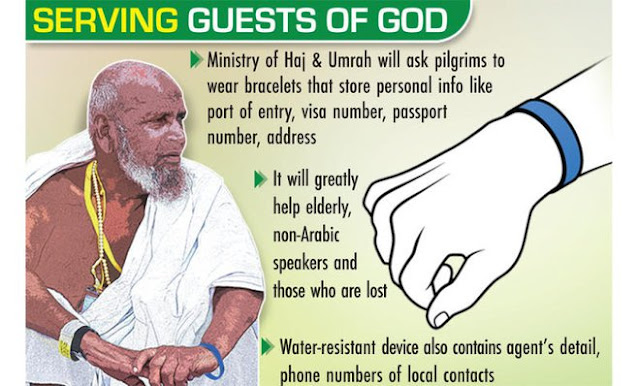
Smart bracelets during Haj for quick emergency response


Smart bracelets during Haj for quick emergency responsearabnews.com

Smart bracelets during Haj for quick emergency response


JEDDAH: The Saudi Red Crescent Authority (SRCA) is introducing electronic smart bracelets during Haj this year that contain all the vital information of the pilgrims to face any emergency, according to Dr. Saleh bin Hamad Al-Suhaibani, secretary-general of the Organization of Arab Red Crescent and Red Cross.

Speaking to Arab News, Al-Suhaibani said the smart bracelet is the latest gadget for rapid response and will contain all the information about the medical history and medical requirements of pilgrims, which will help in saving lives in any situation.

The smart bracelet will contain a special bar-code that operates with smartphones and computers offline and online. He said rapid response entities would immediately be able to access the information on these bracelets and implement it in saving their lives, if so required.

Al-Suhaibani explained that besides pilgrims, these smart bracelets can also be used by the Ministry of Health for hospital inpatients. The Ministry of Labor and Social Development will find it handy for workers and employees with the medical information; and the international organizations for refugees and displaced people, for humanitarian operations in general.

This technology is the latest projects of cooperation and a joint program of Red Crescent and the Saudi Skop group.

The Ministry of Haj announced this year the launch of the e-bracelet that stores the personal information of each pilgrim including where the person entered the Kingdom, visa number, passport number and address.

The device also includes data on pilgrims’ licensed service providers, accommodations in Makkah, Madinah or the holy sites, and the telephone numbers of those helping them.

Earlier, the SRCA participated in a workshop organized by the ministry of Health titled, ““Crisis management and strategic planning,” to combat any type of crisis during this year’s Haj.

The officials from the Saudi Red Crescent participated in the workshop and reviewed strategic plans and procedures for crisis management.

The workshop was held in the presence of a number of officials from the Ministry of Health, heads of Haj committees, and with the participation of specialists from Bournemouth University in the UK.


British haj travel announced 3,4 and 5 star hajj Packages 2016 visit our website & select your own hajj packages 2016. www.britishhajtravel.com/hajj-packages

VIP Hajj Package        Platinum Hajj Package        Golden Hajj Package 

Deluxe Hajj Package

Source: arabnews.com

Thursday, 18 August 2016

A Quranic Pilgrimage

A Quranic Pilgrimage

A Quranic Pilgrimage

Hajj, also known as the greater quranic pilgrimage, is an amazing phenomenon which engulfs the hearts and minds of Muslims from all across the globe. It is an event which is indeed spectacular; a mass sea of human will and flesh surging along the path once traversed by Abraham , the caller to Islamic monotheism. It is a pilgrimage that is centered around the prime maxim of monotheism, every action and ritual maintaining a direct relationship with it.

Inasmuch as Hajj being the single most important and spiritual journey that man will undertake, it is pertinent to note that most are unaware of the Qur’anic verses relating to it. It is in this vein that we shall be taking a brief look at a few verses in Surah Hajj where Allah speaks of this most blessed journey.

The discussion begins with the verse,


“And (remember) when We appointed for Abraham the place of the House (saying) ‘Do not ascribe anything as a partner to Me and purify My House for those who circumbulate, stand, bow, and prostrate.'”[1]

The verse commences the discussion about Hajj through introducing it as an affair which stems from Abraham. We find that the appointment of the house (Kabah) coupled with pure monotheism as Allah established for Abraham His House along with His house rules. In keeping with His guidelines, He articulates acceptable and pleasing behavior: circumbulating, standing, bowing, and prostration – all forms of physical worship. Thus, the verse in question affirms tawhid (monotheism), the action of tawhid (al-Uluhiyah), the direction (qiblah) of tawhid, and the Prophet of tawhid. It is through such points that man may achieve eternal bliss; by believing in the monotheistic nature of Allah without ascribing any form of partnership to him, by worshipping Him in line with His monotheistic nature through the prescribed actions of circumbulating, standing, bowing, and prostrating; facing the Kabah while committing these acts; and following the millah (religion) of Abraham who was a monotheist himself.

Abraham , the Friend of Allah , is given sole importance in relation to the Kabah, and was honored through being commanded to build the Kabah where Allah decreed. It was built out of taqwa and founded upon obedience, he and his son built this great edifice and a part of his offspring remained in Makkah living alongside it. As for Allah’s command to purify His House, it was to purify it from polytheism and disobedience, and from impurities and dirt. Allah, the Most High, ascribes the House to himself through His usage of the pronoun ‘my’, and in doing so sanctified and honored this blessed structure. It is to this end that `Umar b. Al-Khattab said when kissing the black stone, “Verily I know that you are merely a stone, you neither harm nor benefit. Were it not for the fact that the Prophet kissed you, I never would have,” [2] since his kiss was merely because of its sanctified nature which God afforded it, and not because it is special in and of itself.

Allah then says,


“And proclaim unto mankind the Pilgrimage. They will come to you on foot and on every lean camel; they will come from every deep ravine, so that they may witness things that are of benefit to them, and mention the name of Allah on appointed days over the beast of cattle that He has bestowed upon them. Then eat thereof and feed therewith the poor unfortunate.”[3]

After being commanding to build the sanctified structure, Abraham was told to call mankind to undertake the pilgrimage. It is mentioned the Abraham said, “My Lord, how can I call mankind when my voice cannot reach them?” So it was said, “Call, and its conveyance is upon us.” Similarly, the famous exegete Ibn Al-‘Arabi states that “Allah commanded him to climb Abi Qubais [4] and call out, “O mankind, Allah has ordained upon you the Hajj, so undertake the Pilgrimage.” So none were left except that Allah conveyed the call of Abraham to them…” [5]

The verse then states the means by which the pilgrims shall respond to the call, and their coming from “every deep ravine” is from every far and desolate place, so much so that the believers will flock from all corners of the earth – this miraculous statement is evident today where people of all nationalities and races arrive at the sacred House. Interestingly Allah states that “they will come to you” as in to Abraham instead of the House itself. This passage emphasizes the link between the Hajj and Abraham, and that the Hajj is to respond to the call of monotheism – it is in effect an act of monotheism. Furthermore, in responding to Abraham we become of him, as Allah states “Verily, among mankind who have the best claim to Abraham are those who followed him.” [6] Thus, the Hajj establishes the connection between the Muslims and Abraham since we are the only people to follow in his way, in both deed and intent.

As for “the things that are of benefit”, they are of two types: religious and worldly. As for the religious benefit, it is to engage in worship and fulfill one’s duty to Allah . As for the worldly gain, it is to gain an income and some profit. Ibn `Abbas said the verse pertained to benefit in this life and the hereafter. “As for benefit in the hereafter, it is to reside in eternal bliss; and as for this life, it is benefit in regards to profit and business undertakings.” [7] In this regards, the majority of exegetes state that the meaning of the verse “There is no sin on you if you seek the Bounty of your Lord…” [8] is that there is no harm nor sin in undertaking profitable ventures during the Hajj as long as it does not interfere with carrying out the prescribed rituals.

In regards to mentioning the name of Allah on the appointed days, then this is to slaughter the sacrifice in His Glorious name as well as to praise and thank Allah for His many bounties. Ibn `Abbas stated the ‘appointed days’ are the first ten days of the month of Dhul Hijjah. [9] The ‘beast of cattle’ is recorded in the Qur’an as the bahimatul an’am which are camels, cows, and sheep. This is reiterated by the hadith of `Abdullah b. `Abbas as narrated by Abu Jamrah Nasr b. `Imran Ad-Duba’Ä« when he asked Ibn `Abbas about the tamattu’ Hajj and sacrifice. [10] In reference to the discussion pertaining to the benefits of Hajj, the bahimatul an’am are also a benefit in this life and the next since the one selling them benefits financially, and the one who slaughters them benefits in the hereafter. It is then from the divine mercy and wisdom of Allah the Most High that he allows the slaughterer (who now benefits from his sacrifice in this life) and the poor to eat from the sacrificial meat.

In ending the Hajj, Allah says,
“Then let them make an end of their unkemptness and pay their vows and go around the ancient House.”[11]

Their ‘unkemptness’ is the hair on their heads that they have let grow and been unable to fully comb or cut during their time in the state of ihram, and ‘to make and end’ is to either shave or trim one’s hair. As for paying their vows, it is the promises they have made to the Almighty concerning their Hajj, `Umrah or sacrifice. They are then ordered to complete their Hajj by means of the tawaf al-ifadah, the principle circumambulation of the ancient House. The House is stated as being ancient since Allah says that “first House (of worship) appointed for mankind was that at Bakkah (Makkah), full of blessing, and guidance for the universe.” [12]

Allah then states,

“That; and whose extols the sacred things of Allah, it will be well for him in the sight of his Lord.”

The first word of the verse (“that”) is to establish the verses which have preceded as being the decisive commands of Hajj and thus means, ‘that is the command’. As for extolling the sacred things of Allah , it is extremely important since it is amongst the actions which Allah loves and allows the slave to draw close to his Lord. The ‘sacred things’ are everything that Allah has made sacred and ordered to be exalted, such as salah (ritual worship), the manasik (rituals of Hajj), the haram (sacred vicinity), the ihram (the state of a pilgrim), the sacrifice, and all other matters that require exaltation and love since all these forms of worship stem from an obedient heart and subservient limbs. It is to this effect that Allah says, “That (is the command). And whoso extols the offerings consecrated to Allah, it surely is from the piety of the hearts.” [13]

The Hajj, just like the other pillars of Islam combines spirituality with physical action and reminds us that monotheism is not only a belief we maintain within our hearts and utter with our lips, but a principle we live out through our actions, regardless as to whether we be pilgrims or in a normal state going about our daily lives.

British haj travel announced 3,4 and 5 star hajj Packages 2016 visit our website & select your own hajj packages 2016. www.britishhajtravel.com/hajj-packages

VIP Hajj Package            Platinum Hajj Package            Golden Hajj Package            Deluxe Hajj Package 

Source: islamicity.org

Tuesday, 16 August 2016

Haj: The ultimate journey

Haj: The ultimate journey

Haj: The ultimate journey

Haj in the Arabic language means aim, destination or purpose (qasd). The reason is clear: Haj is the ultimate journey of loving submission (ubudiyah) and conscious surrender (riq) to Allah. Its ultimate destination is your encounter with the House of Allah (Bayt Al-Allah) — the Kaaba — with both your physical body and, more importantly, your heart (qalb).

Ibn Al-Jawzi (may Allah bless him) relates a story of an old, blind woman who was journeying to Haj years ago with a caravan. Throughout the journey, she keeps asking: “Are we at the house of my Lord?” Time and again, she is told, “No, mother, we are not there yet.” As the caravan nears Makkah, she is informed that they are almost there. Finally, they enter Masjid Al-Haram. She is led to the Kaaba. Touching the Kaaba, she cries, “Baytu rabbi? The House of my Lord?” Weeping, she clings to the cloth of the Kaaba — and dies.

The woman realized with her heart the true significance of visiting the House of her Lord.

Allah has invited you to His House, which He has called the Al-Bayt Al-Atiq — the ancient, liberated and liberating house. Your journey is one of freedom and liberation. For as your body leaves its material house to journey to Allah’s House, your heart is meant to disengage from the lower self (nafs), the shaytan, and the world and journey to Allah.

The ultimate reward for a Haj mabrur is to return home with the purity of a newborn child. What could be a greater incentive! But beware, for Haj is a selective process. Only a few will attain a Haj mabrur, which is a Haj performed correctly, without any disobedience to Allah and without indulging in any argumentation. Be prepared. Be vigilant. Be focused. This will be one of the greatest — and sweetest — struggles of your life. And though you will long and dream for the rest of your life to come back, you may never return again.

May Allah allow our bodies to journey to His House; may He permit our hearts to find Him, the Lord of the House. Ameen.

The most sacred space

You will be journeying from your earthly house to Makkah, your spiritual home, the most beloved place to Allah in all of space and time. Allah himself has decreed it to be so since the beginning of creation. There is no place more blessed, more beautiful, more virtuous, more exalted than Makkah. Every inch and every corner of Makkah is a haram, a sanctuary made sacred by Allah.

The more you revere Makkah, the more you will be ennobled by Allah. We must take the greatest of care to never think casually of our sojourn in Makkah or live within its precincts in disobedience or negligence.

Some reports teach that it was in Makkah that our father Adam (peace be upon him) longed to go back to paradise and be in the presence of Allah. To console his loneliness, Allah Almighty commanded him to do tawaf around the space of the current Kaaba. And Adam did, and felt whole again.

Other texts teach that Nuh, Ibrahim and many Prophets before them (peace be upon them) did tawaf around Allah’s sacred House. Their spiritual energy and legacy fills the air. You will be walking in the footsteps and the heart-steps of the Prophet Muhammad (peace be upon him) and his noble companions.

Shelter, solace and sight

Haj and its rites are described in various and powerful ways by Allah Almighty and his Prophet (peace be upon him). Through these descriptions, we gain insight into the deeper meanings of Haj. The rites of Haj are described, for example, as manasik, mashair and mashahid.

Mansak (plural manasik), usually translated as ritual, connotes shelter (maskan) and tranquility. The rites of Haj are residences of shelter and tranquility for the heart.

Mashair connotes feeling and experience. The rites of Haj cause the heart to feel and experience the sweetness of nearness to Allah.

Mashahid is to witness with the heart the blessings of Allah at every station — to see, with one’s inner sight, Allah’s will as the Decreer of decrees and the Causer of causes.

Each word connotes a different inner dimension of Haj, as the movement, not only of your body or limbs, but of your heart. For as your body journeys from one place to another, so too must your heart travel through various stations), each of which will provide it with shelter, solace and inner sight.

Bayt Al-Mamur

Angels are the heavenly creatures created of pure light and enveloped in the worship of Allah. Texts teach that the Kaaba is connected in an imperceptible way to the Bayt Al-Mamur, the heavenly Kaaba of the angels, around which they are constantly in tawaf. At least 70,000 angels perform tawaf around this house and are replaced with others, never to return.

Around the Kaaba, we are in a heavenly dimension. Near the Kaaba are the Hajr Aswad, or black stone, and the Maqam Ibrahim, both gems from the Paradise.

We are taught that the stoner was darkened by the sins and transgressions of man. Its heavenly light is now folded from us. The stone will be rendered into a person in the afterlife by Allah and will witness on behalf of those who approached it with truth and sincerity.

The stone can be said to take a picture recording of your heart as you stand before it. Kissing the stone is the most profound renewal of your covenant with Allah and a pledge of love, dedicated obedience and soulful allegiance to Him.

British haj travel announced 3,4 and 5 star hajj Packages 2016 visit our website & select your golden hajj packages 2016.   www.britishhajtravel.com/hajj-packages 

VIP Hajj Package     Platinum Hajj Package       Golden Hajj Package      Deluxe Hajj Package

Source: arabnews.com

Thursday, 11 August 2016

Hajj is obligatory for women as it is for men

Hajj is obligatory for women as it is for men

Hajj is obligatory for women as it is for men

Al-Nawawi said: They are unanimously agreed that Hajj is obligatory upon a woman if she is able to do it. Sharh Saheeh Muslim.

Hajj is fard ‘ayn (an individual obligation) which every Muslim who is accountable and is able to do it must do once in a lifetime. It is one of the pillars of Islam, an obligation which is proven to be so in the Qur’aan and Sunnah, and by scholarly consensus.

In the Qur’aan, Allah says (interpretation of the meaning):

“And Hajj (pilgrimage to Makkah) to the House (Ka‘bah) is a duty that mankind owes to Allaah, those who can afford the expenses (for one’s conveyance, provision and residence); and whoever disbelieves [i.e. denies Hajj (pilgrimage to Makkah), then he is a disbeliever of Allaah], then Allaah stands not in need of any of the ‘Aalameen (mankind, jinn and all that exists)”[Aal ‘Imraan 3:97]

This aayah clearly states that it is obligatory. When the Qur’aan says “a duty that mankind owes to Allaah” this implies that it is obligatory and compulsory. This is the evidence that it is fard. Indeed, we find that the Qur’aan emphatically states that it is obligatory, in the phrase “and whoever disbelieves [i.e. denies Hajj (pilgrimage to Makkah), then he is a disbeliever of Allah], then Allah stands not in need of any of the ‘Aalameen (mankind, jinn and all that exists).” Allah describes going against this obligation as kufr or disbelief. This context shows that failing to do Hajj is not the action of a Muslim, rather it is the action of a non-Muslim.

In the Sunnah, there is the hadeeth of Ibn ‘Umar (may Allaah be pleased with him) according to which the Prophet (peace and blessings of Allah be upon him) said: “Islam is built on five (pillars): the testimony that there is no god except Allaah and that Muhammad is the Messenger of Allah; establishing regular prayer; paying zakaah; fasting Ramadaan; and Hajj.” 

The phrase “Islam is built…” indicates that Hajj is one of the pillars of Islam. Muslim narrated that Abu Hurayrah said: “The Messenger of Allah (peace and blessings of Allah be upon him) gave a sermon and said to us: ‘O people, Allah has enjoined Hajj upon you so perform Hajj.’ A man said, ‘Every year, O Messenger of Allah?’ He did not answer until the man had asked it three times, then the Messenger of Allah (peace and blessings of Allah be upon him) said, ‘If I had said yes, it would have become obligatory and you are not able to do that.’” And there are so many ahaadeeth concerning that that it reaches the level of tawaatur which means that this obligation is something certain and definite.

With regard to ijmaa’ or scholarly consensus, the ummah is unanimously agreed that Hajj once in a lifetime is obligatory for the one who is able to do it. This is something which is well known and no Muslim has any excuse for not knowing it, and the one who denies it is a kaafir.

British haj travel announced 3,4 and 5* star hajj Packages 2016.Visit our website & select your cheap Hajj package: http://www.britishhajtravel.com/hajj-packages

Hajj 2016 We have gladly offered Executive Hajj Packages season 2016 for our significant clients and organization customers.Go along with us and locate the new route with our best Hajj administrations.

VIP Hajj Package        Platinum Hajj Package        Golden Hajj Package        Deluxe Hajj Package

Source: go-makkah.com