Showing posts with label hajj visa requirements 2016. Show all posts

Tuesday, 27 September 2016

Accomodation Tips during Hajj and Umrah


Accomodation Tips during Hajj and Umrah

Accomodation Tips during Hajj and Umrah

  1. Hajj and Umrah is a supreme religious experience. It is however, also physically rigorous and emotionally taxing. Pilgrims are therefore advised to prepare themselves physically and mentally so as to face the difficulties that are likely to confront.

  2. Each pilgrim is entitled to only two baggages such as one suite case and one carry on bag. You are sharing accommodation with some one else respect each other rights and give respect of his & her right and to accommodate each other space for himself and his baggage. This translates into very limited space availability during stay in hotels, transportation and in tents.
     
  3. Hotels in Saudi Arabia classify as Star as per the Saudi Government rating to the Hotels industry therefore do not compare with the USA or Europe Standards.

    Each Pilgrim will be provided with a single mattress space in Mina Tents, however you will be getting Sofa Bed for his/her comfort, each pilgrims will be getting one bed sheet, one light blanket and he/she is advised to bring towel for his personal use.
     
  4. The measurement of most of accommodation is not more than 300 meter ; it's recommended that most of the time to reach some place is the shortest possible route on foot.
     
  5. Pilgrims should try to use the lift judiciously, avoiding use at the same time and similarly those on the near floors such as first and second floors may resort to possible use of stairs.
     
  6. Do not over crowd the lift. It is a safety hazard.
     
  7. It's recommended that you should not use the hotel phone it will cost you more than you expecting. After you check in inform relative or love one your Room # and main phone #.
     
  8. The refrigerator is to be shared by all the pilgrims. Therefore, Pilgrims are requested to use it optimally.

    Pilgrims should not leave their room / building with food being cooked. It is observed that this could lead to fire and is a serious safety threat. This applicable only if you using own cooking or making tea.
     
  9. Pilgrims should remember their hotel location and phone numbers, main landmark nearby and the nearest gate of Haram Sharif. If they miss their buddy, they can reach by the above information. In case they cannot, they may contact the nearest police post.
     
  10. Pilgrims must strictly follow the departure time schedule from Madinah to Makkah and also from Makkah to Mina, Mina to Arafat, Muzdalifa, and back to airport Makkah to Jeddah airport. 
Sporce: go-makkah.com

Thursday, 8 September 2016

Countdown to Haj 2016 begins

hajj 2016 begins
arabnews.com

Countdown to Haj 2016 begins

RIYADH: Domestic pilgrims from some parts of the Kingdom will leave for Makkah on Thursday.

The Ministry of Health has advised them to take care of personal hygiene and ensure that they have all the needed vaccinations and carry medicines with them, in case of need.

More than 300,000 Saudis are expected to join the foreign pilgrims this year.

According to the General Directorate of Passports, until Tuesday, 1,310,408 pilgrims had entered the Kingdom.

The directorate said 1,233,029 pilgrims arrived by air, 64,656 over land, and 12,723 by sea.

This year, Saudi pilgrims were able to obtain permits to perform the Haj through online applications; payments were made according to the package chosen by the pilgrims.

The directorate had warned people not to attempt to do the pilgrimage without a permit given by the authorities.

Most of the pilgrims from distant places such as Dammam and Riyadh chose to leave for the pilgrimage on Thursday so that they can join Friday prayers.

Seventy-seven Haj operators from 200 companies work to serve pilgrims.

Tthe Haj and Umrah Ministry earlier advised people to deal only with registered companies.

Offers for Haj came out in three packages ranging from SR3,000 to SR11,980; SR5,892 to SR11,890; SR3,000 to SR5,250 and the most economical fare (“moyassur“) SR3,000.

hajj guideline
 arabnews.com

Mohammed Saraff, a pilgrim from Riyadh, said he paid SR9,250, which includes full board and lodging in Makkah, Mina and internal transport between the Haj ritual sites.

“I only have to pay for the sacrificial lamb and the bus transport to and from Makkah,” he said.

A pilgrim from the Eastern Province said he will be starting the pilgrimage on Thursday, since it is a long journey from Dammam, while another from Jeddah said that he will start his pilgrimage on Saturday.

The “meeqat” points include Dhul Hulayfah, 9 km from Madinah; Juhfah, 190 km to the northwest of Makkah; Qarn Al-Manazil, 90 km to the east of Makkah; Dhat Irq, 85 km northeast of Makkah; Yalamlam, 50 km southeast of Makkah and Taif.

The famous Ayesha Mosque near Makkah is also considered as “meeqat” point that helps pilgrims perform Umrah again once they complete the obligatory pilgrimage.

Dr. Nazreen Sherbini, specialist in infectious diseases and influenza, said that in addition to vaccination against meningitis, it is advisable to take a flu shot before the pilgrims depart for Makkah.

“Pilgrims should wear a protective mask that covers the nose and their mouth in crowded places, and follow the basic health etiquette while sneezing or coughing,” Sherbini said, warning that they should keep away from people who have incessant coughing, sneezing and a body temperature of more than 38 degrees Celsius, and runny nose.

Sherbini said that all pilgrims should have taken the vaccination in time as advised by the doctors.

The flu vaccine helps prevent all types of flu, she said, adding that pilgrims do not require antibiotics for seasonal flu.

She said more liquids help the patients recover soon, except for those who suffer from renal, respiratory and cardiac diseases.
Source: arabnews.com

Tuesday, 30 August 2016

The Soul of Hajj

The Soul of Hajj
nativepakistan.com

The Soul of Hajj

It is a human show of Islamic unity, it is a show of universal brotherhood. The bodies were left in Miqat and the souls are motivated here.


No annual event on the face of the globe, religious or non-religious, compares to hajj in terms of the sheer number of participants, duration of the event and the breadth of agenda. In spite of this fact, it has always remained equally fascinating and mysterious to not only non-Muslims, who are barred from entering the holy city, but also to millions of Muslims, who had not performed hajj.

What then is hajj? In essence, hajj is man’s evolution toward Allah; his return to Him. It is a symbolic demonstration of the philosophy of creation of Adam , the first man. To further illustrate this, it may be stated that the performance of hajj is a simultaneous show or exhibit of many things. It is a show of creation. It is a show of history. It is a show of unity. It is a show of Islamic ideology. It is a show of Ummah, the community of Muslims. That is why, it is said in the Quran: “And proclaim unto mankind the hajj. … That they may witness things that are of benefit to them.” (Quran 22:27-8)

Just as in any other good show or movie or theatre-play, the following conditions prevail in hajj. Allah is the stage Manager. The theme portrayed is the actions of these main characters – Adam, Haw’a (Eve), Ibrahim, Hajera, Isma’il , and Shaytan. The main scenes are – Masjid al-Haram, ‘Arafat, Mas’a (space between the mountains – Safa and Marwa), Mash’ar (area between ‘Arafat and Mina) and Mina. Important symbols are – Kaba, Safa, Marwa, day, night, sunshine, sunset, idols and rituals of sacrifice. The dress and make-up are – ‘Ihram, halq and taqseer (part of ceremonies of hajj involving cutting of hair and nails, afterward). Lastly, the player of the show is – YOU – the Hajji. You are the main feature of the performance. The role of Adam, Ibrahim, Isma’il and Hajera in confrontation between Allah and Satan is all played by you. As a result, you are the hero of the show!

Hajj is a duty unto Allah for mankind, for him or her who can find a way or means to get there (Quran 3:97). It is not a tax on your wealth, but a duty. Thus, to qualify, you must be sane and wise to understand what you are getting into, and able-bodied to go through this task, and lastly, have the means or resources to perform hajj.

The pillars of hajj are five

(1) ‘Ihram, (2) waiting at ‘Arafat, (3) Tawaf of the Ka’ba, (4) sa’iy or running between the Safa and the Marwa and (5) cutting or trimming of hair.

Others are not pillars, although some may require kaffara or penalty, if not done. The person who puts on the ‘Ihram or cloth for either ‘Umrah (lesser pilgrimage) or hajj (greater pilgrimage) is called a Muhrim.

The months of hajj are the three.

These are the Arabic months of Shawwal, Dhul-Qadah and first ten days of Dhul Hijjah. Thus, one cannot put on Ihram before Shawwal. Hajj and ‘Umrah are performed in three ways – ifrad, tamattu and qiran.

    Ifrad involves first performing hajj and then Umrah.
    Tamattu is when one first performs Umrah and then hajj, both in the same year with some break in between the two.
    Qiran is when one puts on the ‘Ihram with the intention of combining both hajj and ‘Umrah without any break in between the two.

There are ten etiquettes of hajj. These are:

    Requite all wrongdoings and satisfy all adversaries.
    Make provision for hajj from one’s lawful wealth.
    Learn the pillars of hajj and its ceremonies.
    Be kind and forbearing with others, lest the reward be nullified.
    Observe the obligations of prayers and its statutes.
    Be open-handed, maintain the poor and spend as much as he/she is able to.
    At the station of ‘Arafat, remember the Day of Judgment (Yawmil Qiamat).
    Should not miss visitation of the Prophet’s grave in Madinah.
    After return from hajj, one should turn toward Akhirat (Hereafter).
    One should remember his parents and other close relatives who have passed away with pious prayers and make-up for them if they could not fulfill their obligations for hajj.

The steps of hajj are the following:

Miqat – putting on ‘Ihram at designated places with wudhu.

The show of hajj begins with Miqat. At this point, the participant must change his/her clothes. Clothes show individuality, status, preference and distinction. They create superficial barriers that separate man from man. The concept of “I” (and not “We”) emerges which gives birth to discrimination. At Miqat you assume your original shape as a “man”, just one of “children of Adam” who will die one day. The cloth of ‘Ihram is, therefore, the anti-thesis to that “individualism”, it is the kafan (or burial shroud). You wear the kafan, the two pieces of cloth, just like everyone else. You join the mass, the multitude and become nothing or just a drop of water in the ocean that has no special identity of its own. An atmosphere of genuine unity prevails everywhere. It is a human show of Islamic unity, it is a show of universal brotherhood. The bodies were left in Miqat and the souls are motivated here. This is the beginning of your journey, your voyage to nothingness. There is no sex, no perfume, no shoes, no sewn clothes and head covers for men, no face mask, no cutting of hair or nails, i.e., absolutely no signs of aristocracy or distinction. In the state of Muhrim, you don’t even look in a mirror to see your own image. You don’t hunt any animal, you don’t uproot any plant. So you kill the tendencies of aggression by being peaceful to nature. You cease to remain or behave as somebody. Hajj is a movement to returning to Allah, just as Allah says in the Quran: Wa ilal-lahil maseer (24:42), meaning, “Unto Allah is the journeying.” All your selfish egos must be buried at Miqat. You witness your own dead body and visit your own grave. By sacrificing your individuality, you focus on reality, the basic purpose for which you were created – that being a slave unto Allah. Just as when you would be buried in two pieces of cloth, leaving behind all your wealth and worldly belongings, here in Miqat you practice a dress rehearsal for that inevitable event.

It is preferable that you enter Makkah during the daytime.

Each step you take toward Ka’ba, your heart pounds. The weight of being close to Allah’s house seems to get heavier and heavier. You are endowed with a mixed feeling of love and fear. Love, because you have waited this long to get here. Fear, because you don’t know whether you can endure the strain of rituals of hajj, fulfill your duty unto Allah and be born again as an innocent human being.

Make du’a (supplication) for Ka’ba upon seeing it.

Remember this is the Baital Haram – the Sacred House – appointed by Allah (Quran 5:97). This is the first house of worship on the face of the globe. It is to this house that you face while praying. It is also the direction in which your face would be turned when you are buried as dead. It is the center of existence, faith, love, unity and life. It has its own history. It is called Baitil Masabatal-lin-nass wa amana, i.e., the House of resort for mankind and a sanctuary (Quran 2:125). It is also called Baitul Atiq – the Ancient House – in the Quran (22:29). Ibrahim prayed for its security and blessings.

You perform Tawaf (circumambulation) of Ka’ba seven times, unless it is time for a regular prayer led by an Imam, which you need to join in.

Just as planets of our solar system orbit around the sun, you orbit around the world’s sun – the Ka’ba, and become part of a universal system. You demonstrate your love for Allah by making Tawaf around His house. Tawaf should be started from the corner stone – the Black stone, Hajr al-Aswad – with Ka’ba on the left. This is where you make a contract to join all the tribes of the earth, and become like a drop of water entering the ocean. The moment of truth has come and you must select your path, distinct from those who had rejected their Creator. Three of the seven Tawafs must be at a faster pace than normal walking. You should try to touch the stone with hand, and put your forehead on it and then kiss it. By touching the stone, you have shown your allegiance to your Creator, who had sent this very stone from the heaven, so that He could know your love for Him. By touching the stone, you have cut off all forms of allegiance to anything other than Allah, you have become free again from servitude of men and this world. During Tawaf, you become part of the cosmos. You forget about yourself. You are in love with the symbol of unity and servitude to Allah. You see nothing but His symbols, the Ka’ba and the Black Stone, Hajr al-Aswad. By denying yourself you have become a lover of Him just like Hajera who migrated to this land, barren and rugged, without vegetation, without any forms of subsistence, but with complete reliance in Her Lord, Allah Subhana Wa ta’Ala (SWT). And Allah did not neglect either her or her infant son. He brought out the Jamjam well and let people settle there, making it the most important place in the Arabian peninsula. Remember that some rituals of hajj are, in reality, a memory of Hajera. Hijrah or migration is what Hajera did. Any migration like hers is a move toward civilization.

During Tawaf, everyone encircles the Ka’ba collectively. The movement is of one unit and there is no individual identification of men or women, black or white, red or yellow. The movement has transformed one person into the totality of a “people.” All of the “I’s” have transformed into “We,” establishing the universality of ummah with the goal of approaching Allah. Likewise, all your self-centeredness must go and transform into self-denial or ummah-centered activities. Allah’s way is the way of the people. In other words, to approach Allah, you must first approach people. That is why, individual activities in Islam are less meritorious than collective actions. You step out of the Tawaf cycle at the same place you started after completion of the seven orbits. This is just like being resurrected from the same spot where you would be buried.

After Tawaf, perform two rakah of prayer behind Maqam-e Ibrahim in which you pray Surah al-Kafirun in the first rakat and Surah al-Ikhlas in the second.

Maqam is a very blessed place for praying (Quran 2:125). It is the nearest point to Allah. As a matter of fact, there is no place in this entire earth where you get more reward than this place for praying. The stone has the footprint of Ibrahim , the rebel against the established despot of his time, Nimrod. He stood over this stone to lay the corner stone – Hajr al-Aswad and to re-construct the Ka’ba and to pray (Quran 2:125). Do you now understand where you are standing? By standing on the same stone, you vow to become like Ibrahim Hanifah wa Khalil-Allah, the upright friend of Allah, who was uncompromising in his conviction of Tawhid. In Maqam, symbolically, you shake hands with Ibrahim by pledging the same dedication to Allah – i.e., to be like Ibrahim and Isma’il , his son.

Run between the mountains – Safa and Marwa – seven times, starting with the Safa and ending with the Marwa.

This is called Sa’iy. Literally it means search, a movement with an aim. It is depicted by running and hurrying. Here you act like Hajera, the mother of infant Isma’il. She had no food, no water, no shelter, neither for herself nor for her child, but only uncompromising, relentless faith that the God of Ibrahim will not leave her and her only son without sustenance. Remember, when Ibrahim left her and their only son, Isma’il near the valley of Makkah, Hajera asked him: “O Ibrahim, where are you leaving us, while there is no habitation of men nor any provision for food and drink? Who is going to look after us?” Ibrahim replied, “Ilal-lah (to Allah’s protection only).” She said, “Raditu billah (I am fully satisfied with Allah?” She also asked, “Have you done this to fulfill Allah’s command?” When Ibrahim confirmed that by saying, “Yes,” she simply said, “Well in that case, we have no fear, for Allah will not let us die without providing any provision [i.e., He will definitely provide for us in the middle of this desolate, barren desert].” [Bukhari] Do you see the strength of her trust in Allah? Away from the view of his wife and son, Ibrahim prayed, “Our Lord: Lo! I have settled some of my posterity in an uncultivable valley near unto Thy Holy House (Ka’ba), Our Lord! that they may establish proper worship. So, incline some hearts of men that they may yearn toward them, and You provide them with fruits in order that they may be thankful.” (Quran 14: 37). Soon, however, Hajera’s water and food were all gone, there was no milk or water or any food either for herself or for her child. She started looking out for water, running to the top of the mountain, Safa. No, there is no water anywhere. Then she comes down and looks at her infant to check if he is fine. She then goes to the top of the other mountain, Marwa, and takes a deep long look to fetch water. She was searching water, why? Because it is needed for physical salvation, for life to continue. So, should man work for livelihood, trusting in Allah. She searches again and again. After running seven times between these two mountains, she comes down from Marwa to see the condition of her infant son. She hears the sound of gushing water coming from near her son and is surprised to see an angel (Jibril) dig a well near the heel of her infant son. The gushing water from the well was making all that sound. She quickly puts a barrier around it so that water could be stored and that it did not overflow. And this well came to be known as the Jamjam. Muhammad said, “May Allah bless the mother of Isma’il . If she had not put that barrier around the Jamjam, instead of a well, the gushing water would have continued to flow like a spring [and flooded the entire valley].” It was a gift from Allah to the mother and son, and all those who came later. It is a mineral water rich with nutritional and medicinal power to cure man of many diseases. The Safa and the Marwa, thus, became among the signs, indications of Allah (Quran 2:158).

On the seventh day of Dhul-Hijjah, after the Zuhr prayer, Imam explains the meaning of hajj and exhorts people to go to the valley of Mina (nearly six miles north of Makkah) next morning after Fajr prayer.

Visit and stay at Mina on the eighth day (after arriving there in the morning) till the next Fajr (dawn prayer).

Go to ‘Arafat after sun has risen on the ninth, stopping on the way at Namirah and listening to khutbah before Zuhr (mid-day prayer).

Proceed to ‘Arafat (five miles further north) and seek Allah’s forgiveness there till Maghrib (prayer after sunset).

‘Arafat literally means knowledge and science. ‘Arafat represents the beginning of man’s creation, that of our forefather Adam. It was shaytan who misled our forefather by whispering to him saying: “O Adam! Shall I show you the tree of immortality and power that wastes not away?” (Quran 20:120) He caused the downfall of Adam and Haw’a (Eve). For years, they were separated from each other having descended at different places. It was in ‘Arafat that they met again. It was in a small rocky hill of Jabal al-Rahma in the center of ‘Arafat that their sins were forgiven by Allah. So, here in ‘Arafat, you act like Adam or Haw’a and seek forgiveness for you and your loved ones.

After sunset proceed slowly to Muzdalifah (halfway between ‘Arafat and Mina) without praying (Quran 2:198). However, the Imams Abu Hanifah and Sufyan al-Thawri (R) said it is permissible to pray Maghrib before reaching Muzdalifah.

Spend the night before Eid in Muzdalifah. Pray Fajr early. Collect pebbles there (70 per person).

Muzdalifah is part of Mash’ar-ul-Haram. Our Prophet Muhammad prayed for long duration here. You must be in Mash’ar by the nightfall (while you were at ‘Arafat during the day). Darkness engulfs you in Mash’ar. ‘Arafat is knowledge, it requires daylight for clear vision. Mash’ar literally means consciousness and understanding. Such blossom at night through deep reflection or meditation. So, Mash’ar is the stage of insight while ‘Arafat was the stage of experience. Intuition needs no light. It can see in the darkness. It is the stage between knowledge and love, or ‘Arafat and Mina. Here you reflect upon yourself and strengthen your spirit. Are you not in the right way? Are you ready to fight against Satan or his insinuations? In Makkah, during tawaf you joined the crowd and became part of them. Here you are alone, despite being within a crowd. Here you are for yourself only. Therefore, confess your sins to Allah. And this night is a good cover for your tears. Take preparation for tomorrow by getting ready tonight. There is a great battle in which you have to participate tomorrow. So, collect your weaponry – the pebbles – before the day breaks. The pebbles will be used against your enemy. You have to act like Ibrahim here just as he fought against the insinuations of Satan on his way to sacrifice his beloved son, Isma’il .

Go back to Mina and throw seven stones at Jamrat-ul Aqabah, reciting Takbir each time. The remainder 63 stones should be thrown over the next three days of Ayyam al-Tashriq (11th, 12th and 13th of Dhul Hijjah) at a rate of 21 stones per day. Every day, throw the first 7 stones at Jamarah near Mina, and the last seven at Jamarat al-Aqabah, located closer to Makkah.

The tenth day has arrived. This is the day for sacrifice of animal. You are armed with weapons to fight Satan, the enemy of your forefather, the devil who tried to confuse Ibrahim . Mina literally means love. Ibrahim felt too much love for his only son, Isma’il . And Allah wanted to test how great or how real his love was for Him. Ibrahim saw a vision of sacrificing his most beloved son. That was the command from Allah to test Ibrahim of his love and devotion. Can Ibrahim pass this test? He ponders on this unusual, rather cruel, test. He has grown old and he has no other offspring. In his very old age, Allah has listened to his prayer and has blessed him with this son through his second wife, Hajera. As a thanksgiving for answering to his prayer, he has named his son, Isma’il (meaning: God listened [to my prayer]).

Yet, Ibrahim was asked to settle Isma’il and his mother in the valley of Makkah when the child was still an infant. And now that the lad has become old enough to walk and reason, Allah wants him to sacrifice that son to prove that his true love is only for Allah. Just ponder on this for a moment (Quran 37:102). Don’t you get a chill in your back? Satan tries to create doubt in his mind: ‘O Ibrahim, are you sure you want to sacrifice your son, your true love, your joy, the meaning of your existence, the fruit of your life; who would there be after you to worship your Lord; don’t you have heart, any soft feelings toward your son?’ Ibrahim is momentarily confused. Should he or shouldn’t he carry out Allah’s command, “you must sacrifice your son?” Is he dreaming or is it the reality? No, there is no confusion what he saw in his vision is crystal clear; God truly wants him to sacrifice his beloved Isma’il. He wins over Satan, the sneaking whisperer. But then Satan returns and tries to digress him from his task. Ibrahim wins over again. But Satan does not give up that easily, he tries to create confusion for the third time. Ibrahim wins over Satan’s temptations yet for the third time. He is mentally all prepared to carry out the task. His choice is obvious – absolute obedience and devotion to Allah; Isma’il must be sacrificed. He wanted to share the message with his lad. Thus, he talks to his young lad, Isma’il , of his dream and asks his opinion. And what does this “gentle” son (whom the Quran calls Ghulamin Halim) reply? He calmly says: “O my father! Do that which you are commanded. Allah willing, you shall find me of the steadfast.” (Quran 37:102) He answers like the rock of Gibraltar!

What did you expect? Did you expect the son of Ibrahim , the upright, to be any less faithful than his father? So, here in Mina, you act like Ibrahim , the soldier of Tawhid (monotheism), ready to defeat, subdue or shoot down your real enemy, the Satan within you representing your personal egos, desires, cravings, and preferences. These “other” things, the “idols”, were distracting you from the true worship of God. But here in Mina, you are now ready to fight against these taghoots (demi-gods) to show your true devotion and obedience to Allah. You fight Satan just as Ibrahim had fought against him. To mimic that event, you throw stones at Satan at the three Jamarats.

Qurbani or sacrifice an animal, saying only Bismillah.

When both the father and the son – Ibrahim and Isma’il – had surrendered to Allah and Ibrahim had flung Isma’il down upon his face and was about to put the knife on his son’s neck, Allah called Ibrahim : “O Ibrahim! You have already fulfilled the vision.” (Quran 37:104-5) Ibrahim doesn’t have to sacrifice his son. Instead, he should sacrifice this ram, which has been sent to him, as ransom for Isma’il . Unlike the false-gods of polytheism, Allah, the One True God, is not bloodthirsty. He just wanted to check where Ibrahim stood in his devotion and love, whether he was capable of overcoming his personal feeling of love for his son to please Allah. A lesson was taught by Allah – from now on there would be no human sacrifice in the altar of God. Sacrifice of a halal animal whose meat you can eat and distribute among the poor is a sufficient substitute.

Ponder again. What was Ibrahim asked to sacrifice? It was nothing short of the most beloved thing/entity among his possession. But when he was ready, his Isma’il was returned unto him, unscathed and unharmed. And he was made a model for humanity: “And We left for him [Ibrahim ] among the later folk (the salutation): Peace be unto Ibrahim. Thus do we reward the good.” (Quran 37:108-9) If you love something more than you love Allah, then that thing has become your idol and you must be ready to sacrifice that. Are you ready to slaughter your worldly desires, worldly love, your Isma’il in Mina in order that you be free from all attachments save those of Allah? If you are, then slaughter a goat, sheep, ram, cow or camel as a ransom towards your Isma’il. As Dr. Shariati rightly puts it, “To offer a sheep instead of Isma’il is a “sacrifice”, but to sacrifice a sheep just for the sake of sacrifice is “butchery”!” (Ref: Hajj by Dr. Ali Shariati) For surely Allah says, “Their flesh and their blood do not reach Allah, but the devotion from you reaches Him.” (Quran 22:37)

Men should shave their head or trim their hair, at least, one-quarter of head. Women should not shave their head, but only trim slightly at the end of the lock of a hair.

After the Qurbani (sacrifice) of the animal, you have almost completed the basic requirements of hajj, so you can make an end of your unkemptness (Quran 22:29). You have defeated Satan but you may not have succeeded in completely killing it. You may have defeated him outside but he comes back inside of you. So, you should stay the next three days in Mina and continue with your battling of the Satan at Jamarat.

After shaving or trimming the hair, you should go to Makkah and make the Tawaf of visitation and run seven times between the Safa and the Marwa. Then your hajj is complete and you can come out of ‘Ihram.

This is the latter tawaf of the Ka’ba (Quran 22:29), performed after you return from Mina. In Mina, you have defeated Satan and renewed your ties with Allah by following the footsteps of Ibrahim . When you first approached Ka’ba you had not, by then, purified yourself. You were still impure and unconscious. In ‘Arafat you gained consciousness. In Mina you purified yourself. So, this is appropriate that you do the tawaf and sa’iy in the purified state before you return home. During the rituals of hajj you played the roles of Ibrahim and Hajera. Do not replace your role-playing to something else when you return. Like Hajera, always trust in Allah. Like Ibrahim fight the fire of Nimrod, i.e., oppression. Like Ibrahim be prepared to sacrifice your Isma’il, i.e., love or desires, for the sake of your faith. That is the essence of hajj. You return to Allah the way He wanted you to be: a slave totally dedicated to his/her Master.

In closing, let me quote from Ali bin Uthman al-Jullabi al Hujwiri’s (R) Kashf al-Mahjub. A certain man came to Junayd [al-Baghdadi] (R). Junayd asked him whence he came. He replied: “I have been to hajj.” Junayd (R) said: “From the time when you first journeyed from your home have you also journeyed away from all sins?” He said, “No.” “Then,” said Junayd (R), “you have made no journey. At every stage where you halted for the night did you traverse a station on the way to Allah?” He said: “No.” “Then,” said Junayd (R), “you have not trodden the road stage by stage. When you put on the Ihram (pilgrim’s garb) at the proper place did you discard the attributes of humanity as you cast off your ordinary clothes?” “No.” “Then you have not put on the Ihram. When you stood on ‘Arafat did you stand one instant in contemplation of Allah?” “No.” “Then you have not stood on ‘Arafat. When you went to Muzdalifa and achieved your desire did you renounce all sensual desires?” “No.” “Then you have not gone to Muzdalifa. When you circumambulated the Ka’ba did you behold the immaterial beauty of Allah in the abode of purification?” “No.” “Then you have not circumambulated the Ka’ba. When you ran between Safa and Marwa did you attain to the rank of safa (purity) and muruwwat (virtue)?” “No.” “Then you have not run. When you came to Mina did all your wishes cease?” “No.” “Then you have not yet visited Mina. When you reached the slaughter place and offered sacrifice did you sacrifice the objects of sensual desire?” “No.” “Then you have not sacrificed. When you threw the stones did you throw away whatever sensual thoughts were accompanying you?” “No.” “Then you have not yet thrown the stones, and you have not yet performed the pilgrimage. Return and perform the pilgrimage in the manner which I have described in order that you may arrive at the station of Ibrahim .”

May Allah grant us the vigor to follow the dictates of hajj so that this duty is acceptable unto Him.

British haj travel announced 3,4 and 5 star hajj Packages 2016 visit our website & select your own hajj packages 2016. www.britishhajtravel.com/hajj-packages

VIP Hajj Package        Platinum Hajj Package        Golden Hajj Package        Deluxe Hajj Package

Source: islamicity.org

Wednesday, 24 August 2016

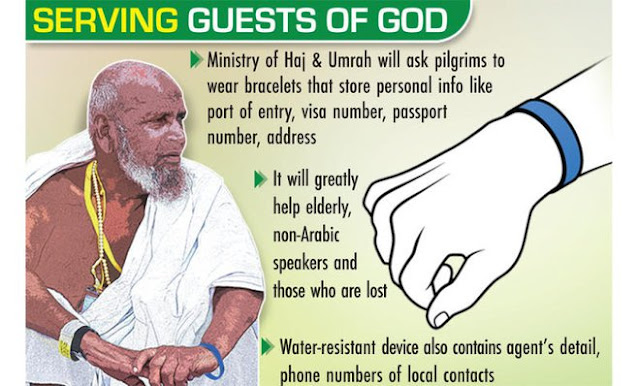
Smart bracelets during Haj for quick emergency response


Smart bracelets during Haj for quick emergency responsearabnews.com

Smart bracelets during Haj for quick emergency response


JEDDAH: The Saudi Red Crescent Authority (SRCA) is introducing electronic smart bracelets during Haj this year that contain all the vital information of the pilgrims to face any emergency, according to Dr. Saleh bin Hamad Al-Suhaibani, secretary-general of the Organization of Arab Red Crescent and Red Cross.

Speaking to Arab News, Al-Suhaibani said the smart bracelet is the latest gadget for rapid response and will contain all the information about the medical history and medical requirements of pilgrims, which will help in saving lives in any situation.

The smart bracelet will contain a special bar-code that operates with smartphones and computers offline and online. He said rapid response entities would immediately be able to access the information on these bracelets and implement it in saving their lives, if so required.

Al-Suhaibani explained that besides pilgrims, these smart bracelets can also be used by the Ministry of Health for hospital inpatients. The Ministry of Labor and Social Development will find it handy for workers and employees with the medical information; and the international organizations for refugees and displaced people, for humanitarian operations in general.

This technology is the latest projects of cooperation and a joint program of Red Crescent and the Saudi Skop group.

The Ministry of Haj announced this year the launch of the e-bracelet that stores the personal information of each pilgrim including where the person entered the Kingdom, visa number, passport number and address.

The device also includes data on pilgrims’ licensed service providers, accommodations in Makkah, Madinah or the holy sites, and the telephone numbers of those helping them.

Earlier, the SRCA participated in a workshop organized by the ministry of Health titled, ““Crisis management and strategic planning,” to combat any type of crisis during this year’s Haj.

The officials from the Saudi Red Crescent participated in the workshop and reviewed strategic plans and procedures for crisis management.

The workshop was held in the presence of a number of officials from the Ministry of Health, heads of Haj committees, and with the participation of specialists from Bournemouth University in the UK.


British haj travel announced 3,4 and 5 star hajj Packages 2016 visit our website & select your own hajj packages 2016. www.britishhajtravel.com/hajj-packages

VIP Hajj Package        Platinum Hajj Package        Golden Hajj Package 

Deluxe Hajj Package

Source: arabnews.com

Thursday, 18 August 2016

A Quranic Pilgrimage

A Quranic Pilgrimage

A Quranic Pilgrimage

Hajj, also known as the greater quranic pilgrimage, is an amazing phenomenon which engulfs the hearts and minds of Muslims from all across the globe. It is an event which is indeed spectacular; a mass sea of human will and flesh surging along the path once traversed by Abraham , the caller to Islamic monotheism. It is a pilgrimage that is centered around the prime maxim of monotheism, every action and ritual maintaining a direct relationship with it.

Inasmuch as Hajj being the single most important and spiritual journey that man will undertake, it is pertinent to note that most are unaware of the Qur’anic verses relating to it. It is in this vein that we shall be taking a brief look at a few verses in Surah Hajj where Allah speaks of this most blessed journey.

The discussion begins with the verse,


“And (remember) when We appointed for Abraham the place of the House (saying) ‘Do not ascribe anything as a partner to Me and purify My House for those who circumbulate, stand, bow, and prostrate.'”[1]

The verse commences the discussion about Hajj through introducing it as an affair which stems from Abraham. We find that the appointment of the house (Kabah) coupled with pure monotheism as Allah established for Abraham His House along with His house rules. In keeping with His guidelines, He articulates acceptable and pleasing behavior: circumbulating, standing, bowing, and prostration – all forms of physical worship. Thus, the verse in question affirms tawhid (monotheism), the action of tawhid (al-Uluhiyah), the direction (qiblah) of tawhid, and the Prophet of tawhid. It is through such points that man may achieve eternal bliss; by believing in the monotheistic nature of Allah without ascribing any form of partnership to him, by worshipping Him in line with His monotheistic nature through the prescribed actions of circumbulating, standing, bowing, and prostrating; facing the Kabah while committing these acts; and following the millah (religion) of Abraham who was a monotheist himself.

Abraham , the Friend of Allah , is given sole importance in relation to the Kabah, and was honored through being commanded to build the Kabah where Allah decreed. It was built out of taqwa and founded upon obedience, he and his son built this great edifice and a part of his offspring remained in Makkah living alongside it. As for Allah’s command to purify His House, it was to purify it from polytheism and disobedience, and from impurities and dirt. Allah, the Most High, ascribes the House to himself through His usage of the pronoun ‘my’, and in doing so sanctified and honored this blessed structure. It is to this end that `Umar b. Al-Khattab said when kissing the black stone, “Verily I know that you are merely a stone, you neither harm nor benefit. Were it not for the fact that the Prophet kissed you, I never would have,” [2] since his kiss was merely because of its sanctified nature which God afforded it, and not because it is special in and of itself.

Allah then says,


“And proclaim unto mankind the Pilgrimage. They will come to you on foot and on every lean camel; they will come from every deep ravine, so that they may witness things that are of benefit to them, and mention the name of Allah on appointed days over the beast of cattle that He has bestowed upon them. Then eat thereof and feed therewith the poor unfortunate.”[3]

After being commanding to build the sanctified structure, Abraham was told to call mankind to undertake the pilgrimage. It is mentioned the Abraham said, “My Lord, how can I call mankind when my voice cannot reach them?” So it was said, “Call, and its conveyance is upon us.” Similarly, the famous exegete Ibn Al-‘Arabi states that “Allah commanded him to climb Abi Qubais [4] and call out, “O mankind, Allah has ordained upon you the Hajj, so undertake the Pilgrimage.” So none were left except that Allah conveyed the call of Abraham to them…” [5]

The verse then states the means by which the pilgrims shall respond to the call, and their coming from “every deep ravine” is from every far and desolate place, so much so that the believers will flock from all corners of the earth – this miraculous statement is evident today where people of all nationalities and races arrive at the sacred House. Interestingly Allah states that “they will come to you” as in to Abraham instead of the House itself. This passage emphasizes the link between the Hajj and Abraham, and that the Hajj is to respond to the call of monotheism – it is in effect an act of monotheism. Furthermore, in responding to Abraham we become of him, as Allah states “Verily, among mankind who have the best claim to Abraham are those who followed him.” [6] Thus, the Hajj establishes the connection between the Muslims and Abraham since we are the only people to follow in his way, in both deed and intent.

As for “the things that are of benefit”, they are of two types: religious and worldly. As for the religious benefit, it is to engage in worship and fulfill one’s duty to Allah . As for the worldly gain, it is to gain an income and some profit. Ibn `Abbas said the verse pertained to benefit in this life and the hereafter. “As for benefit in the hereafter, it is to reside in eternal bliss; and as for this life, it is benefit in regards to profit and business undertakings.” [7] In this regards, the majority of exegetes state that the meaning of the verse “There is no sin on you if you seek the Bounty of your Lord…” [8] is that there is no harm nor sin in undertaking profitable ventures during the Hajj as long as it does not interfere with carrying out the prescribed rituals.

In regards to mentioning the name of Allah on the appointed days, then this is to slaughter the sacrifice in His Glorious name as well as to praise and thank Allah for His many bounties. Ibn `Abbas stated the ‘appointed days’ are the first ten days of the month of Dhul Hijjah. [9] The ‘beast of cattle’ is recorded in the Qur’an as the bahimatul an’am which are camels, cows, and sheep. This is reiterated by the hadith of `Abdullah b. `Abbas as narrated by Abu Jamrah Nasr b. `Imran Ad-Duba’Ä« when he asked Ibn `Abbas about the tamattu’ Hajj and sacrifice. [10] In reference to the discussion pertaining to the benefits of Hajj, the bahimatul an’am are also a benefit in this life and the next since the one selling them benefits financially, and the one who slaughters them benefits in the hereafter. It is then from the divine mercy and wisdom of Allah the Most High that he allows the slaughterer (who now benefits from his sacrifice in this life) and the poor to eat from the sacrificial meat.

In ending the Hajj, Allah says,
“Then let them make an end of their unkemptness and pay their vows and go around the ancient House.”[11]

Their ‘unkemptness’ is the hair on their heads that they have let grow and been unable to fully comb or cut during their time in the state of ihram, and ‘to make and end’ is to either shave or trim one’s hair. As for paying their vows, it is the promises they have made to the Almighty concerning their Hajj, `Umrah or sacrifice. They are then ordered to complete their Hajj by means of the tawaf al-ifadah, the principle circumambulation of the ancient House. The House is stated as being ancient since Allah says that “first House (of worship) appointed for mankind was that at Bakkah (Makkah), full of blessing, and guidance for the universe.” [12]

Allah then states,

“That; and whose extols the sacred things of Allah, it will be well for him in the sight of his Lord.”

The first word of the verse (“that”) is to establish the verses which have preceded as being the decisive commands of Hajj and thus means, ‘that is the command’. As for extolling the sacred things of Allah , it is extremely important since it is amongst the actions which Allah loves and allows the slave to draw close to his Lord. The ‘sacred things’ are everything that Allah has made sacred and ordered to be exalted, such as salah (ritual worship), the manasik (rituals of Hajj), the haram (sacred vicinity), the ihram (the state of a pilgrim), the sacrifice, and all other matters that require exaltation and love since all these forms of worship stem from an obedient heart and subservient limbs. It is to this effect that Allah says, “That (is the command). And whoso extols the offerings consecrated to Allah, it surely is from the piety of the hearts.” [13]

The Hajj, just like the other pillars of Islam combines spirituality with physical action and reminds us that monotheism is not only a belief we maintain within our hearts and utter with our lips, but a principle we live out through our actions, regardless as to whether we be pilgrims or in a normal state going about our daily lives.

British haj travel announced 3,4 and 5 star hajj Packages 2016 visit our website & select your own hajj packages 2016. www.britishhajtravel.com/hajj-packages

VIP Hajj Package            Platinum Hajj Package            Golden Hajj Package            Deluxe Hajj Package 

Source: islamicity.org

Wednesday, 27 July 2016

HAJJ AS WORSHIP

HAJJ AS WORSHIP

HAJJ AS WORSHIP

Hajj is to of leave one's relatives, wealth, and all the secular comforts. It is to enduring difficulties and hardships for Allah’s sake.

"And proclaim among people the pilgrimage; they will come to you on foot and on every lean camel, coming from every remote path.”
Holy Qur'an (22:27)
Hajj is a form of worship, where physical and spiritual factors intertwine.   

It is, therefore, a physical form of worship in which the worshipper gives of himself physically and goes through hardships in the way of Allah, Showing his complete servitude to Allah and his independence from any power other than Him. This neat target of Hajj is the goal of any worship in Islam as a whole and it has to be for the sake of Allah uniquely. It is the absolute purpose of man's worship. Man's conscience completely awakens and man is rendered, purified and cleansed of all evil and vice, provided sincerity of intention is involved.

For this target, Hajj has been determined as one of the five Islamic pillars and the Holy Our'an regards it as Allah's right over His servants:

“…it is the duly of mankind towards Allah to make the pilgrimage to the House, whoever can afford the way there;...”

Holy Qur'an (3:97)

Hajj is a basic pillar of religion, and a backbone of faith. Traditions and texts reported from the Prophet (Peace and blessings of Allah be upon him) and his pure ancestry have all pointed  to the importance of Hajj.

It is reported that Prophet Muhammad (Peace and blessings of Allah be upon him) said:

"Prayer was not ordained, Hajj and Tawaf were not made incumbent on the faithful, and rites were not conveyed to man, but to remember Allah.”
And he (Peace and blessings of Allah be upon him) also said:

" Those who perform Hajj and Umrah are the guests of Allah. Allah grants them whatever what they ask Him, accepts their prayers, and compensates them for their expenditures and good deeds.”

Imam Ja'far al-Sadiq is reported to have said:

"So long as the Ka’ ba is secure, so is the religion”

And he also said:

"If one should leave off Hajj, when he is capable of performing it, with no legitimate excuse, then he has neglected an Islamic rite.”

Islam gives Hajj a primordial consideration. It even offers Islamic states the ability to send a number of Muslims to Mecca, even forcibly. The main purpose is to ensure the freshness as well as dynamism of the Islamic rites. When the pilgrims cannot attend the journey, the Islamic state is responsible for paying the traveling expenses to Mecca to allow them perform their rites.

Imam Ja'far bin Muhammad al-Sadiq is reported to have said:

"Should all the people abandon Hajj, the governor can oblige them to perform it. Should they stop performing hajj to the tomb of the Prophet (Peace and blessings of Allah be upon him) ,the governor is authorized to order them to do so, if they are penniless, he should pay them from the treasury.”
It was reported from Imam Ja'far al-Sadiq

"If anyone of you had amounts of gold as huge as Abu-Qubais (a mountain in Arabia) and spent it in the way of Allah, its reward would never be equal to the reward of Hajj (from Allah), A dirham disbursed by the hajj is worth 2000 dirhams in the way of Allah.”

He is also reported to have said:

"Hajj is the jihad (holy struggle for the sake of Allah) of the weak.”

Moreover, He said:"He who is not prevented from the Hajj by an obvious necessity, a tyrannical ruler or a disease which confines him (or her) at home and dies without having performed the Hajj, might as well die a Jew or a Christian.”
Source: go-makkah.com

Friday, 15 July 2016

Why do Muslims go to the Mecca? Is there something inside the Hajj?

Why do Muslims go to the Mecca

Why do Muslims go to the Mecca? Is there something inside the Hajj?

It's because they revive the sunnah(way of or teaching of)Mohammad(PBUH) and the command of Allah .

Millions of muslims every year performs Hajj.Why Hajj?


We Muslims feel honoured and proud to be the slaves of Allaah, the One, the Self-Sufficient Master, Who begets not nor was He begotten, and there is none co-equal or comparable unto Him; He is our Lord and we have no Lord besides Him. Hence we respond to the commands of our Lord with the utmost humility and submit to His commands.


If a Muslim does Hajj in the manner required by his Lord, then Allaah has promised to forgive him his sins and admit him to Paradise, on condition that he does not spoil this action by committing any major action that would invalidate it and earn the anger of Allaah. 


Ther are innumerable reasons for muslims to perform hajj having both spiritual benefits as well as fulfillment of Allah's command.


Perhaps in no other spiritual or religious event is unity this more evident than in the Hajj in Mecca, during which millions of Muslims set aside all differences of race, caste, economic status, nationality, and even sect as they unite in the holy pilgrimage, each donning the simple two-piece white garb of the non-attached traveler, allowing nearly no apparent difference whatsoever between men as they stand together in the Divine Presence of their Creator. 


During the Hajj in Mecca, Muslims honor the Holy Ka’ba originally built by Adam (as) as the first House of God when he awakened upon the earth, rebuilt by Abraham and Ishmael (as)centuries later, and finally purified by the Prophet Muhammad (saws) in the seventh century of the idolatry that had desecrated it.


During the Hajj in Mecca, one cannot but be reminded of the life beyond, the life eternal, when the world and all it contains has fallen away, and all that matters is the eternal destiny of the human soul,continually maintain focus on Eternity, on the Divine Presence of God, rather than allowing yourself to become overtaken by dunya, the world of form and appearances that continually seeks to distract us and lead us into heedlessness, unconsciousness and loss of purpose. Use the Five Daily Prayers as an opportunity to continually reaffirm your focus and direction in life. Tune in to the power of the present moment.


Finally, Muslims go to the Mecca for hajj to realize our true divine destiny and purpose, to become what God Almighty created humanity for — awakened and enlightened spiritual deputies of the One, perfected servants in creation, open, clear, transparent, purified of selfishness, living exemplars of goodness, beauty, light, compassion and love.

Source: quora.com

Tuesday, 28 June 2016

Devotion in Hajj

Devotion in Hajj

Devotion in Hajj

Hajj is a journey full of symbolism, for it represents the soul’s journey towards the Almighty. All its aspects are replete with profound meanings about life. when performing Hajj we decipher that each rite and stage reveals and embodies our strong devotion to Allah.

" So whoever hopes for the Meeting with his Lord, let him work righteousness and associate none as a partner in the worship of his Lord." (Surah Al-Kahf : 110)

And they were commanded not, but that they should worship Allah, and worship none but Him Alone (abstaining from ascribing partners to Him), and perform As-Salat (Iqamat-as-Salat) and give Zakat, and that is the right religion. (Surah Al-Bayyina : 5)

So worship Allah (Alone) by doing religious deeds sincerely for Allah's sake only.  Surely the religion (i.e. the worship and the obedience) is for Allah only. And those who take Auliya' (protectors, helpers, lords, gods) besides Him (say): " We worship them only that they may bring us near to Allah." Verily Allah will judge between them concerning that wherein they differ. Truly, Allah guides not him who is a liar, and a disbeliever. (Surah Az-Zumar :2,3)

In Islam, devotion and loyalty in worship means to worship only for the sake of Allah’s love and his veneration in the hope of gaining his reward and satisfaction. You see them bowing and falling down prostrate (in prayer), seeking Bounty from Allah and (His) Good Pleasure. (Surah Al-Fath : 29).

Thus, any kind of worship whether by performing Hajj or any other act of worship is not accepted unless it is solely performed for Allah’s sake. Thus, Hajj pilgrims must be faithful and loyal to the Almighty. They must not make from their Hajj trip a touristic or commercial one.

Moreover, pilgrims must be sincere in their intentions. One should not seek to be called “HAJJI” and avoid talking much about his/her Hajj trip intending to let others know about his/her performance of Hajj.

Pilgrims should avoid speaking about the hardships they encountered during their trip too. Such behaviour will discourage those who still have not performed Hajj.

Furthermore, Hajj is not a trip to gain fame. Pilgrims should strictly refrain from such kind of behaviour and talk. It must consolidate our faith and reinforce our loyalty and devotion to the Almighty. It has to be considered as an act that increases our love to the hereafter and decreases the love of the worldly pleasure.

"Whoever performs Hajj for the Pleasure of Allah and therein utters no word of evil, nor commits any evil deed, shall return from it (free from sin) as the day on which his mother gave birth to him." (Bukhari, Muslim)

Source: go-makkah.com

Friday, 17 June 2016

Islam improved my life as a woman

Islam improved my life as a woman

Islam improved my life as a woman

Diana Beatty, or Masooma Amtullah, is in Colorado. She had a bad stereotype images of Muslims. But when she came into contact with Muslims and began reading Qur’an, she says, she completely changed.

I am a 23-year-old college student, studying physics and training to become a teacher. I am a native of Colorado, US. I converted nearly three years ago now.

My father and brother are electricians. I have only one sibling, my brother, who is 27 and is married with two young children. My mother is a legal secretary for the county attorney’s office. My father is an alcoholic and smokes a lot and his habits make the household very stressful and unhappy at times because he tends to be very selfish and angry. My mother is bitter about him often and lives in a loveless marriage, I think. But to most appearances they are an ideal family. They keep dogs at the house, and that along with the alcohol makes visiting difficult but I try to go when I can.

In college I met a Muslim for the first time. Only after meeting some Muslims did I slowly come to realize how ignorant I was about Islam and Muslims; a lot of what I had learned growing up was quite erroneous, but for the most part I just never heard anything at all about it.

I became curious about the religion because the good manners of the Muslims I met appealed to me, as well as the sincerity and worship aspect of the Muslim prayer. The idea of a religion which guided us in every aspect of life was something I had been looking for. I was raised Christian and at the time of meeting the Muslims was quite religious and studying the bible seriously. But the questions the Bible left unanswered for me, the Qur’an answered.

At first I did not like to read Qur’an, but the Muslims I knew, I took them as my example of what a Muslim is like and saw that the stereotype I had been raised with just didn’t fit. I wondered how I knew Bible was right and Qur’an was wrong, especially when so much was similar between them, they seemed to originate from the same source. I could not believe my Bible study teacher when he said something very negative about Qur’an. Nor could I believe that these Muslims who were in general far more religious and worshipping of God than the Christians would go to hell for sure, as I was taught.

As I continued my study, I was able to read the Bible in a new light and see contradictions and even errors and scientific fallacies that before I had dismissed as due to my failure to understand the Word of God. But these errors and contradictions were absent in Qur’an. And what Qur’an said about God and our purpose and all these things I found more logical and easier to understand, and I knew that I believed God would provide us with a religion that we could understand and that was fair.

It was a difficult time but over a period of several months I studied the two religions and Islam won out, I became convinced that it was the true religion that Allah had sent for us and so I reverted. At that time I still was not sure about everything, I still was not sure about hijab in particular, and I did not know anything like how to pray etc. but in time I started to learn.

It was very difficult to conclude that everyone I had ever known, my teachers, my parents, my grandparents, my friends, my preachers, were all wrong. It was hard to decide to go against my family and do something I knew they would hate and would not understand. I was terrified to make the wrong choice, but Christianity teaches if you do not believe Jesus (peace be upon him) died for your sins then you go to hell, so I was afraid of being misled. I was afraid that my peers and coworkers and bosses would react negatively and even that I might be disowned from my family.

My mother complained about my Islamic dress, that seems to bother them more than anything, and she will send Christian religious literature to me, etc. When I first put on hijab she cried for literally a week and was so hurt, she wrote me a letter saying it was a slap in the face and I was abandoning how they raised me and trying to be an Arab. They convinced themselves that I was doing it only for my Muslim husband (I ended up marrying a Muslim man) and so they didn’t like him and wished for our relationship to end. I was told by family members that I was going to hell. It was not hard to give up the non-halal food, the alcohol, to start praying, to wear hijab (after some initial difficulty), the only thing that was really hard was hurting my family and being constantly pushed by them.

In this process, I did lose a few who just could not handle the change but most of my friends did not really mind. Nor did I have any problem obtaining multiple jobs of my choice in hijab. I am generally not discriminated against at all on the college campus, although you do have to get used to stares and a more formal relationship with coworkers. I find most respect me a great deal for doing what I believe. It is only my family who has a great difficulty, because it is their daughter. Well, and men never know what to think when I decline to shake their hand.

It is difficult to describe to someone who has never felt it how Islam can change and improve one’s life. But Islam changed me totally.

I have no doubt about our purpose in this world and that I am following the right path, I have a certainty I never knew before, and peace that goes with it. God’s plan makes much more sense to me and I feel I have an idea where I belong. Plus, through Islam, it is rarely an ambiguous question if something is right or wrong, unlike my Christian friends who often doubt if they are doing the right thing. I finally have a hold on the things that really matter and am not lost anymore. I didn’t even really know I was lost before, but when I found Islam and looked back it was so clear to me that I had been searching for years. Alhamdolillah, I was guided. Islam also improved my life as a woman in that I find good Muslim men treat women with so much more respect than is found in American society that I am raised in. I feel special to be a woman.

As a woman I earlier found myself faced with incredible responsibility of working full time and raising a family and cooking and cleaning and never fitting in fully to any of those roles. As a Muslim woman I feel freer to look at myself and choose the path which truly suits my nature and have others accept that, and I feel like a woman and it feels good; like coming home. Reverting to Islam feels like coming home.
Articel by: arabnews.com

Wednesday, 15 June 2016

Preparedness to deal with Umrah rush reviewed

Preparedness to deal with Umrah rush reviewed

Preparedness to deal with Umrah rush reviewed

JEDDAH: The Cabinet during its weekly meeting on Monday was briefed on plans prepared by various government and private agencies to serve those performing Umrah and visiting the Prophet’s Mosque, which outlines the commitment of the leadership to provide top quality services.

The Cabinet was briefed on the outcomes of the 23rd annual meeting of the region’s governors and decisions taken to improve service delivery and enhance security for citizens throughout the country.

Essam bin Saad bin Saeed, acting minister of culture and information, said the Cabinet also hailed the announcement of the National Transformation Program 2020, part of Vision 2030, for outlining concrete plans to achieve sustainable economic growth in the country.

Saeed said that the Cabinet welcomed the decision by the United Nations to delete the names of the countries involved in a coalition, to restore the legitimate government in Yemen, from a list accusing them of causing the deaths of children in that country. The initial UN report was “not based on accurate and reliable information about the coalition’s efforts,” he said.

The Cabinet announced several decisions, including tasking the General Authority of Civil Aviation to assist in forming a board of directors for Saudi Arabian Airlines, with a president appointed by the prime minister.

The board should consist of four people representing the government and five from the private sector for a period of three years, renewable once. The chairman of the board has to be appointed by the head of the Council for Economic and Development Affairs.

The Cabinet decided to approve the protocol amending the Marrakesh Agreement on the establishment of the World Trade Organization, and authorized the Ministry of Foreign Affairs to sign the document.

The Cabinet further authorized the Ministry of Labor and Social Development to sign a draft executive cooperation pact with Jordan, under the auspices of the Saudi-Jordanian Joint Committee.

The Cabinet also approved the regulations around the 2.5 percent annual tax on undeveloped land in the Kingdom. The most prominent features of the rules include the definition of undeveloped lands as all vacant land dedicated to residential use or commercial residential use within urban boundaries.

The application of fees, to be collected by the Housing Ministry, would be “in stages” outlined as: On undeveloped land of 10,000 square meters and more; developed land belonging to one owner of no more than 10,000 square meters; and developed land belonging to one owner of no more than 5,000 square meters. The ministry would be responsible for penalyzing tax evaders.
Source: arabnews.com

Tuesday, 14 June 2016

Ramadan and self-development

Ramadan and self-development


RAMADAN, a very special month, has come again. It is the right time to start planning for your self-development. As an individual looking to be successful in the future, perhaps now is the best time for you to start questioning yourself and to ask what is important to you and what you want in life. Here are some tips which will help you with your self-development in Ramadan:

Get into a dialogue with your heart. There are many times when the heart actually protests against our wrongdoings, but we ignore it. Now is the time for you to be true to yourself and consult the heart when in doubt. Do not feel scared to admit your ego and crush your deeply-rooted arrogance.

Spend some time alone every day for deep contemplation. This is a very good way of doing self-reflection. Think of what has gone wrong in your life or why you have not been happy despite all that you have. Come up with some resolutions to improve yourself and leave your old bad habits and attitudes. Then pray for strength. When your intention is sincere, divine help will follow.

Mend broken relationships. The concept of solidarity, brotherhood and kinship is passionately emphasized. If you have not been on good terms with a friend or a family member, honor Ramadan with reconciliation and by patching up broken hearts through soothing words of apology or loving gestures. Remember, apologizing does not mean losing and the reward of building human relationship is immense. Be kind and exercise patience.

Patience is crucial for success in anything you do. Whether it is work or calamity, patience has to always be there as the most powerful tool. When angered, restrain yourself and think before blurting out any word.
Remember, every success starts with a single step and every step starts with intention. May you become successful with the blessings of this Ramadan!

Source: saudigazette.com.sa

Thursday, 9 June 2016

30% increase in Umrah pilgrims seen by 2020

30% increase in Umrah pilgrims seen by 2020

30% increase in Umrah pilgrims seen by 2020

JEDDAH: The National Transformation Program of 2020, one of the initiatives of the Kingdom’s 2030 Vision, stated that the annual increase of Haj pilgrims to the Kingdom stands at 13 percent. However, annually increasing in Umrah visitors will be 30 percent.

According to the National Transformation Program, whose details were announced Tuesday at a news conference, the number of Haj pilgrims from both inside and outside the Kingdom, is expected to go up by 2020 to 2.5 million, an annual increase of up to 13 percent. The number of pilgrims last year, was estimated at 1.5 million.

The spokesman of the Ministry of Haj and Umrah, Hatem Alqadi, said the annual increase in pilgrims will be open to all Muslims from all over the globe, adding that the work will be the same, and the mechanism of housing and feeding the pilgrims will be pursued by the ministry based on contracts with companies and institutions that provide pilgrim services, including transportation.

He said the ministry will be working throughout the year and has much experience in supporting pilgrims and those visiting the Prophet’s Mosque in Madinah.

He added that by 2020, 15 million Umrah visitors will reach the Kingdom, a 30 percent increase over the current 6 million, according to Al-Watan.
Source: arabnews.com

Wednesday, 8 June 2016

Umrah in Ramadan is like accompanying me on Hajj

Umrah in Ramadan is like accompanying me on Hajj

Umrah in Ramadan is like accompanying me on Hajj

Ibn `Abbâs relates that Allah’s Messenger (peace be upon him) asked a woman from Madinah: “What prevented you from embarking on the Hajj pilgrimage with us?”

She replied: “We had two camels. My husband and child took one and left the other for the rest of us to ride on.”

The Prophet (peace be upon him) then told her: “When the month or Ramadan arrives, go for ‘umrah, because `umrah in Ramadan is like accompanying me on Hajj.” [Sahîh al-Bukhârî (1764)]
The meaning of this hadith

What a great achievement it would be for one of us to accompany Allah’s Messenger (peace be upon him) on Hajj! Think of standing beside him on the Plain of `Arafah. Imagine spending the night in his encampment in Muzdalifah and then getting up the next morning to go with him to Minâ. What would it be like to perform tawâf and sa`y alongside him.

The apparent meaning of the hadîth is that our performing `umrah in Ramadan is really that significant.

The ruling for `umrah in general & for `umrah in Ramadan

We must understand that going for `umrah in Ramadan is Sunnah. It is not an obligation and should not be treated as one.

Indeed, the majority of scholars hold the opinion that performing `umrah in one’s lifetime is not a religious obligation at all. This is the view of the Hanafî and Mâlikî schools of though. It is also one of the views expressed by Ahmad b. Hanbal. Al-Shâfî also one time held this view, and it seems to have been his older opinion, The official position of the Shâfi`î school of law is that `umrah is obligatory upon a Muslim, just like Hajj, once in a lifetime.

The stronger of the two opinions – and Allah knows best – is that `umrah is not an obligation. The Qur’ân clearly mentions the obligation of the Hajj without once indicating anything similar for `umrah.

The Prophet (peace be upon him) further emphasized this by saying: “O people! Allah has enjoined the Hajj upon you, so go for Hajj.” [Sahîh Muslim (1337)]

And by saying: “Islam is built upon five things: the testimony that there is no God but Allah and that Muhammad is His servant and Messenger, the establishment of prayer, the payment of Zakâh, the pilgrimage to the House, and the fast during the month of Ramadan.” [Sahîh al-Bukhârî (8) and Sahîh Muslim (16)]

We also have where a man from central Arabia with disheveled hair approached the Prophet (peace be upon him) and asked him about Islam. The Prophet (peace be upon him) said to him: “There are five prayers to be offered in the day and the night.”

The man asked: “Do I have to offer any others?”

The Prophet (peace be upon him) replied: “No, unless you do so voluntarily.” Then he continued: “You must fast the month of Ramadan.”

The man asked: “Do I have to offer any other fasts?”

The Prophet (peace be upon him) replied: “No, unless you do so voluntarily.”

Then the Prophet (peace be upon him) informed him about Zakâh, and he asked: “Do I have to pay anything else?”

The Prophet (peace be upon him) replied: “No, unless you do so voluntarily.”

The man then turned away saying: “By Allah, I will do nothing extra for these things nor do any less than I have to.”

At this, Allah’s Messenger (peace be upon him) remarked: “He will attain success if he proves truthful.” [Sâhîh al-Bukhârî (46) and Sâhîh Muslim (11)]

As for specific hadîth on the topic of the ruling of `umrah, there are some which indicate that it is obligatory and others that indicate it is not obligatory. However, all of these hadîth have some weakness that can be levied against them.

Therefore, we say on the strength of the general evidence that `umrah is a Sunnah. It is not an obligation.

Some practical considerations

It should make us truly happy to see how many Muslims converge on Mecca every year in Ramadan to perform `umrah. However, there are a few matters that we need to consider, so that the best possible effects of observing this Sunnah can be realized.

Some people neglect their families to go on `umrah in Ramadan. This is a serious problem, because the blessed month of Ramadan is a time for people to show greater concern for their families. It is especially bad for parents to neglect their children during this month.

Unfortunately this is exactly what a lot of parents do. They leave their children behind – because those children are in school – and abandon them for at least half of Ramadan. The children spend these precious days without anyone to look after them and guide them. Younger children miss out on essential aspects of their upbringing. Older children may even fall into sin.

There is another mistake parents make regarding their children. Some parents take their children along with them to Mecca. Then, the father decides to spend his time in seclusion at the Sacred Mosque, leaving his children to languish in the hotel.

This is a serious concern. Children who are left to their own devices in a strange environment can easily get into trouble. How often we see adolescents and young adults behaving badly in Mecca during this sacred month, since they see the whole thing as a festive holiday. They act as they please while their parents spend their time in worship – but neglect their parental responsibilities.

It is, without doubt, a good thing for parents to take their children to Mecca. It can be a wonderful, faith-inspiring experience. However, this requires from the parents to be responsible and conscious of their duties to their children. Parents who are unable to manage their children should either stay in their homes and spend a fulfilling Ramadan with their families, or if they go to Mecca, make sure to do everything as a family and leave out i`tikâf.

What is the point of parents seeking extra reward from their personal devotions while incurring sin due to their neglect of those whom Allah has made them responsible for?

And Allah knows best.

Source: en.islamtoday.net

Friday, 20 May 2016

Dammam-Riyadh train trip in only 3 hours, 40 minutes

Dammam-Riyadh train trip in only 3 hours, 40 minutes

Dammam-Riyadh train trip in only 3 hours, 40 minutes

RIYADH: Beginning June 1, the Riyadh-Dammam train outing will be abbreviated by 50 minutes for travelers' benefit.

Rumaih Mohammed Al-Rumaih, president of the Saudi Railways Organization, said on Thursday an express prepare would be begun amongst Dammam and Riyadh, which would lessen the voyage time from 4 hours 30 minutes to 3 hours 40 minutes.

He said the train would leave Dammam at 9:15 a.m. for Riyadh and the train from Riyadh to Dammam at 1:10 p.m. He said arrangements were in progress to set up dry ports in Riyadh, Jeddah, Dammam and Sudair.

He said that the train venture had gotten to be well known as a result of its cost, accommodation and solace. "Consistently we see the train is filled to 90 limit."

Thursday, 19 May 2016

The ‘Heart of Islam’ beckons tourists from all over the world

The ‘Heart of Islam’ beckons tourists from all over the world

The ‘Heart of Islam’ beckons tourists from all over the world

THE Saudi ‘Vision 2030’ is based on three pillars, of which the first one is the Kingdom’s status as the heart of the Arab and Islamic world. While unveiling the Vision, Deputy Crown Prince Muhammad Bin Salman, second deputy premier and minister of defense, emphasized that the Kingdom will do its utmost to ensure that Muslims from around the world can visit the Holy Sites. “We recognize that Allah the Almighty has bestowed on our land a gift more precious than oil. Our Kingdom is the Land of the Two Holy Mosques, the most sacred sites on earth, and the direction of the Kaaba (Qibla) to which more than a billion Muslims turn at prayer,” he said while asserting “Our vision is a tolerant country with Islam as its constitution and moderation as its method.”

Underlining the essence of the Vision 2030, the Deputy Crown Prince said: “Our nation is the core of the Arab and Islamic worlds and represents the heart of Islam. We are confident that, God willing, we will build a brighter future, one based on the bedrock of Islamic principles. We will continue to excel in performing our duties towards pilgrims to the fullest and promote our deep-rooted national identity.”

The principles of Islam will be the driving force for the Kingdom to realize its great Vision. The values of moderation, tolerance, excellence, discipline, equity, and transparency will be the bedrock of its success. In this scenario, religious tourism attains top priority in the Vision 2030 as the Kingdom has the privilege to serve the Two Holy Mosques, the pilgrims and all visitors to the blessed holy sites. In serving Umrah pilgrims, Saudi Arabia has assumed a prominent place in the world and has become synonymous with hospitality and a warm welcome to all Muslims.

In the last decade, the number of Umrah visitors entering the country from abroad has tripled, reaching eight million people. The Vision envisages enriching pilgrims’ spiritual journeys and cultural experiences while in the Kingdom. The Kingdom’s priorities in the Vision with regard to attracting religious tourists include setting up of more world-class museums, preparing new tourist and historical sites and cultural venues, and improving the pilgrimage experience within the Kingdom in its capacity as a treasure trove of Islamic heritage, and historical sites. The Vision aims to increase the Kingdom’s capacity to welcome 30 million Umrah pilgrims in place of the current annual figure of 8 million.

The highlight of religious tourism in the Vision will be augmented by the ambitious initiative of Saudi Commission for Tourism and National Heritage (SCTH). Prince Sultan Bin Salman, president of SCTH, recently said that the Post Umrah Program is a key part of ‘The Kingdom is destination of Muslims’ initiative. He said the program aims at enabling Umrah performers to see the country’s landmarks, historical sites, tourist attractions and shopping centers. They might also opt to make cultural, medical, educational and shopping tours, visit exhibitions and attend conferences after having completed Umrah, he said. “We want to link a Muslim to his roots — religiously, culturally and emotionally,” he said, adding, that it is never just an economic or financial project. He cited the procedure of automatic conversion of an Umrah visa to a tourist one, which was once subject to discussion with several agencies. Non-Umrah visa holders could also avail themselves of the opportunity to join the Post Umrah Program.

Khaled Almaeena, Saudi Gazette’s Editor at Large and managing partner of QUARTZ Communications, said that the Vision can turn into reality with its implementation takes its course at the hands of qualified and right people.
Pilgrims from all over the world have to get a chance to see the vast treasure of ancient Islamic historic and heritage sites across the Kingdom.
The Vision will be a golden opportunity to project and display the richness of Islamic culture and heritage of Saudi Arabia in front of the Muslims from every nook and corner of the world. “It is unfortunate that many historic and heritage sites have been removed. However, the serious efforts being made by SCTH to preserve the remaining ones are extremely commendable. Apart from highlighting the cultural treasures, the Vision will also provide an added economic value for the Kingdom, which is keen on reducing the dependence on oil and diversifying its sources of revenue.”

MadinahOn his part, Dr. Siddeek Ahmed, chairman and managing director of Eram Group & ITL World, congratulated the great visionaries of the Kingdom for formulating the Vision 2030, since it would be beneficial not only for the Saudi citizens but also to the expatriates as well. He specially thanked Deputy Crown Prince Muhammad Bin Salman, the architect of the Vision and the National Transformation Program (NTP). “In my humble point of view, change is inevitable in every 15 to 20 years in all sectors. The proper understanding of the real pulse of the people and economy plays a key role while formulating the concept of revamping. Focusing on non oil revenue is highly recommended and a special thrust on post Umrah tourism is indeed a very good idea,” he said while underscoring that the blend of traditional values with a modern and global outlook is ideal for the Kingdom’s tourism.
Ahmed also stressed the need to create awareness globally about the Kingdom’s Islamic archeological treasures and rich tradition, most of which are among the unexplored areas. The proposed World’s best Islamic museum in Riyadh is significant in this respect. “Saudi Arabia’s road, rail and air connectivity are a big plus point. The tourism expense such as transportation, recreation, food & beverage, restaurants and hotels is minimum compared to other tourism destinations in Middle East, which is an added value for the Kingdom’s religious tourism sector.

Ahmed noted that Princess Nourah Bint Abdulrahman University is the largest university for women in the world, and King Abdullah University of Science and Technology (KAUST) boasts of having the fastest growing research and citation records in the world, which are unaware to most of the world unfortunately. Educational voyage, MICE and Experience Saudi are the other areas, which can give importance in regard to tourism sector. Also sports tourism is another area, which Kingdom can focus.

In the implementation stage, consulting and opinion gathering with the other stakeholders like tourism operators and travel agents are very important to understand the real pulse of the foreign travelers. Conducting seminars even in other countries through Saudi embassies are also needed to create awareness. Ahmed suggested of appointing an official spokesman for the Pilgrim tourism updates. Authorized travel agents can also propagate with the marketing collaterals to their customers, he said. “No doubt Saudi Arabia is the world Muslims’ destination besides its role as a peace maker. Being an owner of a travel management company I extend my wholehearted support to the country which gave me all good blessings,” he added.

Mohammed Alungal, president of Al-Abeer Group, congratulated Deputy Crown Prince Muhammad Bin Salman for his bold and excellent initiative to come out with the Vision 2030, which will bring about remarkable positive changes in all spheres of Saudi life, benefitting both Saudis and expatriates. “The Vision’s thrust on tapping full potential of religious tourism will be a great service to the Islamic Ummah as a whole. Pilgrims from various parts of the world can benefit from the positive merits of tourism in the Kingdom unlike many other Muslim countries. Muslim tourists who prefer destinations such as Dubai are not in a position to enjoy this religious aspect of tourism,” he said while emphasizing that the Vision will unearth the huge non-oil economic potential of Saudi Arabia, which sits on the world’s largest oil reserve. Alungal sees bright future for health and medical tourism in the Kingdom. He also called for a thrust in the higher education sector and opening of off campuses of world-class universities. “The proposed Green Card will be a boost for many expatriate investors to pump their investments into the Kingdom’s vital sectors,” he said adding that he wants to grab the Green Card whenever it started issuing for the expatriates.

Khalid Al-Dabbagh, who served at Saudi Aramco and Royal Commission in Yanbu for more than three decades, said that the Vision 2030 has been instrumental in shifting the priorities of Saudi people who hitherto had the assumption that oil is everything in their life. Saudi Aramco, the world’s largest oil producer and exporter, is now going to sell part of its stake so as to ensure the Saudi citizens’ participation, besides ensuring more transparency in its overall functioning, and of course, it is a fabulous initiative, Al-Dabbagh said. The entire Saudi nation appreciates the bold initiative of Deputy Crown Prince Muhammad Bin Salman for presenting this excellent blueprint. “The Vision is now the talk of the entire nation, and everywhere — on streets, markets, offices, city squares, as well as on television and social media — the Vision is the hot topic of discourse,” he said noting that Saudis in all corners of the globe also talking about the prospect of a shining future of the Kingdom, to be brought about by the Vision 2030. “Now we are preparing ourselves to take up Vision 2030, besides preparing our kids to embrace it.” According to Al-Dabbagh, Muslims all over the world would be the beneficiaries of this great initiative. “The pilgrims from all over the world can benefit from the benefits of religious tourism and post Umrah program. It shows the visitors what the birthplace of Islam keeps in its trove for them.

Source: saudigazette.com.sa