Showing posts with label hajj visa requirements. Show all posts

Tuesday, 30 August 2016

The Soul of Hajj

The Soul of Hajj
nativepakistan.com

The Soul of Hajj

It is a human show of Islamic unity, it is a show of universal brotherhood. The bodies were left in Miqat and the souls are motivated here.


No annual event on the face of the globe, religious or non-religious, compares to hajj in terms of the sheer number of participants, duration of the event and the breadth of agenda. In spite of this fact, it has always remained equally fascinating and mysterious to not only non-Muslims, who are barred from entering the holy city, but also to millions of Muslims, who had not performed hajj.

What then is hajj? In essence, hajj is man’s evolution toward Allah; his return to Him. It is a symbolic demonstration of the philosophy of creation of Adam , the first man. To further illustrate this, it may be stated that the performance of hajj is a simultaneous show or exhibit of many things. It is a show of creation. It is a show of history. It is a show of unity. It is a show of Islamic ideology. It is a show of Ummah, the community of Muslims. That is why, it is said in the Quran: “And proclaim unto mankind the hajj. … That they may witness things that are of benefit to them.” (Quran 22:27-8)

Just as in any other good show or movie or theatre-play, the following conditions prevail in hajj. Allah is the stage Manager. The theme portrayed is the actions of these main characters – Adam, Haw’a (Eve), Ibrahim, Hajera, Isma’il , and Shaytan. The main scenes are – Masjid al-Haram, ‘Arafat, Mas’a (space between the mountains – Safa and Marwa), Mash’ar (area between ‘Arafat and Mina) and Mina. Important symbols are – Kaba, Safa, Marwa, day, night, sunshine, sunset, idols and rituals of sacrifice. The dress and make-up are – ‘Ihram, halq and taqseer (part of ceremonies of hajj involving cutting of hair and nails, afterward). Lastly, the player of the show is – YOU – the Hajji. You are the main feature of the performance. The role of Adam, Ibrahim, Isma’il and Hajera in confrontation between Allah and Satan is all played by you. As a result, you are the hero of the show!

Hajj is a duty unto Allah for mankind, for him or her who can find a way or means to get there (Quran 3:97). It is not a tax on your wealth, but a duty. Thus, to qualify, you must be sane and wise to understand what you are getting into, and able-bodied to go through this task, and lastly, have the means or resources to perform hajj.

The pillars of hajj are five

(1) ‘Ihram, (2) waiting at ‘Arafat, (3) Tawaf of the Ka’ba, (4) sa’iy or running between the Safa and the Marwa and (5) cutting or trimming of hair.

Others are not pillars, although some may require kaffara or penalty, if not done. The person who puts on the ‘Ihram or cloth for either ‘Umrah (lesser pilgrimage) or hajj (greater pilgrimage) is called a Muhrim.

The months of hajj are the three.

These are the Arabic months of Shawwal, Dhul-Qadah and first ten days of Dhul Hijjah. Thus, one cannot put on Ihram before Shawwal. Hajj and ‘Umrah are performed in three ways – ifrad, tamattu and qiran.

    Ifrad involves first performing hajj and then Umrah.
    Tamattu is when one first performs Umrah and then hajj, both in the same year with some break in between the two.
    Qiran is when one puts on the ‘Ihram with the intention of combining both hajj and ‘Umrah without any break in between the two.

There are ten etiquettes of hajj. These are:

    Requite all wrongdoings and satisfy all adversaries.
    Make provision for hajj from one’s lawful wealth.
    Learn the pillars of hajj and its ceremonies.
    Be kind and forbearing with others, lest the reward be nullified.
    Observe the obligations of prayers and its statutes.
    Be open-handed, maintain the poor and spend as much as he/she is able to.
    At the station of ‘Arafat, remember the Day of Judgment (Yawmil Qiamat).
    Should not miss visitation of the Prophet’s grave in Madinah.
    After return from hajj, one should turn toward Akhirat (Hereafter).
    One should remember his parents and other close relatives who have passed away with pious prayers and make-up for them if they could not fulfill their obligations for hajj.

The steps of hajj are the following:

Miqat – putting on ‘Ihram at designated places with wudhu.

The show of hajj begins with Miqat. At this point, the participant must change his/her clothes. Clothes show individuality, status, preference and distinction. They create superficial barriers that separate man from man. The concept of “I” (and not “We”) emerges which gives birth to discrimination. At Miqat you assume your original shape as a “man”, just one of “children of Adam” who will die one day. The cloth of ‘Ihram is, therefore, the anti-thesis to that “individualism”, it is the kafan (or burial shroud). You wear the kafan, the two pieces of cloth, just like everyone else. You join the mass, the multitude and become nothing or just a drop of water in the ocean that has no special identity of its own. An atmosphere of genuine unity prevails everywhere. It is a human show of Islamic unity, it is a show of universal brotherhood. The bodies were left in Miqat and the souls are motivated here. This is the beginning of your journey, your voyage to nothingness. There is no sex, no perfume, no shoes, no sewn clothes and head covers for men, no face mask, no cutting of hair or nails, i.e., absolutely no signs of aristocracy or distinction. In the state of Muhrim, you don’t even look in a mirror to see your own image. You don’t hunt any animal, you don’t uproot any plant. So you kill the tendencies of aggression by being peaceful to nature. You cease to remain or behave as somebody. Hajj is a movement to returning to Allah, just as Allah says in the Quran: Wa ilal-lahil maseer (24:42), meaning, “Unto Allah is the journeying.” All your selfish egos must be buried at Miqat. You witness your own dead body and visit your own grave. By sacrificing your individuality, you focus on reality, the basic purpose for which you were created – that being a slave unto Allah. Just as when you would be buried in two pieces of cloth, leaving behind all your wealth and worldly belongings, here in Miqat you practice a dress rehearsal for that inevitable event.

It is preferable that you enter Makkah during the daytime.

Each step you take toward Ka’ba, your heart pounds. The weight of being close to Allah’s house seems to get heavier and heavier. You are endowed with a mixed feeling of love and fear. Love, because you have waited this long to get here. Fear, because you don’t know whether you can endure the strain of rituals of hajj, fulfill your duty unto Allah and be born again as an innocent human being.

Make du’a (supplication) for Ka’ba upon seeing it.

Remember this is the Baital Haram – the Sacred House – appointed by Allah (Quran 5:97). This is the first house of worship on the face of the globe. It is to this house that you face while praying. It is also the direction in which your face would be turned when you are buried as dead. It is the center of existence, faith, love, unity and life. It has its own history. It is called Baitil Masabatal-lin-nass wa amana, i.e., the House of resort for mankind and a sanctuary (Quran 2:125). It is also called Baitul Atiq – the Ancient House – in the Quran (22:29). Ibrahim prayed for its security and blessings.

You perform Tawaf (circumambulation) of Ka’ba seven times, unless it is time for a regular prayer led by an Imam, which you need to join in.

Just as planets of our solar system orbit around the sun, you orbit around the world’s sun – the Ka’ba, and become part of a universal system. You demonstrate your love for Allah by making Tawaf around His house. Tawaf should be started from the corner stone – the Black stone, Hajr al-Aswad – with Ka’ba on the left. This is where you make a contract to join all the tribes of the earth, and become like a drop of water entering the ocean. The moment of truth has come and you must select your path, distinct from those who had rejected their Creator. Three of the seven Tawafs must be at a faster pace than normal walking. You should try to touch the stone with hand, and put your forehead on it and then kiss it. By touching the stone, you have shown your allegiance to your Creator, who had sent this very stone from the heaven, so that He could know your love for Him. By touching the stone, you have cut off all forms of allegiance to anything other than Allah, you have become free again from servitude of men and this world. During Tawaf, you become part of the cosmos. You forget about yourself. You are in love with the symbol of unity and servitude to Allah. You see nothing but His symbols, the Ka’ba and the Black Stone, Hajr al-Aswad. By denying yourself you have become a lover of Him just like Hajera who migrated to this land, barren and rugged, without vegetation, without any forms of subsistence, but with complete reliance in Her Lord, Allah Subhana Wa ta’Ala (SWT). And Allah did not neglect either her or her infant son. He brought out the Jamjam well and let people settle there, making it the most important place in the Arabian peninsula. Remember that some rituals of hajj are, in reality, a memory of Hajera. Hijrah or migration is what Hajera did. Any migration like hers is a move toward civilization.

During Tawaf, everyone encircles the Ka’ba collectively. The movement is of one unit and there is no individual identification of men or women, black or white, red or yellow. The movement has transformed one person into the totality of a “people.” All of the “I’s” have transformed into “We,” establishing the universality of ummah with the goal of approaching Allah. Likewise, all your self-centeredness must go and transform into self-denial or ummah-centered activities. Allah’s way is the way of the people. In other words, to approach Allah, you must first approach people. That is why, individual activities in Islam are less meritorious than collective actions. You step out of the Tawaf cycle at the same place you started after completion of the seven orbits. This is just like being resurrected from the same spot where you would be buried.

After Tawaf, perform two rakah of prayer behind Maqam-e Ibrahim in which you pray Surah al-Kafirun in the first rakat and Surah al-Ikhlas in the second.

Maqam is a very blessed place for praying (Quran 2:125). It is the nearest point to Allah. As a matter of fact, there is no place in this entire earth where you get more reward than this place for praying. The stone has the footprint of Ibrahim , the rebel against the established despot of his time, Nimrod. He stood over this stone to lay the corner stone – Hajr al-Aswad and to re-construct the Ka’ba and to pray (Quran 2:125). Do you now understand where you are standing? By standing on the same stone, you vow to become like Ibrahim Hanifah wa Khalil-Allah, the upright friend of Allah, who was uncompromising in his conviction of Tawhid. In Maqam, symbolically, you shake hands with Ibrahim by pledging the same dedication to Allah – i.e., to be like Ibrahim and Isma’il , his son.

Run between the mountains – Safa and Marwa – seven times, starting with the Safa and ending with the Marwa.

This is called Sa’iy. Literally it means search, a movement with an aim. It is depicted by running and hurrying. Here you act like Hajera, the mother of infant Isma’il. She had no food, no water, no shelter, neither for herself nor for her child, but only uncompromising, relentless faith that the God of Ibrahim will not leave her and her only son without sustenance. Remember, when Ibrahim left her and their only son, Isma’il near the valley of Makkah, Hajera asked him: “O Ibrahim, where are you leaving us, while there is no habitation of men nor any provision for food and drink? Who is going to look after us?” Ibrahim replied, “Ilal-lah (to Allah’s protection only).” She said, “Raditu billah (I am fully satisfied with Allah?” She also asked, “Have you done this to fulfill Allah’s command?” When Ibrahim confirmed that by saying, “Yes,” she simply said, “Well in that case, we have no fear, for Allah will not let us die without providing any provision [i.e., He will definitely provide for us in the middle of this desolate, barren desert].” [Bukhari] Do you see the strength of her trust in Allah? Away from the view of his wife and son, Ibrahim prayed, “Our Lord: Lo! I have settled some of my posterity in an uncultivable valley near unto Thy Holy House (Ka’ba), Our Lord! that they may establish proper worship. So, incline some hearts of men that they may yearn toward them, and You provide them with fruits in order that they may be thankful.” (Quran 14: 37). Soon, however, Hajera’s water and food were all gone, there was no milk or water or any food either for herself or for her child. She started looking out for water, running to the top of the mountain, Safa. No, there is no water anywhere. Then she comes down and looks at her infant to check if he is fine. She then goes to the top of the other mountain, Marwa, and takes a deep long look to fetch water. She was searching water, why? Because it is needed for physical salvation, for life to continue. So, should man work for livelihood, trusting in Allah. She searches again and again. After running seven times between these two mountains, she comes down from Marwa to see the condition of her infant son. She hears the sound of gushing water coming from near her son and is surprised to see an angel (Jibril) dig a well near the heel of her infant son. The gushing water from the well was making all that sound. She quickly puts a barrier around it so that water could be stored and that it did not overflow. And this well came to be known as the Jamjam. Muhammad said, “May Allah bless the mother of Isma’il . If she had not put that barrier around the Jamjam, instead of a well, the gushing water would have continued to flow like a spring [and flooded the entire valley].” It was a gift from Allah to the mother and son, and all those who came later. It is a mineral water rich with nutritional and medicinal power to cure man of many diseases. The Safa and the Marwa, thus, became among the signs, indications of Allah (Quran 2:158).

On the seventh day of Dhul-Hijjah, after the Zuhr prayer, Imam explains the meaning of hajj and exhorts people to go to the valley of Mina (nearly six miles north of Makkah) next morning after Fajr prayer.

Visit and stay at Mina on the eighth day (after arriving there in the morning) till the next Fajr (dawn prayer).

Go to ‘Arafat after sun has risen on the ninth, stopping on the way at Namirah and listening to khutbah before Zuhr (mid-day prayer).

Proceed to ‘Arafat (five miles further north) and seek Allah’s forgiveness there till Maghrib (prayer after sunset).

‘Arafat literally means knowledge and science. ‘Arafat represents the beginning of man’s creation, that of our forefather Adam. It was shaytan who misled our forefather by whispering to him saying: “O Adam! Shall I show you the tree of immortality and power that wastes not away?” (Quran 20:120) He caused the downfall of Adam and Haw’a (Eve). For years, they were separated from each other having descended at different places. It was in ‘Arafat that they met again. It was in a small rocky hill of Jabal al-Rahma in the center of ‘Arafat that their sins were forgiven by Allah. So, here in ‘Arafat, you act like Adam or Haw’a and seek forgiveness for you and your loved ones.

After sunset proceed slowly to Muzdalifah (halfway between ‘Arafat and Mina) without praying (Quran 2:198). However, the Imams Abu Hanifah and Sufyan al-Thawri (R) said it is permissible to pray Maghrib before reaching Muzdalifah.

Spend the night before Eid in Muzdalifah. Pray Fajr early. Collect pebbles there (70 per person).

Muzdalifah is part of Mash’ar-ul-Haram. Our Prophet Muhammad prayed for long duration here. You must be in Mash’ar by the nightfall (while you were at ‘Arafat during the day). Darkness engulfs you in Mash’ar. ‘Arafat is knowledge, it requires daylight for clear vision. Mash’ar literally means consciousness and understanding. Such blossom at night through deep reflection or meditation. So, Mash’ar is the stage of insight while ‘Arafat was the stage of experience. Intuition needs no light. It can see in the darkness. It is the stage between knowledge and love, or ‘Arafat and Mina. Here you reflect upon yourself and strengthen your spirit. Are you not in the right way? Are you ready to fight against Satan or his insinuations? In Makkah, during tawaf you joined the crowd and became part of them. Here you are alone, despite being within a crowd. Here you are for yourself only. Therefore, confess your sins to Allah. And this night is a good cover for your tears. Take preparation for tomorrow by getting ready tonight. There is a great battle in which you have to participate tomorrow. So, collect your weaponry – the pebbles – before the day breaks. The pebbles will be used against your enemy. You have to act like Ibrahim here just as he fought against the insinuations of Satan on his way to sacrifice his beloved son, Isma’il .

Go back to Mina and throw seven stones at Jamrat-ul Aqabah, reciting Takbir each time. The remainder 63 stones should be thrown over the next three days of Ayyam al-Tashriq (11th, 12th and 13th of Dhul Hijjah) at a rate of 21 stones per day. Every day, throw the first 7 stones at Jamarah near Mina, and the last seven at Jamarat al-Aqabah, located closer to Makkah.

The tenth day has arrived. This is the day for sacrifice of animal. You are armed with weapons to fight Satan, the enemy of your forefather, the devil who tried to confuse Ibrahim . Mina literally means love. Ibrahim felt too much love for his only son, Isma’il . And Allah wanted to test how great or how real his love was for Him. Ibrahim saw a vision of sacrificing his most beloved son. That was the command from Allah to test Ibrahim of his love and devotion. Can Ibrahim pass this test? He ponders on this unusual, rather cruel, test. He has grown old and he has no other offspring. In his very old age, Allah has listened to his prayer and has blessed him with this son through his second wife, Hajera. As a thanksgiving for answering to his prayer, he has named his son, Isma’il (meaning: God listened [to my prayer]).

Yet, Ibrahim was asked to settle Isma’il and his mother in the valley of Makkah when the child was still an infant. And now that the lad has become old enough to walk and reason, Allah wants him to sacrifice that son to prove that his true love is only for Allah. Just ponder on this for a moment (Quran 37:102). Don’t you get a chill in your back? Satan tries to create doubt in his mind: ‘O Ibrahim, are you sure you want to sacrifice your son, your true love, your joy, the meaning of your existence, the fruit of your life; who would there be after you to worship your Lord; don’t you have heart, any soft feelings toward your son?’ Ibrahim is momentarily confused. Should he or shouldn’t he carry out Allah’s command, “you must sacrifice your son?” Is he dreaming or is it the reality? No, there is no confusion what he saw in his vision is crystal clear; God truly wants him to sacrifice his beloved Isma’il. He wins over Satan, the sneaking whisperer. But then Satan returns and tries to digress him from his task. Ibrahim wins over again. But Satan does not give up that easily, he tries to create confusion for the third time. Ibrahim wins over Satan’s temptations yet for the third time. He is mentally all prepared to carry out the task. His choice is obvious – absolute obedience and devotion to Allah; Isma’il must be sacrificed. He wanted to share the message with his lad. Thus, he talks to his young lad, Isma’il , of his dream and asks his opinion. And what does this “gentle” son (whom the Quran calls Ghulamin Halim) reply? He calmly says: “O my father! Do that which you are commanded. Allah willing, you shall find me of the steadfast.” (Quran 37:102) He answers like the rock of Gibraltar!

What did you expect? Did you expect the son of Ibrahim , the upright, to be any less faithful than his father? So, here in Mina, you act like Ibrahim , the soldier of Tawhid (monotheism), ready to defeat, subdue or shoot down your real enemy, the Satan within you representing your personal egos, desires, cravings, and preferences. These “other” things, the “idols”, were distracting you from the true worship of God. But here in Mina, you are now ready to fight against these taghoots (demi-gods) to show your true devotion and obedience to Allah. You fight Satan just as Ibrahim had fought against him. To mimic that event, you throw stones at Satan at the three Jamarats.

Qurbani or sacrifice an animal, saying only Bismillah.

When both the father and the son – Ibrahim and Isma’il – had surrendered to Allah and Ibrahim had flung Isma’il down upon his face and was about to put the knife on his son’s neck, Allah called Ibrahim : “O Ibrahim! You have already fulfilled the vision.” (Quran 37:104-5) Ibrahim doesn’t have to sacrifice his son. Instead, he should sacrifice this ram, which has been sent to him, as ransom for Isma’il . Unlike the false-gods of polytheism, Allah, the One True God, is not bloodthirsty. He just wanted to check where Ibrahim stood in his devotion and love, whether he was capable of overcoming his personal feeling of love for his son to please Allah. A lesson was taught by Allah – from now on there would be no human sacrifice in the altar of God. Sacrifice of a halal animal whose meat you can eat and distribute among the poor is a sufficient substitute.

Ponder again. What was Ibrahim asked to sacrifice? It was nothing short of the most beloved thing/entity among his possession. But when he was ready, his Isma’il was returned unto him, unscathed and unharmed. And he was made a model for humanity: “And We left for him [Ibrahim ] among the later folk (the salutation): Peace be unto Ibrahim. Thus do we reward the good.” (Quran 37:108-9) If you love something more than you love Allah, then that thing has become your idol and you must be ready to sacrifice that. Are you ready to slaughter your worldly desires, worldly love, your Isma’il in Mina in order that you be free from all attachments save those of Allah? If you are, then slaughter a goat, sheep, ram, cow or camel as a ransom towards your Isma’il. As Dr. Shariati rightly puts it, “To offer a sheep instead of Isma’il is a “sacrifice”, but to sacrifice a sheep just for the sake of sacrifice is “butchery”!” (Ref: Hajj by Dr. Ali Shariati) For surely Allah says, “Their flesh and their blood do not reach Allah, but the devotion from you reaches Him.” (Quran 22:37)

Men should shave their head or trim their hair, at least, one-quarter of head. Women should not shave their head, but only trim slightly at the end of the lock of a hair.

After the Qurbani (sacrifice) of the animal, you have almost completed the basic requirements of hajj, so you can make an end of your unkemptness (Quran 22:29). You have defeated Satan but you may not have succeeded in completely killing it. You may have defeated him outside but he comes back inside of you. So, you should stay the next three days in Mina and continue with your battling of the Satan at Jamarat.

After shaving or trimming the hair, you should go to Makkah and make the Tawaf of visitation and run seven times between the Safa and the Marwa. Then your hajj is complete and you can come out of ‘Ihram.

This is the latter tawaf of the Ka’ba (Quran 22:29), performed after you return from Mina. In Mina, you have defeated Satan and renewed your ties with Allah by following the footsteps of Ibrahim . When you first approached Ka’ba you had not, by then, purified yourself. You were still impure and unconscious. In ‘Arafat you gained consciousness. In Mina you purified yourself. So, this is appropriate that you do the tawaf and sa’iy in the purified state before you return home. During the rituals of hajj you played the roles of Ibrahim and Hajera. Do not replace your role-playing to something else when you return. Like Hajera, always trust in Allah. Like Ibrahim fight the fire of Nimrod, i.e., oppression. Like Ibrahim be prepared to sacrifice your Isma’il, i.e., love or desires, for the sake of your faith. That is the essence of hajj. You return to Allah the way He wanted you to be: a slave totally dedicated to his/her Master.

In closing, let me quote from Ali bin Uthman al-Jullabi al Hujwiri’s (R) Kashf al-Mahjub. A certain man came to Junayd [al-Baghdadi] (R). Junayd asked him whence he came. He replied: “I have been to hajj.” Junayd (R) said: “From the time when you first journeyed from your home have you also journeyed away from all sins?” He said, “No.” “Then,” said Junayd (R), “you have made no journey. At every stage where you halted for the night did you traverse a station on the way to Allah?” He said: “No.” “Then,” said Junayd (R), “you have not trodden the road stage by stage. When you put on the Ihram (pilgrim’s garb) at the proper place did you discard the attributes of humanity as you cast off your ordinary clothes?” “No.” “Then you have not put on the Ihram. When you stood on ‘Arafat did you stand one instant in contemplation of Allah?” “No.” “Then you have not stood on ‘Arafat. When you went to Muzdalifa and achieved your desire did you renounce all sensual desires?” “No.” “Then you have not gone to Muzdalifa. When you circumambulated the Ka’ba did you behold the immaterial beauty of Allah in the abode of purification?” “No.” “Then you have not circumambulated the Ka’ba. When you ran between Safa and Marwa did you attain to the rank of safa (purity) and muruwwat (virtue)?” “No.” “Then you have not run. When you came to Mina did all your wishes cease?” “No.” “Then you have not yet visited Mina. When you reached the slaughter place and offered sacrifice did you sacrifice the objects of sensual desire?” “No.” “Then you have not sacrificed. When you threw the stones did you throw away whatever sensual thoughts were accompanying you?” “No.” “Then you have not yet thrown the stones, and you have not yet performed the pilgrimage. Return and perform the pilgrimage in the manner which I have described in order that you may arrive at the station of Ibrahim .”

May Allah grant us the vigor to follow the dictates of hajj so that this duty is acceptable unto Him.

British haj travel announced 3,4 and 5 star hajj Packages 2016 visit our website & select your own hajj packages 2016. www.britishhajtravel.com/hajj-packages

VIP Hajj Package        Platinum Hajj Package        Golden Hajj Package        Deluxe Hajj Package

Source: islamicity.org

Wednesday, 24 August 2016

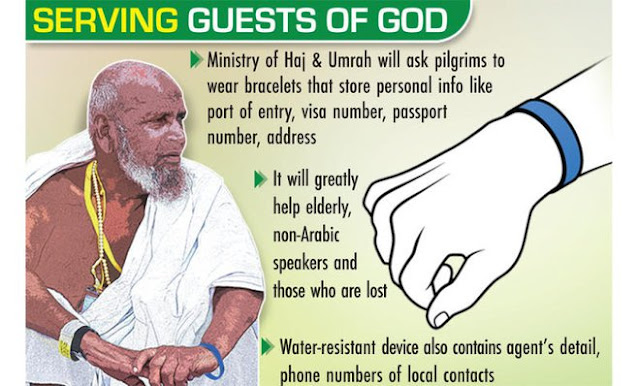
Smart bracelets during Haj for quick emergency response


Smart bracelets during Haj for quick emergency responsearabnews.com

Smart bracelets during Haj for quick emergency response


JEDDAH: The Saudi Red Crescent Authority (SRCA) is introducing electronic smart bracelets during Haj this year that contain all the vital information of the pilgrims to face any emergency, according to Dr. Saleh bin Hamad Al-Suhaibani, secretary-general of the Organization of Arab Red Crescent and Red Cross.

Speaking to Arab News, Al-Suhaibani said the smart bracelet is the latest gadget for rapid response and will contain all the information about the medical history and medical requirements of pilgrims, which will help in saving lives in any situation.

The smart bracelet will contain a special bar-code that operates with smartphones and computers offline and online. He said rapid response entities would immediately be able to access the information on these bracelets and implement it in saving their lives, if so required.

Al-Suhaibani explained that besides pilgrims, these smart bracelets can also be used by the Ministry of Health for hospital inpatients. The Ministry of Labor and Social Development will find it handy for workers and employees with the medical information; and the international organizations for refugees and displaced people, for humanitarian operations in general.

This technology is the latest projects of cooperation and a joint program of Red Crescent and the Saudi Skop group.

The Ministry of Haj announced this year the launch of the e-bracelet that stores the personal information of each pilgrim including where the person entered the Kingdom, visa number, passport number and address.

The device also includes data on pilgrims’ licensed service providers, accommodations in Makkah, Madinah or the holy sites, and the telephone numbers of those helping them.

Earlier, the SRCA participated in a workshop organized by the ministry of Health titled, ““Crisis management and strategic planning,” to combat any type of crisis during this year’s Haj.

The officials from the Saudi Red Crescent participated in the workshop and reviewed strategic plans and procedures for crisis management.

The workshop was held in the presence of a number of officials from the Ministry of Health, heads of Haj committees, and with the participation of specialists from Bournemouth University in the UK.


British haj travel announced 3,4 and 5 star hajj Packages 2016 visit our website & select your own hajj packages 2016. www.britishhajtravel.com/hajj-packages

VIP Hajj Package        Platinum Hajj Package        Golden Hajj Package 

Deluxe Hajj Package

Source: arabnews.com

Thursday, 18 August 2016

A Quranic Pilgrimage

A Quranic Pilgrimage

A Quranic Pilgrimage

Hajj, also known as the greater quranic pilgrimage, is an amazing phenomenon which engulfs the hearts and minds of Muslims from all across the globe. It is an event which is indeed spectacular; a mass sea of human will and flesh surging along the path once traversed by Abraham , the caller to Islamic monotheism. It is a pilgrimage that is centered around the prime maxim of monotheism, every action and ritual maintaining a direct relationship with it.

Inasmuch as Hajj being the single most important and spiritual journey that man will undertake, it is pertinent to note that most are unaware of the Qur’anic verses relating to it. It is in this vein that we shall be taking a brief look at a few verses in Surah Hajj where Allah speaks of this most blessed journey.

The discussion begins with the verse,


“And (remember) when We appointed for Abraham the place of the House (saying) ‘Do not ascribe anything as a partner to Me and purify My House for those who circumbulate, stand, bow, and prostrate.'”[1]

The verse commences the discussion about Hajj through introducing it as an affair which stems from Abraham. We find that the appointment of the house (Kabah) coupled with pure monotheism as Allah established for Abraham His House along with His house rules. In keeping with His guidelines, He articulates acceptable and pleasing behavior: circumbulating, standing, bowing, and prostration – all forms of physical worship. Thus, the verse in question affirms tawhid (monotheism), the action of tawhid (al-Uluhiyah), the direction (qiblah) of tawhid, and the Prophet of tawhid. It is through such points that man may achieve eternal bliss; by believing in the monotheistic nature of Allah without ascribing any form of partnership to him, by worshipping Him in line with His monotheistic nature through the prescribed actions of circumbulating, standing, bowing, and prostrating; facing the Kabah while committing these acts; and following the millah (religion) of Abraham who was a monotheist himself.

Abraham , the Friend of Allah , is given sole importance in relation to the Kabah, and was honored through being commanded to build the Kabah where Allah decreed. It was built out of taqwa and founded upon obedience, he and his son built this great edifice and a part of his offspring remained in Makkah living alongside it. As for Allah’s command to purify His House, it was to purify it from polytheism and disobedience, and from impurities and dirt. Allah, the Most High, ascribes the House to himself through His usage of the pronoun ‘my’, and in doing so sanctified and honored this blessed structure. It is to this end that `Umar b. Al-Khattab said when kissing the black stone, “Verily I know that you are merely a stone, you neither harm nor benefit. Were it not for the fact that the Prophet kissed you, I never would have,” [2] since his kiss was merely because of its sanctified nature which God afforded it, and not because it is special in and of itself.

Allah then says,


“And proclaim unto mankind the Pilgrimage. They will come to you on foot and on every lean camel; they will come from every deep ravine, so that they may witness things that are of benefit to them, and mention the name of Allah on appointed days over the beast of cattle that He has bestowed upon them. Then eat thereof and feed therewith the poor unfortunate.”[3]

After being commanding to build the sanctified structure, Abraham was told to call mankind to undertake the pilgrimage. It is mentioned the Abraham said, “My Lord, how can I call mankind when my voice cannot reach them?” So it was said, “Call, and its conveyance is upon us.” Similarly, the famous exegete Ibn Al-‘Arabi states that “Allah commanded him to climb Abi Qubais [4] and call out, “O mankind, Allah has ordained upon you the Hajj, so undertake the Pilgrimage.” So none were left except that Allah conveyed the call of Abraham to them…” [5]

The verse then states the means by which the pilgrims shall respond to the call, and their coming from “every deep ravine” is from every far and desolate place, so much so that the believers will flock from all corners of the earth – this miraculous statement is evident today where people of all nationalities and races arrive at the sacred House. Interestingly Allah states that “they will come to you” as in to Abraham instead of the House itself. This passage emphasizes the link between the Hajj and Abraham, and that the Hajj is to respond to the call of monotheism – it is in effect an act of monotheism. Furthermore, in responding to Abraham we become of him, as Allah states “Verily, among mankind who have the best claim to Abraham are those who followed him.” [6] Thus, the Hajj establishes the connection between the Muslims and Abraham since we are the only people to follow in his way, in both deed and intent.

As for “the things that are of benefit”, they are of two types: religious and worldly. As for the religious benefit, it is to engage in worship and fulfill one’s duty to Allah . As for the worldly gain, it is to gain an income and some profit. Ibn `Abbas said the verse pertained to benefit in this life and the hereafter. “As for benefit in the hereafter, it is to reside in eternal bliss; and as for this life, it is benefit in regards to profit and business undertakings.” [7] In this regards, the majority of exegetes state that the meaning of the verse “There is no sin on you if you seek the Bounty of your Lord…” [8] is that there is no harm nor sin in undertaking profitable ventures during the Hajj as long as it does not interfere with carrying out the prescribed rituals.

In regards to mentioning the name of Allah on the appointed days, then this is to slaughter the sacrifice in His Glorious name as well as to praise and thank Allah for His many bounties. Ibn `Abbas stated the ‘appointed days’ are the first ten days of the month of Dhul Hijjah. [9] The ‘beast of cattle’ is recorded in the Qur’an as the bahimatul an’am which are camels, cows, and sheep. This is reiterated by the hadith of `Abdullah b. `Abbas as narrated by Abu Jamrah Nasr b. `Imran Ad-Duba’Ä« when he asked Ibn `Abbas about the tamattu’ Hajj and sacrifice. [10] In reference to the discussion pertaining to the benefits of Hajj, the bahimatul an’am are also a benefit in this life and the next since the one selling them benefits financially, and the one who slaughters them benefits in the hereafter. It is then from the divine mercy and wisdom of Allah the Most High that he allows the slaughterer (who now benefits from his sacrifice in this life) and the poor to eat from the sacrificial meat.

In ending the Hajj, Allah says,
“Then let them make an end of their unkemptness and pay their vows and go around the ancient House.”[11]

Their ‘unkemptness’ is the hair on their heads that they have let grow and been unable to fully comb or cut during their time in the state of ihram, and ‘to make and end’ is to either shave or trim one’s hair. As for paying their vows, it is the promises they have made to the Almighty concerning their Hajj, `Umrah or sacrifice. They are then ordered to complete their Hajj by means of the tawaf al-ifadah, the principle circumambulation of the ancient House. The House is stated as being ancient since Allah says that “first House (of worship) appointed for mankind was that at Bakkah (Makkah), full of blessing, and guidance for the universe.” [12]

Allah then states,

“That; and whose extols the sacred things of Allah, it will be well for him in the sight of his Lord.”

The first word of the verse (“that”) is to establish the verses which have preceded as being the decisive commands of Hajj and thus means, ‘that is the command’. As for extolling the sacred things of Allah , it is extremely important since it is amongst the actions which Allah loves and allows the slave to draw close to his Lord. The ‘sacred things’ are everything that Allah has made sacred and ordered to be exalted, such as salah (ritual worship), the manasik (rituals of Hajj), the haram (sacred vicinity), the ihram (the state of a pilgrim), the sacrifice, and all other matters that require exaltation and love since all these forms of worship stem from an obedient heart and subservient limbs. It is to this effect that Allah says, “That (is the command). And whoso extols the offerings consecrated to Allah, it surely is from the piety of the hearts.” [13]

The Hajj, just like the other pillars of Islam combines spirituality with physical action and reminds us that monotheism is not only a belief we maintain within our hearts and utter with our lips, but a principle we live out through our actions, regardless as to whether we be pilgrims or in a normal state going about our daily lives.

British haj travel announced 3,4 and 5 star hajj Packages 2016 visit our website & select your own hajj packages 2016. www.britishhajtravel.com/hajj-packages

VIP Hajj Package            Platinum Hajj Package            Golden Hajj Package            Deluxe Hajj Package 

Source: islamicity.org

Thursday, 11 August 2016

Hajj is obligatory for women as it is for men

Hajj is obligatory for women as it is for men

Hajj is obligatory for women as it is for men

Al-Nawawi said: They are unanimously agreed that Hajj is obligatory upon a woman if she is able to do it. Sharh Saheeh Muslim.

Hajj is fard ‘ayn (an individual obligation) which every Muslim who is accountable and is able to do it must do once in a lifetime. It is one of the pillars of Islam, an obligation which is proven to be so in the Qur’aan and Sunnah, and by scholarly consensus.

In the Qur’aan, Allah says (interpretation of the meaning):

“And Hajj (pilgrimage to Makkah) to the House (Ka‘bah) is a duty that mankind owes to Allaah, those who can afford the expenses (for one’s conveyance, provision and residence); and whoever disbelieves [i.e. denies Hajj (pilgrimage to Makkah), then he is a disbeliever of Allaah], then Allaah stands not in need of any of the ‘Aalameen (mankind, jinn and all that exists)”[Aal ‘Imraan 3:97]

This aayah clearly states that it is obligatory. When the Qur’aan says “a duty that mankind owes to Allaah” this implies that it is obligatory and compulsory. This is the evidence that it is fard. Indeed, we find that the Qur’aan emphatically states that it is obligatory, in the phrase “and whoever disbelieves [i.e. denies Hajj (pilgrimage to Makkah), then he is a disbeliever of Allah], then Allah stands not in need of any of the ‘Aalameen (mankind, jinn and all that exists).” Allah describes going against this obligation as kufr or disbelief. This context shows that failing to do Hajj is not the action of a Muslim, rather it is the action of a non-Muslim.

In the Sunnah, there is the hadeeth of Ibn ‘Umar (may Allaah be pleased with him) according to which the Prophet (peace and blessings of Allah be upon him) said: “Islam is built on five (pillars): the testimony that there is no god except Allaah and that Muhammad is the Messenger of Allah; establishing regular prayer; paying zakaah; fasting Ramadaan; and Hajj.” 

The phrase “Islam is built…” indicates that Hajj is one of the pillars of Islam. Muslim narrated that Abu Hurayrah said: “The Messenger of Allah (peace and blessings of Allah be upon him) gave a sermon and said to us: ‘O people, Allah has enjoined Hajj upon you so perform Hajj.’ A man said, ‘Every year, O Messenger of Allah?’ He did not answer until the man had asked it three times, then the Messenger of Allah (peace and blessings of Allah be upon him) said, ‘If I had said yes, it would have become obligatory and you are not able to do that.’” And there are so many ahaadeeth concerning that that it reaches the level of tawaatur which means that this obligation is something certain and definite.

With regard to ijmaa’ or scholarly consensus, the ummah is unanimously agreed that Hajj once in a lifetime is obligatory for the one who is able to do it. This is something which is well known and no Muslim has any excuse for not knowing it, and the one who denies it is a kaafir.

British haj travel announced 3,4 and 5* star hajj Packages 2016.Visit our website & select your cheap Hajj package: http://www.britishhajtravel.com/hajj-packages

Hajj 2016 We have gladly offered Executive Hajj Packages season 2016 for our significant clients and organization customers.Go along with us and locate the new route with our best Hajj administrations.

VIP Hajj Package        Platinum Hajj Package        Golden Hajj Package        Deluxe Hajj Package

Source: go-makkah.com

Thursday, 4 August 2016

Pilgrims start arriving from tomorrow

Pilgrims start arriving from tomorrow

Pilgrims start arriving from tomorrow

JEDDAH — King Abdulaziz International Airport’s Haj terminal in Jeddah and Prince Muhammad International Airport in Madinah have completed all preparations for receiving pilgrims who will start arriving at these airports from Thursday (Dhul Qada 1), the first day of the Haj season of 2016.

For the coming period of two and a half months, the airports are expected to receive around 1.4 million pilgrims from all over the world.

More than 7,000 staff, representing 27 government and private agencies, will be involved in implementing the Haj plan.

According to the plan, all the lounges of the Haj terminal will be converted into arrival lounges from Dhul Qada 1 till Dhul Hijja 4 (Aug. 4 – Sept. 5) and departure lounges from Dhul Hijjah 16 to Muharram 15 (Sept. 17 to Oct. 16).

The first flight carrying pilgrims from New Delhi will land at 5.30 p.m.at Madinah airport. A total of 1,36,020 Indians will perform Haj this year.

The General Authority of Civil Aviation (GACA), in coordination with the Ministry of Haj and Umrah and other agencies, has prepared a plan in line with the directive of the Saudi leadership, to fast-track the arrival procedures by taking advantage of the e-track system.

Upon arrival at the terminal, officials from the Ministry of Health will receive pilgrims and give them necessary health guidelines and services, and then they will proceed to the Passport Control to complete immigration procedures.

The Haj terminal is spread over 90,000 square meters of roofed area and 160,000 sq. meters of open area. There are 142 counters for Passports (Jawazat) and 120 counters of the Ministry of Haj.

At Madinah airport, officials of the government and private departments serving pilgrims met to finalize the Haj operation plan. It is expected that the airport will receive a total of 2,678 Haj flights, a five percent increase over last year.

Meanwhile, Prince Khaled Al-Faisal, emir of Makkah and adviser to Custodian of the Two Holy Mosques and chairman of the Central Haj Committee, met Minister of Haj Muhammad Saleh Bantan at his office in Jeddah on Tuesday.

During the meeting, Prince Khaled was briefed on the second phase of the e-track and e-bracelet systems for pilgrims and GPS system for pilgrims’ buses.

Hajj 2016 We have gladly offered Executive Hajj Packages season 2016 for our significant clients and organization customers.Go along with us and locate the new route with our best Hajj administrations.

Source: saudigazette.com.sa

Monday, 25 July 2016

Women and Hajj

Women and Hajj

Women and Hajj

Despite the equality of men and women in the Islamic rulings, there are some rulings specified for women out of mercy towards them because of their different nature.

  • If a woman still in her Iddah (waiting period) when she is divorced and she wants to go for Hajj, she may go but she has to be accompanied by a Mahram . However, if  the waiting period is for the death of the husband, she cannot go to Hajj for staying at home is one of the obligations of the waiting period for the wido
     
  • The companionship of a Mahram is an obligation for women when she is performing Hajj. If she has got no Mahram, she cannot perform Hajj and her Hajj is not valid. Allah’s apostle (peace and blessings of Allah be upon him) said: “A woman should not travel except in the company of a Mahram.” (Bukhari and Muslim)
         
  • Regarding Ihram of the woman it is it like that of the man with exception to clothes: A woman should assume Ihram like and she is permitted to wear whatever clothes she likes as long as they meet the Islamic rulings. A woman cannot  wear Niqaab , Burqa' or gloves. The Prophet (peace and blessings of Allah be upon him) said: “A woman in the state of Ihraam should not wear Niqaab or gloves.” (Bukhaari) .
         
  • Talbiyah for women and hajj: unlike men, women should say Talbiyah in a low voice. and it is impermissible for her to raise her voice when saying Talbiyah in the presence of men.
         
  • Ramal and Idhtibaa': The rulings of Ramal and Idhtibaa' are not applicable to women. She should not perform Ramal, Idhtibaa' or run during Sa‘i between Al-Safa and Al-Marwa.
         
  • Shortening hair: A woman has to cut the length of a fingertip from her hair. Ibn Abbas said, “It is not obligatory upon women to shave their hair (after ending Ihraam), rather, it is obligatory upon them to shorten the hair.” (Abu Daawood )
         
  • If a woman menstruates and does not become pure until she fears missing the company; she should not perform Tawaf until she becomes pure, for the Prophet, (peace and blessings of Allah be upon him) said to Aa’isha when she was menstruating: “Perform each rite that the pilgrim performs with exception to performing Tawaf around the House.” (Bukhaari and Muslim). However, if she perform Tawaf, for example, lest she should miss the company, some scholars including Ibn Taymiyah, endorse the idea that it is permissible for her to perform Tawaf because of necessity.
Source:go-makkah.com

Wednesday, 20 July 2016

A History of the Hajj

A History of the Hajj

A History of the Hajj

Hajj literally means ‘to set out for a place’. Islamicly, however, it refers to the annual pilgrimage that Muslims make to Makkah with the intention of performing certain religious rites in accordance with the method prescribed by the ProphetMuhammad, may the mercy and blessings of God be upon him.

Hajj and its rites were first ordained by God in the time of the Prophet Abraham and he was the one who was entrusted by God to build the Kaaba - the House of God - along with his son Ishmael at Makkah.  God described the Kaaba and its building as follows:
“And remember when We showed Abraham the site of the [Sacred] House [saying]: Associate not anything [in worship with Me and purify My House for those who circumambulate it [i.e. perform Tawaaf] and those who stand up for prayer and those who bow down and make prostration [in prayer etc.].”  (Quran 22:26)
After building the Kaaba, Abraham would come to Makkah to perform Hajj every year, and after his death, this practice was continued by his son.  However, gradually with the passage of time, both the form and the goal of the Hajj rites were changed.  As idolatry spread throughout Arabia, the Kaaba lost its purity and idols were placed inside it.  Its walls became covered with poems and paintings, including one of Jesus and his mother Maryand.  Eventually over 360 idols came to be placed around the Kaaba.

During the Hajj period itself, the atmosphere around the sacred precincts of the Kaaba was like a circus.  Men and women would go round the Kaaba naked, arguing that they should present themselves before God in the same condition they were born.  Their prayer became devoid of all sincere remembrance of God and was instead reduced to a series of hand clapping, whistling and the blowing of horns.  Even the Hajj call was distorted by them with the following additions: “No one is Your partner except one who is permitted by you.  You are his Master and the Master of what he possesses.”

Sacrifices were also made in the name of God.  However, the blood of the sacrificed animals was poured onto the walls of the Kaaba and the flesh was hung from pillars around the Kaaba, in the belief that God demanded the flesh and blood of these animals.
Singing, drinking, adultery and other acts of immorality was rife amongst the pilgrims and the poetry competitions, which were held, were a major part of the whole Hajj event.  In these competitions, poets would praise the bravery and splendor of their own tribesmen and tell exaggerated tales of the cowardice and miserliness of other tribes.  Competitions in generosity were also staged where the chief of each tribe would set up huge cauldrons and feed the pilgrims, only so that they could become well-known for their extreme generosity.
Thus the people had totally abandoned the teachings of their forefather and leader Abraham.  The House that he had made pure for the worship of God alone, had been totally desecrated by the pagans and the rites which he had established were completely distorted by them.  This sad state of affairs continued for nearly two and a half thousand years.  But then after this long period, the time came for the supplication of Abraham to be answered:
“Our Lord!  Send amongst them a Messenger of their own, who shall recite unto them your verses and instruct them in the book and the Wisdom and sanctify them.  Verily you are the All-Mighty, the All-Wise.” (Quran 2:129)
Sure enough, a man by the name of Muhammad ibn ‘Abdullaah was born in the very city that Abraham had made this supplication centuries earlier.  For twenty-three years, the Prophet Muhammad spread the message of monotheism - the same message that Abraham and all the other Prophets came with - and established the law of God upon the land.  He expended every effort into making the word of God supreme and his victory over falsehood culminated in the smashing of the idols inside the Kaaba which once again became the universal centre for the worshippers of the one True God.

Not only did the Prophet rid the Kaaba of all its impurities, but he also reinstated all the rites of Hajj which were established by God’s Permission, in the time of Abraham.  Specific injunctions in the Quran were revealed in order to eliminate all the false rites which had become rampant in the pre-Islamic period.  All indecent and shameful acts were strictly banned in God’s statement:
“There is to be no lewdness nor wrangles during Hajj.” (Quran 2:197)
Competitions among poets in the exaltations of their forefathers and their tribesmen’s’ achievements were all stopped.  Instead, God told them:
“And when you have completed your rites [of Hajj] then remember God as you remember your forefathers; nay with a more vigorous remembrance.” (Quran 2:200)
Competitions in generosity were also prohibited.  Of course, the feeding of the poor pilgrims was still encouraged as this was done in the time of Abraham, but God commanded that the slaughtering of the animals which was done for this purpose should be done seeking the pleasure of God rather than fame and the praise of the people.  He said:
“So mention the name of God over these animals when they are drawn up in lines.  Then, when they are drawn on their sides [after the slaughter], eat thereof and feed the beggar who does not ask, and the beggar who asks.” (Quran 22:36)
As for the deplorable practice of spattering blood of the sacrificed animals on the walls of the Kaaba and hanging their flesh on altars, then God clearly informed them that: 
“It is neither their meat nor their blood that reaches God, but it is Taqwaa (piety) from you that reaches Him.” (Quran 22:37)
The Prophet, may the mercy and blessings of God be upon him, also put a stop to the practice of circling the Kaaba in a state of nudity and the argument that the pagans put forward to justify this ritual was sharply rebutted in God’s question:
“Say: Who has forbidden the adornment [i.e. clothes] given by God which He has produced for His Slaves?” (Quran 7:32)
Another custom which was prohibited through the Quran was that of setting off for Hajj without taking any provisions for the journey.  In the pre-Islamic period, some people who claimed righteousness, having total dependency on God, would travel to perform Hajj begging food the whole journey.  They considered this form of behavior a sign of piety and an indication of how much faith they had in God.  However God told mankind that to have sufficient provisions for the journey was one of the preconditions for making Hajj.  He said
“And take a provision [with you] for the journey, but the best provision is piety.” (Quran 2:197)
In this way, all the pre-Islamic practices, which were based in ignorance, were abolished and Hajj was once more made a model of piety, fear of God, purity, simplicity and austerity.  Now, when the pilgrims reached the Kaaba, they no longer found the carnivals and the frolic and frivolity that had once occupied the minds of the pilgrims there before.  Now, there was the remembrance of God at every step and every action and every sacrifice was devoted to Him alone.  It was this kind of Hajj that was worthy of the reward of paradise, as the Prophet said:
“The reward for an accepted Hajj is nothing less than paradise.” (Saheeh Al-Bukhari)
Source: islamreligion.com

Thursday, 14 July 2016

The Values of Hajj

The Values of Hajj

The Values of Hajj

Hajj is a collection of actions and recitations. These collections inspire the Muslim's soul with spiritual sublime feelings.

Generally speaking, Hajj includes a number of prayers performed by the pilgrim during a definite period. Every action, word, and prayer is a symbol that inspires the soul with a vivid feeling and encompasses a secret and an objective.
 

Ihram, Talbiyah (Tawaf) (circumambulation), Saa’y, Wuquf (staying at Arafat) to name but a few, are a mixture of actions and feelings which are spiritually experienced by the pilgrim. Every action has got a deep meaning and each rite aims at the accommodation of the values of Islam and the demonstration of its purposes in a symbolic and accurate way.

Rites are performed within the hugest gatherings of people. Crowds assemble to worship Allah, the almighty.  Their target is Allah’s satisfaction and forgiveness, submission and surrender to his will.

Once a Muslim decides to perform Hajj, his heart will long to reach his purpose, Allah’s satisfaction and the purification of the self.

Performing Hajj is the sacrifice of money and many physical desires and pleasures for the sake of Allah. It leaves an everlasting mark in the Muslim’s heart to constantly remember the Almighty.

It equally renewed the society. Performing Hajj cannot be undertaken singly. Its rites have to be performed communally. Herein, lies the basic principles of Islam: Brotherhood, Unity, peace and equality.

Pilgrims coming from different nationalities will get to know each other, pray and supplicate together so that the Almighty ease their hardships and forgive them.
Source:go-makkah.com

Friday, 1 July 2016

Pilgrimage Hadeeths

Pilgrimage Hadeeths

Pilgrimage Hadeeths

Narrated 'Abdullah bin Abbas : Al-Fadl (his brother) was riding behind Allah's Apostle and a woman from the tribe of Khath'am came and Al-Fadl started looking at her and she started looking at him. The Prophet turned Al-Fadl's face to the other side. The woman said, "O Allah's Apostle! The obligation of Hajj enjoined by Allah on His devotees has become due on my father and he is old and weak, and he cannot sit firm on the Mount; may I perform Hajj on his behalf?" The Prophet replied, "Yes, you may." That happened during the Hajj-al-Wida (of the Prophet ).

  • Narrated 'Abdullah bin Abbas : Al-Fadl (his brother) was riding behind Allah's Apostle and a woman from the tribe of Khath'am came and Al-Fadl started looking at her and she started looking at him. The Prophet turned Al-Fadl's face to the other side. The woman said, "O Allah's Apostle! The obligation of Hajj enjoined by Allah on His devotees has become due on my father and he is old and weak, and he cannot sit firm on the Mount; may I perform Hajj on his behalf?" The Prophet replied, "Yes, you may." That happened during the Hajj-al-Wida (of the Prophet ). 
  • Narrated Ibn 'Umar: I saw that Allah's Apostle used to ride on his Mount at Dhul Hulaifa and used to start saying, "Labbaik" when the Mount stood upright.
  • Narrated Jabir bin 'Abdullah : that Allah's Apostle started saying, "Labbaik" from Dhul-Hulaifa when his Mount stood upright carrying him
  • Narrated Thumama bin 'Abdullah bin Anas: Anas performed the Hajj on a pack-saddle and he was not a miser. Anas said, "Allah's Apostle performed Hajj on a pack-saddle and the same Mount was carrying his baggage too." 
  • Narrated Al-Qasim bin Muhammad: 'Aisha said, "O Allah's Apostle! You performed 'Umra but I did not." He said, "O 'Abdur-Rahman! Go along with your sister and let her perform 'Umra from Tan'im." 'Abdur-Rahman made her ride over the pack-saddle of a she-camel and she performed 'Umrah.
  • Narrated Abu Huraira: The Prophet was asked, "Which is the best deed?" He said, "To believe in Allah and His Apostle." He was then asked, "Which is the next (in goodness)?" He said, "To participate in Jihad in Allah's Cause." He was then asked, "Which is the next?" He said, "To perform Hajj-Mabrur. "
  • Narrated 'Aisha: (the mother of the faithful believers) I said, "O Allah's Apostle! We consider Jihad as the best deed." The Prophet said, "The best Jihad (for women) is Hajj Mabrur. "
  • Narrated Abu Huraira: The Prophet (p.b.u.h) said, "Whoever performs Hajj for Allah's pleasure and does not have sexual relations with his wife, and does not do evil or sins then he will return (after Hajj free from all sins) as if he were born anew."
  • Narrated Zaid bin Jubair: I went to visit 'Abdullah bin 'Umar at his house which contained many tents made of cotton cloth and these were encircled with Suradik (part of the tent). I asked him from where, should one assume Ihram for Umra. He said, "Allah's Apostle had fixed as Miqat (singular of Mawaqit) Qarn for the people of Najd, Dhul-Hulaifa for the people of Medina, and Al-Juhfa for the people of Sham." 
  • Narrated Ibn Abbas: The people of Yemen used to come for Hajj and used not to bring enough provisions with them and used to say that they depend on Allah. On their arrival in Medina they used to beg the people, and so Allah revealed, "And take a provision (with you) for the journey, but the best provision is the fear of Allah." (2.197). 
Source: go-makkah.com

Wednesday, 22 June 2016

Over six million pilgrims performing Umrah

Over six million pilgrims performing Umrah

Over six million pilgrims performing Umrah

JEDDAH – A record number of more than six million pilgrims will perform Umrah by the end of the holy month of Ramadan, which witnesses the peak Umrah season of the year.

As of Tuesday, a total of 5,888,986 pilgrims arrived in the holy city of Makkah from all over the world, according to the statistical report of the Information Center at the Ministry of Haj and Umrah, the Saudi Press Agency reported.

The holy city will witness huge influx of Umrah pilgrims during the last 10 days of Ramadan.

“The number of Umrah pilgrims will exceed six million over the coming days.
The ministry, in cooperation and coordination with the concerned agencies, has made elaborate arrangements to cope with the unprecedented rush of pilgrims as well as to enable them to perform their rituals in ease and comfort,” the center said in a press statement adding that it has so far rendered 43,000 services to the pilgrims.

Meanwhile, Tarek Al-Abdul Jabbar, assistant president of the Airports, made an inspection tour of the Haj and Umrah terminal of King Abdulaziz International Airport in Jeddah on Monday.

Accompanied by Abdullah Al-Reemi, director general of KAIA, and other senior airport officials, he reviewed the arrangements and facilities being made for the pilgrims. It is noteworthy that there are around 7,000 officials and employees, representing 27 public and private sectors, engaged in serving the pilgrims at the 14 departure and arrival lounges at the airport.
Source: saudigazette.com.sa

Tuesday, 7 June 2016

A beginner's guide to Ramadan

A beginner's guide to Ramadan
source: arabnews

A beginner's guide to Ramadan

Millions of Muslims around the world on Monday marked the start of Ramadan, a month of intense prayer, dawn-to-dusk fasting and nightly feasts. Others will begin fasting a day later, Tuesday, due to a moon-sighting methodology that can lead to different countries declaring the start of Ramadan a day or two apart.
Here are some questions and answers about Islam's holiest month:


WHY DO MUSLIMS FAST?


The fast is intended to bring the faithful closer to God and to remind them of the suffering of those less fortunate. Ramadan is a time to detach from worldly pleasures and focus on one's inner self.
 It's seen as a way to physically and spiritually purify, refraining from habits such as smoking and caffeine. Muslims often donate to charities during the month and feed the hungry. Many spend more time at mosques during Ramadan and use their downtime to recite the Quran.
 London's new Muslim mayor, Sadiq Khan, wrote in the Guardian that he plans to use Ramadan to "build bridges" and break bread with Muslims and non-Muslims around the city at synagogues, churches and mosques, though he acknowledged that 19-hour-long fasts during the longer summer days in Europe and forgoing coffee will be challenging.
Fasting during Ramadan is one of the five pillars of Islam, along with the Muslim declaration of faith, daily prayer, charity, and performing Haj.


HOW DO MUSLIMS FAST?


Muslims abstain from eating and drinking from dawn to dusk for the entire month of Ramadan. A single sip of water or a puff of a cigarette is enough to invalidate the fast.
However, Muslim scholars say it's not enough to just avoid food and drinks during the day. Ramadan is also an exercise in self-restraint. Muslims are encouraged to avoid gossip and arguments. Sexual intercourse between spouses is also forbidden during the daytime fast.
Just before the fast, Muslims have a pre-dawn meal of power foods to get them through the day, the "suhoor." Egyptians eat mashed fava beans called "ful," spiced with cumin and olive oil, while in Lebanon and Syria, popular suhoor food is flatbread with thyme, cheese or yogurt. In Afghanistan, people eat dates and dumplings stuffed with potato and leeks, first steamed, then fried.


HOW DO MUSLIMS BREAK THEIR FAST?


Muslims traditionally break their fast like Prophet Muhammad (peace be upon him) did some 1,400 years ago, with a sip of water and some dates at sunset. That first sip of water is the most anticipated moment of the day.
After sunset prayers, a large feast known as "iftar" is shared with family and friends. Iftar is a social event as much as it is a gastronomical adventure. Across the Arab world, apricot juices are an iftar staple. In South Asia and Turkey, yogurt-based drinks are popular. 
Every night of Ramadan, mosques and aid organizations set up tents and tables for the public to have free iftar meals.


CAN MUSLIMS BE EXEMPTED FROM FASTING?


Yes. There are exceptions for children, the elderly, those who are ill, women who are pregnant, nursing or menstruating, and people traveling, which can include athletes during tournaments.
 Many Muslims, particularly those living in the United States and Europe, are accepting and welcoming of others around them who aren't observing Ramadan. 
However, non-Muslims or adult Muslims who eat in public during the day can be fined or even jailed in some Mideast countries.

In many predominantly Muslim countries like Indonesia, karaoke bars and nightclubs are closed across much of the country for the month. Restaurants there use curtains to conceal customers who eat during the day.
 And in Egypt, the Dar Al-Ifta, which is the main authority in charge of issuing religious edits, on Monday warned against eating in public, saying this is not an act of "personal freedom, but chaos — an assault on Islam."
 In China, minority Uighur Muslims complain of heavy restrictions by the Communist Party, such as bans on fasting by party members, civil servants, teachers and students during Ramadan, as well as generally enforced bans on children attending mosques, women wearing veils and young men growing beards.


WHAT ARE SOME RAMADAN TRADITIONS?


Typically, the start of the month is welcomed with the greeting of "Ramadan kareem!" Another hallmark of Ramadan is nightly prayer at the mosque among Muslims called "taraweeh. "
Egyptians have the tradition of Ramadan lanterns called the "fanoos," often the centerpiece at an iftar table or seen hanging in window shops and from balconies. In the Arabian Gulf countries, wealthy families hold "majlis" where they open their doors for people to pass by all hours of the night for food, tea, coffee and conversation.
 Increasingly common are Ramadan tents in five-star hotels that offer lavish and pricey meals from sunset to sunrise. While Ramadan is a boon for retailers in the Middle East and South Asia, critics say the holy month is increasingly becoming commercialized. Scholars have also been disturbed by the proliferation of evening television shows during Ramadan. In Pakistan, live game shows give away gifts promoting their sponsors. In the Arab world, month-long soap operas starring Egypt's top actors, rake in millions of dollars in advertising.


HOW DO MUSLIMS MARK THE END OF RAMADAN?


The end of Ramadan is marked by intense worship as Muslims seek to have their prayers answered during "Laylat al-Qadr" or "the Night of Destiny." It is on this night, which falls during the last 10 nights of Ramadan, that Muslims believe that God sent the Angel Gabriel to the Prophet Muhammad and revealed the first versus of the Quran. 
The end of Ramadan is celebrated by a three-day holiday called Eid Al-Fitr. Children often receive new clothes, gifts and cash.
 Muslims attend early morning Eid prayers the day after Ramadan. Families usually spend the day at parks and eating — now during the day.
Source: arabnews.com

Tuesday, 31 May 2016

Civil Defense emergency plan for Ramadan ready

Civil Defense emergency plan for Ramadan ready

Civil Defense emergency plan for Ramadan ready


MAKKAH — Crown Prince Muhammad Bin Naif, deputy premier and minister of interior, has approved a contingency plan prepared by Civil Defense to deal with any emergency in Makkah and Madinah during Ramadan, said a top official.

Lt. Gen. Sulaiman Bin Abdullah Al-Amr, director general of the Civil Defense, said preventive measures will also be taken to ward off any threats to the safety of pilgrims, visitors and others in the holy cities.
“The Crown Prince has made it clear that the safety of pilgrims in Makkah and Madinah is paramount.

“The Crown Prince ordered the Civil Defense to take all precautions necessary to ensure the safety of pilgrims. Pilgrims come from all over the world to perform a religious duty, therefore they should feel safe and secure and focus on their spirituality,” said Al-Amr.

He also said the Civil Defense submitted a comprehensive plan and he is grateful for the Crown Prince’s support and encouragement.

“With Umrah and Haj seasons, the Two Holy Mosques become extremely crowded. It is the duty and responsibility of the Civil Defense to ensure the safety and security of pilgrims and to ensure that the directorate takes all necessary precautions to aid and protect pilgrims,” said Al-Amr.

He added the plan involves 19 other directorates and authorities.

“The Civil Defense emergency plan is a comprehensive one involving 19 authorities and directorates.

“Each of the 19 directorates has a representative in the Civil Defense control room. The Civil Defense will be ready for emergency rescue operations, medical aid, evacuation, sheltering and others,” said Al-Amr.
“The plan has three phases. The first phase is prevention. In this phase, the Civil Defense takes all precautions necessary to anticipate any potential danger or threat on pilgrims and prevent it. The first phase took started at the beginning of this month. The Civil Defense ran more than 1,210 inspection campaigns under a preventive scanning plan,” said AL-Amr.
He added the campaigns recorded 197 violations.

“The second phase focuses on field preparation. The Civil Defense has officers spread out in critical areas and they are equipped with the tools necessary to deal with any emergency through various strategies such as evacuation,” said Al-Amr.

He added the third phase focuses on raising awareness among pilgrims of the importance of safety measures.

“The Civil Defense offers a number of educational workshops and lectures on safety in the Two Holy Mosques. The Civil Defense is also active through social media to ensure its message reaches a wide layer of people,” said Al-Amr.
Source: saudigazette.com.sa

Tuesday, 24 May 2016

Cover face in ehram

Cover face in ehram

Cover face in ehram

As Salaam Aleikum wa Rahmatullahi wa Barakatuh. (May Allah's Peace, Mercy and Blessings be upon all of you)

One of our brothers/sisters has asked this question:

In The Name Of Allah (SWT) the Lord of all that Exist!

Asalam-u-ALikum-wa-rehmatullahi-wa-barakatahu!

Jazak Allah Khair Brother for all your answers.

Q1:In the state of Ah'raam can we cover our face (niqab)...as i have heared that the cloth should not touch the nose.Can u help with the refrence.Jazak Allah!

Q2:Someone told me that on The Day of Judgement everyone will be called after their mothers name.LIke here in this world we are recognized by our father name.is this True??

May Allah accept from u all & Give us Knowledge that benefits us in this world as well as in the HereAfter.Ameen!

 (There may be some grammatical and spelling errors in the above statement. The forum does not change anything from questions, comments and statements received from our readers for circulation in confidentiality.)

Answer:

Cover face in ehram

In the name of Allah, We praise Him, seek His help and ask for His forgiveness. Whoever Allah guides none can misguide, and whoever He allows to fall astray, none can guide them aright. We bear witness that there is none worthy of worship but Allah Alone, and we bear witness that Muhammad (saws) is His slave-servant and the seal of His Messengers.

Q-1:In the state of Ah'raam can we cover our face (niqab)...as i have heared that the cloth should not touch the nose.Can u help with the refrence.Jazak Allah!

The Messenger of Allah (saws) said: "A pilgrim woman must neither cover her face nor wear gloves."

Related by Ahmad and Bukhari.

It is not permissible for a pilgrim woman to cover her face or her hands upto her wrists while she is in the state of ehraam for pilgrimage.

If Allah Subhanah has blessed one amongst the believing women to adorn the naqaab which covers her face, she would be required to remove her face cover and leave her hands upto her wrists uncovered as soon as she enters into the state of ehram from the Meeqat until she completes her pilgrimage and comes out of the state of ehram.

Q-2: Someone told me that on The Day of Judgement everyone will be called after their mothers name.LIke here in this world we are recognized by our father name.is this True??

Allah says in the Holy Quran Chapter 33 Surah Ahzaab verse 5:

Call them by (the names) of their fathers: that is juster in the sight of Allah, but if ye know not their father's (names call them) your Brothers in faith or your friends. But there is no blame on you if ye make a mistake therein: (what counts is) the intention of your hearts: and Allah is Oft-Returning Most Merciful.

Allah Subhanah has guided the believers to call the believers by their fathers name in the life of this world; and there is absolutely no reason to assume that when we are given life again in the life of the Hereafter, we will be called by our mothers name!

There is absolutely nothing mentioned in the Glorious Quran or the authentic and established Sunnah regarding the misconception that one will be called by their mothers name on the Day of Judgment, unless of course, one happens to be Prophet Isa son of Hadrat Maryam (a.s.)!

Whatever written of Truth and benefit is only due to Allahs Assistance and Guidance, and whatever of error is of me alone. Allah Alone Knows Best and He is the Only Source of Strength.
Article by: islamhelpline.net