Showing posts with label Preston hajj packages. Show all posts

Monday, 29 August 2016

Govt launches ‘no vaccine, no Haj’ campaign this year

Govt launches ‘no vaccine, no Haj’ campaign this yeararabnews.com

Govt launches ‘no vaccine, no Haj’ campaign this year


JEDDAH: The Ministry of Health has embarked on its new campaign titled, “No vaccine, no Haj,” aimed at eradicating all infectious diseases that spread with the end of the Haj season.

The ministry is implementing this campaign for the first time, and has put in place a condition that all those wishing to perform Haj rituals this season should receive the seasonal flu vaccine, in addition to other preventive treatments against polio and meningitis for pilgrims coming from countries affected by these diseases.

Abdullah Asiri, the undersecretary for preventive health, confirmed the ministry’s readiness to implement the campaign, starting with the distribution of awareness materials at various health sectors and large shopping
centers, in addition to broadcasting awareness messages on ATM monitors, and via SMSs, to raise awareness and increase the coverage of targeted groups, a local publication reported.

He said the vaccines include the seasonal flu, meningitis and polio for pilgrims coming from the affected countries.

He confirmed the safety and effectiveness of the vaccines and their positive impacts, and their role in boosting the capabilities of the immune system, explaining that they do not cause any long-term negative impacts.

He added: “Vaccines have not registered any harmful or dangerous effects on recipients, but sometimes they cause mild associated symptoms, such as a slight rise in body temperature, soreness, or simple swelling at the injection site, which vanishes within few days.”

He emphasized that the ministry is prepared to deal with the current Haj season.

“Just like every year, we start preparing for the next Haj season immediately after the end of the previous one. All the ministry’s agencies and departments are mobilized for the planning and implementation of programs according to their specialty,” he added.

In regards to the control of epidemics and infectious diseases, the assistant undersecretary for preventive health said the ministry is working on several axes, including updating the health requirements for all pilgrims coming to perform Haj and Umrah, or for any other purpose, in accordance with the epidemiological developments and the targeted diseases.

On the other hand, the Ministry of Foreign Affairs, through its embassies around the world, addresses the health directorates to take preventive measures for the coming pilgrimage.

This is in addition to the in-place public health programs, which include operations in the central control room, the work of epidemiological survey teams at all health facilities, as well as the work of field teams that cover pilgrims, the medical missions’ teams, the emergency management teams, food and drinking water safety teams, and other related departments and teams.

British haj travel announced 3,4 and 5 star hajj Packages 2016 visit our website & select your own hajj packages 2016. www.britishhajtravel.com/hajj-packages

VIP Hajj Package        Platinum Hajj Package        Golden Hajj Package        Deluxe Hajj Package

Source: arabnews.com

Tuesday, 23 August 2016

The first 10 days of Dul Hijjah

The first 10 days of Dul Hijjah

The first 10 days of Dul Hijjah

Among the special seasons of worship are the first 10 days of Dul Hijjah, which Allah has preferred over all the other days of the year. Ibn Abbas (may Allah be pleased with him) reported that the Prophet (peace and blessings of Allah be upon him) said: “There are no days in which righteous deeds are more beloved to Allah than these 10 days.” (Al-Bukhari).
 

PRAISE be to Allah Who has created time and has made some times better than others, some months and days and nights better than others, when rewards are multiplied many times, as a mercy toward His slaves. This encourages them to do more righteous deeds and makes them more eager to worship Him, so that the Muslim renews his efforts to gain a greater share of reward, prepare himself for death and supply himself in readiness for the Day of Judgment.

This season of worship brings many benefits, such as the opportunity to correct one’s faults and make up for any shortcomings or anything that one might have missed. Every one of these special occasions involves some kind of worship through which the slaves may draw closer to Allah, and some kind of blessing though, which Allah bestows His favor and mercy upon whomsoever He will. The happy person is the one who makes the most of these special months, days and hours and draws nearer to his Lord during these times through acts of worship; he will most likely be touched by the blessing of Allah and will feel the joy of knowing that he is safe from the flames of Hell. (Ibn Rajab)

This Hadith and others indicate that these 10 days are better than all the other days of the year, with no exceptions, not even the last 10 days of Ramadan. But the last 10 nights of Ramadan are better, because they include Laylat Al-Qadr (the Night of Power), which is better than a 1,000 months. Thus the various reports may be reconciled. (See Tafseer Ibn Kathir)

The virtue of these 10 days is based on many things: Allah swears an oath by them, and swearing an oath by something is indicative of its importance and great benefit. Allah says: “By the dawn; by the 10 nights.” (Qur’an, 89:1-2) Ibn Abbaas, Ibn Al-Zubayr, Mujahid and others of the earlier and later generations said that this refers to the first 10 days of Dul Hijjah.

The Prophet (peace be upon him) testified that these are the best days of this world, as we have already quoted above from Sahih Hadith.

The Prophet (peace be upon him) commanded us to recite a lot of Tasbeeh (Subhan-Allah), Tahmeed (Al-hamdu Lillah) and Takbeer (Allahu akbar) during this time. Abdullah ibn Omar (may Allah be pleased with him) reported that the Prophet (peace be upon him) said: “There are no days greater in the sight of Allah and in which righteous deeds are more beloved to Him than these 10 days, so during this time recite a great deal of Tahleel (La ilaha ill-Allah), Takbeer and Tahmeed.” (Ahmad).

These 10 days include Yawm Arafah (the Day of Arafah), on which Allah perfected His religion. Fasting on this day will expiate for the sins of two years.; and the Day of Sacrifice, the greatest day of the entire year and the greatest day of Haj, which combines acts of worship in a way unlike any other day. These 10 days include the days of sacrifice and of Haj.

Things to avoid

One who wants to offer a sacrifice must stop cutting his hair and nails and removing anything from his skin, from the beginning of the 10 days until after he has offered his sacrifice, because the Prophet (peace be upon him) said: “When you see the new moon of Dul Hijjah, if any one of you wants to offer a sacrifice, then he should stop cutting his hair and nails until he has offered his sacrifice.” According to another report he said: “He should not remove (literally, touch) anything from his hair or skin.” (Muslim)

The Prophet’s instruction here makes one thing obligatory and his prohibition makes another haram, according to the soundest opinion, because these commands and prohibitions are unconditional and unavoidable. However, if a person does any of these things deliberately, he must seek Allah’s forgiveness but is not required to offer (an extra) sacrifice in expiation; his sacrifice will be acceptable. Whoever needs to remove some hair, nails, etc. because it is harming him, such as having a broken nail or a wound in a site where there is hair, should do so, and there is nothing wrong with that. The state of ihram is so important that it is permitted to cut one’s hair if leaving it will cause harm. There is nothing wrong with men or women washing their heads during the first 10 days of Dul Hijjah, because the Prophet (peace be upon him) only forbade cutting the hair, not washing it.

Some women delegate their brothers or sons to make the sacrifice on their behalf, then cut their hair during these 10 days. This is not correct, because the ruling applies to the one who is offering the sacrifice, whether or not he (or she) delegates someone else to carry out the actual deed. The prohibition does not apply to the person delegated, only to the person who is making the sacrifice, as is indicated in the Hadith. The person who is sacrificing on behalf of someone else, for whatever reason, does not have to adhere to this prohibition.

Concerning the types of worship to be performed during these 10 days: One must understand that these days are a great blessing from Allah to His slave, which is appreciated properly by the actively righteous. It is the Muslim’s duty to appreciate this blessing and make the most of the opportunity, by devoting these 10 days to paying more attention to striving hard in worship. Among His blessings to His slaves, Allah has given us many ways in which to do good and worship Him, so that the Muslim may be constantly active and consistent in his worship of his Lord. Among the good deeds which the Muslim should strive to do during the first 10 days of Dul Hijjah are:

Fasting. It is sunnah to fast on the ninth day of the month, because the Prophet (peace be upon him) urged us to do good deeds during this time, and fasting is one of the best of deeds. Allah has chosen fasting for Himself, as is stated in the Hadith Qudsi: “Allah says: ‘All the deeds of the son of Adam are for him, except for fasting, which is for Me and I am the One Who will reward him for it’.” (Bukhari) The Prophet (peace be upon him) used to fast on the first nine days of Dul Hijjah.

Takbeer. It is Sunnah to say Takbeer (‘Allahu Akbar’), Tahmeed (‘Al-hamdu Lillah’), Tahleel (‘La ilaha ill-Allah’) and Tasbih (Subhan Allah’) during the first 10 days of Dul Hijjah, and to say it loudly in the mosque, the home, the street and every place where it is permitted to remember Allah and mention His name out loud, as an act of worship and as a proclamation of the greatness of Allah, may He be exalted. Men should recite these phrases out loud, and women should recite them quietly.

Performing Haj, Umrah. One of the best deeds that one can do during these 10 days is to perform Haj to the Sacred House of Allah. The one whom Allah helps to go on Haj to His House and to perform all the rituals properly is included in the words of the Prophet (peace be upon him): “An accepted Haj brings no less a reward than Paradise.”

Doing more good deeds in general, because good deeds are beloved by Allah and will bring a great reward from Him. Whoever is not able to go to Haj should occupy himself at this blessed time by worshipping Allah, praying (salaat), reading Qur’an, remembering Allah, making supplication, giving charity, honoring his parents, upholding the ties of kinship, enjoining what is good and forbidding what is evil, and other good deeds and acts of worship.

Sacrifice. One of the good deeds that will bring a person closer to Allah during these 10 days is offering a sacrifice, by choosing a high-quality animal and fattening it, spending money for the sake of Allah.

Sincere repentance. One of the most important things to do during these 10 days is to repent sincerely to Allah and to give up all kinds of disobedience and sin. Repentance means coming back to Allah and foregoing all the deeds, open and secret, that He dislikes, out of regret for what has passed, giving it up immediately and being determined never to return to it, but to adhere firmly to the Truth by doing what Allah loves.

British haj travel announced 3,4 and 5 star hajj Packages 2016 visit our website & select your own hajj packages 2016. www.britishhajtravel.com/hajj-packages

VIP Hajj Package         Platinum Hajj Package         Golden Hajj Package   

 Deluxe Hajj


Source: arabnews.com

Wednesday, 17 August 2016

One fifth of humankind shares a single aspiration

  One fifth of humankind shares a single aspiration


The hajj, or pilgrimage to Makkah, a central duty of Islam whose origins date back to the Prophet Abraham, brings together Muslims of all races and tongues for one of life’s most moving spiritual experiences.

For 14 centuries, countless millions of Muslims, men and women from the four corners of the earth, have made the pilgrimage to Makkah, the birthplace of Islam. In carrying out this obligation, they fulfill one of the five "pillars" of Islam, or central religious duties of the believer.
Muslims trace the recorded origins of the divinely prescribed pilgrimage to the Prophet Abraham, or Ibrahim, as he is called in Arabic. According to the Qur’an, it was Abraham who, together with Ishmael (Isma’il), built the Ka’bah, "the House of God," the focal point toward which Muslims turn in their worship five times each day. It was Abraham, too – known as Khalil Allah, "the friend of God" – who established the rituals of the hajj, which recall events or practices in his life and that of Hagar (Hajar) and their son Ishmael.

In the chapter entitled "The Pilgrimage," the Qur’an speaks of the divine command to perform the hajj and prophesies the permanence of this institution:

And when We assigned for Abraham the place of the House, saying "Do not associate Anything with Me, and purify My House for those who go around it and for those who stand and bow and prostrate themselves in worship. And proclaim the Pilgrimage among humankind: They will come to you on foot and on every camel made lean By traveling deep, distant ravines.

By the time the Prophet Muhammad received the divine call, however, pagan practices had come to muddy some of the original observances of the hajj. The Prophet, as ordained by God, continued the Abrahamic hajj after restoring its rituals to their original purity.

Furthermore, Muhammad himself instructed the believers in the rituals of the hajj. He did this in two ways: by his own practice, or by approving the practices of his Companions. This added some complexity to the rituals, but also provided increased flexibility in carrying them out, much to the benefit of pilgrims ever since. It is lawful, for instance, to have some variation in the order in which the several rites are carried out, because the Prophet himself is recorded as having approved such actions. Thus, the rites of the hajj are elaborate, numerous and varied; aspects of some of them are highlighted below.

The hajj to Makkah is a once-in-a-lifetime obligation upon male and female adults whose health and means permit it, or, in the words of the Qur’an, upon "those who can make their way there." It is not an obligation on children, though some children do accompany their parents on this journey.

Before setting out, a pilgrim should redress all wrongs, pay all debts, plan to have enough funds for his own journey and for the maintenance of his family while he is away, and prepare himself for good conduct throughout the hajj.

When pilgrims undertake the hajj journey, they follow in the footsteps of millions before them. Nowadays hundreds of thousands of believers from over 70 nations arrive in the Kingdom of Saudi Arabia by road, sea and air every year, completing a journey now much shorter and in some ways less arduous than it often was in the past.

Till the 19th century, traveling the long distance to Makkah usually meant being part of a caravan. There were three main caravans: the Egyptian one, which formed in Cairo; the Iraqi one, which set out from Baghdad; and the Syrian, which, after 1453, started at Istanbul, gathered pilgrims along the way, and proceeded to Makkah from Damascus.

As the hajj journey took months if all went well, pilgrims carried with them the provisions they needed to sustain them on their trip. The caravans were elaborately supplied with amenities and security if the persons traveling were rich, but the poor often ran out of provisions and had to interrupt their journey in order to work, save up their earnings, and then go on their way. This resulted in long journeys which, in some cases, spanned ten years or more. Travel in earlier days was filled with adventure. The roads were often unsafe due to bandit raids. The terrain the pilgrims passed through was also dangerous, and natural hazards and diseases often claimed many lives along the way. Thus, the successful return of pilgrims to their families was the occasion of joyous celebration and thanksgiving for their safe arrival.

Lured by the mystique of Makkah and Madinah, many Westerners have visited these two holy cities, on which the pilgrims converge, since the 15th century. Some of them disguised themselves as Muslims; others, who had genuinely converted, came to fulfill their duty. But all seem to have been moved by their experience, and many recorded their impressions of the journey and the rituals of the hajj in fascinating accounts. Many hajj travelogues exist, written in languages as diverse as the pilgrims themselves.

The pilgrimage takes place each year between the eighth and the 13th days of Dhu al-Hijjah, the 12th month of the Muslim lunar calendar. Its first rite is the donning of the ihram.

The ihram, worn by men, is a white seamless garment made up of two pieces of cloth or toweling; one covers the body from waist to ankle and the other is thrown over the shoulder. This garb was worn by both Abraham and Muhammad. Women generally wear a simple white dress and a head covering, but not a veil. Men’s heads must be uncovered; both men and women may use an umbrella.

The ihram is a symbol of purity and of the renunciation of evil and mundane matters. It also indicates the equality of all people in the eyes of God. When the pilgrim wears his white apparel, he or she enters into a state of purity that prohibits quarreling, committing violence to man or animal and having conjugal relations. Once he puts on his hajj clothes the pilgrim cannot shave, cut his nails or wear any jewelry, and he will keep his unsown garment on till he completes the pilgrimage.

A pilgrim who is already in Makkah starts his hajj from the moment he puts on the ihram. Some pilgrims coming from a distance may have entered Makkah earlier with their ihram on and may still be wearing it. The donning of the ihram is accompanied by the primary invocation of the hajj, the talbiyah:
Here I am, O God, at Thy Command! Here I am at Thy Command! Thou art without associate; Here I am at Thy Command! Thine are praise and grace and dominion! Thou art without associate.

The thunderous, melodious chants of the talbiyah ring out not only in Makkah but also at other nearby sacred locations connected with the hajj.

On the first day of the hajj, pilgrims sweep out of Makkah toward Mina, a small uninhabited village east of the city. As their throngs spread through Mina, the pilgrims generally spend their time meditating and praying, as the Prophet did on his pilgrimage.

During the second day, the 9th of Dhu al-Hijjah, pilgrims leave Mina for the plain of ‘Arafat for the wuquf, "the standing," the central rite of the hajj. As they congregate there, the pilgrims’ stance and gathering reminds them of the Day of Judgment. Some of them gather at the Mount of Mercy, where the Prophet delivered his unforgettable Farewell Sermon, enunciating far-reaching religious, economic, social and political reforms. These are emotionally charged hours, which the pilgrims spend in worship and supplication. Many shed tears as they ask God to forgive them. On this sacred spot, they reach the culmination of their religious lives as they feel the presence and closeness of a merciful God.

The first Englishwoman to perform the hajj, Lady Evelyn Cobbold, described in 1934 the feelings pilgrims experience during the wuquf at ‘Arafat. "It would require a master pen to describe the scene, poignant in its intensity, of that great concourse of humanity of which I was one small unit, completely lost to their surroundings in a fervor of religious enthusiasm. Many of the pilgrims had tears streaming down their cheeks; others raised their faces to the starlit sky that had witnessed this drama so often in the past centuries. The shining eyes, the passionate appeals, the pitiful hands outstretched in prayer moved me in a way that nothing had ever done before, and I felt caught up in a strong wave of spiritual exaltation. I was one with the rest of the pilgrims in a sublime act of complete surrender to the Supreme Will which is Islam."

She goes on to describe the closeness pilgrims feel to the Prophet while standing in ‘Arafat: "…as I stand beside the granite pillar, I feel I am on Sacred ground. I see with my mind’s eye the Prophet delivering that last address, over thirteen hundred years ago, to the weeping multitudes. I visualize the many preachers who have spoken to countless millions who have assembled on the vast plain below; for this is the culminating scene of the Great Pilgrimage."

The Prophet is reported to have asked God to pardon the sins of pilgrims who "stood" at ‘Arafat, and was granted his wish. Thus, the hopeful pilgrims prepare to leave this plain joyfully, feeling reborn without sin and intending to turn over a new leaf.

Just after sunset, the mass of pilgrims proceeds to Muzdalifah, an open plain about halfway between ‘Arafat and Mina. There they first pray and then collect a fixed number of chickpea-sized pebbles to use on the following days.

Before daybreak on the third day, pilgrims move en masse from Muzdalifah to Mina. There they cast at white pillars the pebbles they have previously collected. According to some traditions, this practice is associated with the Prophet Abraham. As pilgrims throw seven pebbles at each of these pillars, they remember the story of Satan’s attempt to persuade Abraham to disregard God’s command to sacrifice his son.

Throwing the pebbles is symbolic of humans’ attempt to cast away evil and vice, not once but seven times – the number seven symbolizing infinity.

Following the casting of the pebbles, most pilgrims sacrifice a goat, sheep or some other animal. They give the meat to the poor after, in some cases, keeping a small portion for themselves.

This rite is associated with Abraham’s readiness to sacrifice his son in accordance with God’s wish. It symbolizes the Muslim’s willingness to part with what is precious to him, and reminds us of the spirit of Islam, in which submission to God’s will plays a leading role. This act also reminds the pilgrim to share worldly goods with those who are less fortunate, and serves as an offer of thanksgiving to God.

As the pilgrims have, at this stage, finished a major part of the hajj, they are now allowed to shed their ihram and put on everyday clothes. On this day Muslims around the world share the happiness the pilgrims feel and join them by performing identical, individual sacrifices in a worldwide celebration of ‘Id al-Adha, "the Festival of Sacrifice." Men either shave their heads or clip their hair, and women cut off a symbolic lock, to mark their partial deconsecration. This is done as a symbol of humility. All proscriptions, save the one of conjugal relations, are now lifted.

Still so journing in Mina, pilgrims visit Makkah to perform another essential rite of the hajj: the tawaf, the seven-fold circling of the Ka’bah, with a prayer recited during each circuit. Their circumambulation of the Ka’bah, the symbol of God’s oneness, implies that all human activity must have God at its center. It also symbolizes the unity of God and man.

Thomas Abercrombie, a convert to Islam and a writer and photographer for National Geographic Magazine, performed the hajj in the 1970’s and described the sense of unity and harmony pilgrims feel during the circling: "Seven times we circled the shrine," he wrote, "repeating the ritual devotions in Arabic: ‘Lord God, from such a distant land I have come unto Thee…. Grant me shelter under Thy throne.’ Caught up in the whirling scene, lifted by the poetry of the prayers, we orbited God’s house in accord with the atoms, in harmony with the planets."

While making their circuits pilgrims may kiss or touch the Black Stone. This oval stone, first mounted in a silver frame late in the seventh century, has a special place in the hearts of Muslims as, according to some traditions, it is the sole remnant of the original structure built by Abraham and Ishmael. But perhaps the single most important reason for kissing the stone is that the Prophet did so.

No devotional significance whatsoever is attached to the stone, for it is not, nor has ever been, an object of worship. The second caliph, ‘Umar ibn al-Khattab, made this crystal clear when, on kissing the stone himself in emulation of the Prophet, he proclaimed: "I know that you are but a stone, incapable of doing good or harm. Had I not seen the Messenger of God kiss you – may God’s blessing and peace be upon him – I would not kiss you."

After completing the tawaf, pilgrims pray, preferably at the Station of Abraham, the site where Abraham stood while he built the Ka’bah. Then they drink of the water of Zamzam.

Another, and sometimes final, rite is the sa’y, or "the running." This is a reenactment of a memorable episode in the life of Hagar, who was taken into what the Qur’an calls the "uncultivable valley" of Makkah, with her infant son Ishmael, to settle there.

The sa’y commemorates Hagar’s frantic search for water to quench Ishmael’s thirst. She ran back and forth seven times between two rocky hillocks, al-Safa and al-Marwah, until she found the sacred water known as Zamzam. This water, which sprang forth miraculously under Ishmael’s tiny feet, is now enclosed in a marble chamber the Ka’bah.

These rites performed, the pilgrims are completely deconsecrated: They may resume all normal activities. According to the social customs of some countries, pilgrims can henceforth proudly claim the title of al-Hajj or Hajji.

They now return to Mina, where they stay up to the 12th or 13th day of Dhu al-Hijjah. There they throw their remaining pebbles at each of the pillars in the manner either practiced or approved by the Prophet. They then take leave of the friends they have made during the Hajj. Before leaving Makkah, however, pilgrims usually make a final tawaf round the Ka’bah to bid farewell to the Holy City.

Usually pilgrims either precede or follow the hajj, "the greater pilgrimage," with the ‘umrah, "the lesser pilgrimage," which is sanctioned by the Qur’an and was performed by the Prophet. The ‘umrah, unlike the hajj, takes place only in Makkah itself and can be performed at any time of the year. The ihram, talbiyah and the restrictions required by the state of consecration are equally essential in the ‘umrah, which also shares three other rituals with the hajj: the tawaf, sa’y and shaving or clipping the hair. The observance of the ‘umrah by pilgrims and visitors symbolizes veneration for the unique sanctity of Makkah.

Before or after going to Makkah, pilgrims also avail themselves of the opportunity provided by the hajj or the ‘umrah to visit the Prophet’s Mosque in Madinah, the second holiest city in Islam. Here, the Prophet lies buried in a simple grave under the green dome of the mosque. The visit to Madinah is not obligatory, as it is not part of the hajj or ‘umrah, but the city – which welcomed Muhammad when he migrated there from Makkah – is rich in moving memories and historical sites that are evocative of him as a prophet and statesman.

In this city, loved by Muslims for centuries, people still feel the presence of the Prophet’s spirit. Muhammad Asad, an Austrian Jew who converted to Islam in 1926 and made five pilgrimages between 1927 and 1932, comments on this aspect of the city: "Even after thirteen centuries [the Prophet’s] spiritual presence is almost as alive here as it was then. It was only because of him that the scattered group of villages once called Yathrib became a city and has been loved by all Muslims down to this day as no city anywhere else in the world has ever been loved. It has not even a name of its own: for more than thirteen hundred years it has been called Madinat an-Nabi, ‘the City of the Prophet.’ For more than thirteen hundred years, so much love has converged here that all shapes and movements have acquired a kind of family resemblance, and all differences of appearance find a tonal transition into a common harmony."
As pilgrims of diverse races and tongues return to their homes, they carry with them cherished memories of Abraham, Ishmael, Hagar, and Muhammad. They will always remember that universal concourse, where poor and rich, black and white, young and old, met on equal footing.

They return with a sense of awe and serenity: awe for their experience at ‘Arafat, when they felt closest to God as they stood on the site where the Prophet delivered his sermon during his first and last pilgrimage; serenity for having shed their sins on that plain, and being thus relieved of such a heavy burden. They also return with a better understanding of the conditions of their brothers in Islam. Thus is born a spirit of caring for others and an understanding of their own rich heritage that will last throughout their lives.

The pilgrims go back radiant with hope and joy, for they have fulfilled God’s ancient injunction to humankind to undertake the pilgrimage. Above all, they return with a prayer on their lips: May it please God, they pray, to find their hajj acceptable, and may what the Prophet said be true of their own individual journey: "There is no reward for a pious pilgrimage but Paradise."
Source: islamicity.org

Tuesday, 16 August 2016

Haj: The ultimate journey

Haj: The ultimate journey

Haj: The ultimate journey

Haj in the Arabic language means aim, destination or purpose (qasd). The reason is clear: Haj is the ultimate journey of loving submission (ubudiyah) and conscious surrender (riq) to Allah. Its ultimate destination is your encounter with the House of Allah (Bayt Al-Allah) — the Kaaba — with both your physical body and, more importantly, your heart (qalb).

Ibn Al-Jawzi (may Allah bless him) relates a story of an old, blind woman who was journeying to Haj years ago with a caravan. Throughout the journey, she keeps asking: “Are we at the house of my Lord?” Time and again, she is told, “No, mother, we are not there yet.” As the caravan nears Makkah, she is informed that they are almost there. Finally, they enter Masjid Al-Haram. She is led to the Kaaba. Touching the Kaaba, she cries, “Baytu rabbi? The House of my Lord?” Weeping, she clings to the cloth of the Kaaba — and dies.

The woman realized with her heart the true significance of visiting the House of her Lord.

Allah has invited you to His House, which He has called the Al-Bayt Al-Atiq — the ancient, liberated and liberating house. Your journey is one of freedom and liberation. For as your body leaves its material house to journey to Allah’s House, your heart is meant to disengage from the lower self (nafs), the shaytan, and the world and journey to Allah.

The ultimate reward for a Haj mabrur is to return home with the purity of a newborn child. What could be a greater incentive! But beware, for Haj is a selective process. Only a few will attain a Haj mabrur, which is a Haj performed correctly, without any disobedience to Allah and without indulging in any argumentation. Be prepared. Be vigilant. Be focused. This will be one of the greatest — and sweetest — struggles of your life. And though you will long and dream for the rest of your life to come back, you may never return again.

May Allah allow our bodies to journey to His House; may He permit our hearts to find Him, the Lord of the House. Ameen.

The most sacred space

You will be journeying from your earthly house to Makkah, your spiritual home, the most beloved place to Allah in all of space and time. Allah himself has decreed it to be so since the beginning of creation. There is no place more blessed, more beautiful, more virtuous, more exalted than Makkah. Every inch and every corner of Makkah is a haram, a sanctuary made sacred by Allah.

The more you revere Makkah, the more you will be ennobled by Allah. We must take the greatest of care to never think casually of our sojourn in Makkah or live within its precincts in disobedience or negligence.

Some reports teach that it was in Makkah that our father Adam (peace be upon him) longed to go back to paradise and be in the presence of Allah. To console his loneliness, Allah Almighty commanded him to do tawaf around the space of the current Kaaba. And Adam did, and felt whole again.

Other texts teach that Nuh, Ibrahim and many Prophets before them (peace be upon them) did tawaf around Allah’s sacred House. Their spiritual energy and legacy fills the air. You will be walking in the footsteps and the heart-steps of the Prophet Muhammad (peace be upon him) and his noble companions.

Shelter, solace and sight

Haj and its rites are described in various and powerful ways by Allah Almighty and his Prophet (peace be upon him). Through these descriptions, we gain insight into the deeper meanings of Haj. The rites of Haj are described, for example, as manasik, mashair and mashahid.

Mansak (plural manasik), usually translated as ritual, connotes shelter (maskan) and tranquility. The rites of Haj are residences of shelter and tranquility for the heart.

Mashair connotes feeling and experience. The rites of Haj cause the heart to feel and experience the sweetness of nearness to Allah.

Mashahid is to witness with the heart the blessings of Allah at every station — to see, with one’s inner sight, Allah’s will as the Decreer of decrees and the Causer of causes.

Each word connotes a different inner dimension of Haj, as the movement, not only of your body or limbs, but of your heart. For as your body journeys from one place to another, so too must your heart travel through various stations), each of which will provide it with shelter, solace and inner sight.

Bayt Al-Mamur

Angels are the heavenly creatures created of pure light and enveloped in the worship of Allah. Texts teach that the Kaaba is connected in an imperceptible way to the Bayt Al-Mamur, the heavenly Kaaba of the angels, around which they are constantly in tawaf. At least 70,000 angels perform tawaf around this house and are replaced with others, never to return.

Around the Kaaba, we are in a heavenly dimension. Near the Kaaba are the Hajr Aswad, or black stone, and the Maqam Ibrahim, both gems from the Paradise.

We are taught that the stoner was darkened by the sins and transgressions of man. Its heavenly light is now folded from us. The stone will be rendered into a person in the afterlife by Allah and will witness on behalf of those who approached it with truth and sincerity.

The stone can be said to take a picture recording of your heart as you stand before it. Kissing the stone is the most profound renewal of your covenant with Allah and a pledge of love, dedicated obedience and soulful allegiance to Him.

British haj travel announced 3,4 and 5 star hajj Packages 2016 visit our website & select your golden hajj packages 2016.   www.britishhajtravel.com/hajj-packages 

VIP Hajj Package     Platinum Hajj Package       Golden Hajj Package      Deluxe Hajj Package

Source: arabnews.com

Thursday, 11 August 2016

Hajj is obligatory for women as it is for men

Hajj is obligatory for women as it is for men

Hajj is obligatory for women as it is for men

Al-Nawawi said: They are unanimously agreed that Hajj is obligatory upon a woman if she is able to do it. Sharh Saheeh Muslim.

Hajj is fard ‘ayn (an individual obligation) which every Muslim who is accountable and is able to do it must do once in a lifetime. It is one of the pillars of Islam, an obligation which is proven to be so in the Qur’aan and Sunnah, and by scholarly consensus.

In the Qur’aan, Allah says (interpretation of the meaning):

“And Hajj (pilgrimage to Makkah) to the House (Ka‘bah) is a duty that mankind owes to Allaah, those who can afford the expenses (for one’s conveyance, provision and residence); and whoever disbelieves [i.e. denies Hajj (pilgrimage to Makkah), then he is a disbeliever of Allaah], then Allaah stands not in need of any of the ‘Aalameen (mankind, jinn and all that exists)”[Aal ‘Imraan 3:97]

This aayah clearly states that it is obligatory. When the Qur’aan says “a duty that mankind owes to Allaah” this implies that it is obligatory and compulsory. This is the evidence that it is fard. Indeed, we find that the Qur’aan emphatically states that it is obligatory, in the phrase “and whoever disbelieves [i.e. denies Hajj (pilgrimage to Makkah), then he is a disbeliever of Allah], then Allah stands not in need of any of the ‘Aalameen (mankind, jinn and all that exists).” Allah describes going against this obligation as kufr or disbelief. This context shows that failing to do Hajj is not the action of a Muslim, rather it is the action of a non-Muslim.

In the Sunnah, there is the hadeeth of Ibn ‘Umar (may Allaah be pleased with him) according to which the Prophet (peace and blessings of Allah be upon him) said: “Islam is built on five (pillars): the testimony that there is no god except Allaah and that Muhammad is the Messenger of Allah; establishing regular prayer; paying zakaah; fasting Ramadaan; and Hajj.” 

The phrase “Islam is built…” indicates that Hajj is one of the pillars of Islam. Muslim narrated that Abu Hurayrah said: “The Messenger of Allah (peace and blessings of Allah be upon him) gave a sermon and said to us: ‘O people, Allah has enjoined Hajj upon you so perform Hajj.’ A man said, ‘Every year, O Messenger of Allah?’ He did not answer until the man had asked it three times, then the Messenger of Allah (peace and blessings of Allah be upon him) said, ‘If I had said yes, it would have become obligatory and you are not able to do that.’” And there are so many ahaadeeth concerning that that it reaches the level of tawaatur which means that this obligation is something certain and definite.

With regard to ijmaa’ or scholarly consensus, the ummah is unanimously agreed that Hajj once in a lifetime is obligatory for the one who is able to do it. This is something which is well known and no Muslim has any excuse for not knowing it, and the one who denies it is a kaafir.

British haj travel announced 3,4 and 5* star hajj Packages 2016.Visit our website & select your cheap Hajj package: http://www.britishhajtravel.com/hajj-packages

Hajj 2016 We have gladly offered Executive Hajj Packages season 2016 for our significant clients and organization customers.Go along with us and locate the new route with our best Hajj administrations.

VIP Hajj Package        Platinum Hajj Package        Golden Hajj Package        Deluxe Hajj Package

Source: go-makkah.com

Thursday, 4 August 2016

Pilgrims start arriving from tomorrow

Pilgrims start arriving from tomorrow

Pilgrims start arriving from tomorrow

JEDDAH — King Abdulaziz International Airport’s Haj terminal in Jeddah and Prince Muhammad International Airport in Madinah have completed all preparations for receiving pilgrims who will start arriving at these airports from Thursday (Dhul Qada 1), the first day of the Haj season of 2016.

For the coming period of two and a half months, the airports are expected to receive around 1.4 million pilgrims from all over the world.

More than 7,000 staff, representing 27 government and private agencies, will be involved in implementing the Haj plan.

According to the plan, all the lounges of the Haj terminal will be converted into arrival lounges from Dhul Qada 1 till Dhul Hijja 4 (Aug. 4 – Sept. 5) and departure lounges from Dhul Hijjah 16 to Muharram 15 (Sept. 17 to Oct. 16).

The first flight carrying pilgrims from New Delhi will land at 5.30 p.m.at Madinah airport. A total of 1,36,020 Indians will perform Haj this year.

The General Authority of Civil Aviation (GACA), in coordination with the Ministry of Haj and Umrah and other agencies, has prepared a plan in line with the directive of the Saudi leadership, to fast-track the arrival procedures by taking advantage of the e-track system.

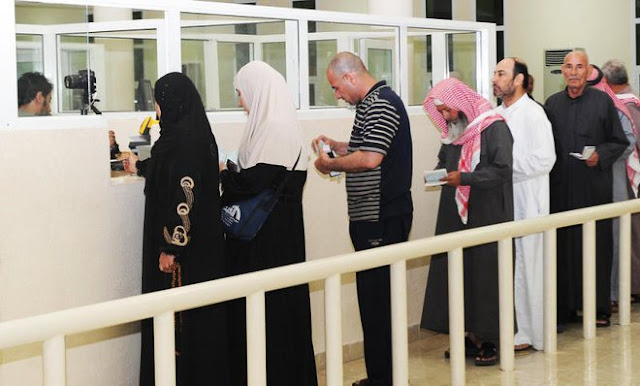
Upon arrival at the terminal, officials from the Ministry of Health will receive pilgrims and give them necessary health guidelines and services, and then they will proceed to the Passport Control to complete immigration procedures.

The Haj terminal is spread over 90,000 square meters of roofed area and 160,000 sq. meters of open area. There are 142 counters for Passports (Jawazat) and 120 counters of the Ministry of Haj.

At Madinah airport, officials of the government and private departments serving pilgrims met to finalize the Haj operation plan. It is expected that the airport will receive a total of 2,678 Haj flights, a five percent increase over last year.

Meanwhile, Prince Khaled Al-Faisal, emir of Makkah and adviser to Custodian of the Two Holy Mosques and chairman of the Central Haj Committee, met Minister of Haj Muhammad Saleh Bantan at his office in Jeddah on Tuesday.

During the meeting, Prince Khaled was briefed on the second phase of the e-track and e-bracelet systems for pilgrims and GPS system for pilgrims’ buses.

Hajj 2016 We have gladly offered Executive Hajj Packages season 2016 for our significant clients and organization customers.Go along with us and locate the new route with our best Hajj administrations.

Source: saudigazette.com.sa

Monday, 25 July 2016

Women and Hajj

Women and Hajj

Women and Hajj

Despite the equality of men and women in the Islamic rulings, there are some rulings specified for women out of mercy towards them because of their different nature.

  • If a woman still in her Iddah (waiting period) when she is divorced and she wants to go for Hajj, she may go but she has to be accompanied by a Mahram . However, if  the waiting period is for the death of the husband, she cannot go to Hajj for staying at home is one of the obligations of the waiting period for the wido
     
  • The companionship of a Mahram is an obligation for women when she is performing Hajj. If she has got no Mahram, she cannot perform Hajj and her Hajj is not valid. Allah’s apostle (peace and blessings of Allah be upon him) said: “A woman should not travel except in the company of a Mahram.” (Bukhari and Muslim)
         
  • Regarding Ihram of the woman it is it like that of the man with exception to clothes: A woman should assume Ihram like and she is permitted to wear whatever clothes she likes as long as they meet the Islamic rulings. A woman cannot  wear Niqaab , Burqa' or gloves. The Prophet (peace and blessings of Allah be upon him) said: “A woman in the state of Ihraam should not wear Niqaab or gloves.” (Bukhaari) .
         
  • Talbiyah for women and hajj: unlike men, women should say Talbiyah in a low voice. and it is impermissible for her to raise her voice when saying Talbiyah in the presence of men.
         
  • Ramal and Idhtibaa': The rulings of Ramal and Idhtibaa' are not applicable to women. She should not perform Ramal, Idhtibaa' or run during Sa‘i between Al-Safa and Al-Marwa.
         
  • Shortening hair: A woman has to cut the length of a fingertip from her hair. Ibn Abbas said, “It is not obligatory upon women to shave their hair (after ending Ihraam), rather, it is obligatory upon them to shorten the hair.” (Abu Daawood )
         
  • If a woman menstruates and does not become pure until she fears missing the company; she should not perform Tawaf until she becomes pure, for the Prophet, (peace and blessings of Allah be upon him) said to Aa’isha when she was menstruating: “Perform each rite that the pilgrim performs with exception to performing Tawaf around the House.” (Bukhaari and Muslim). However, if she perform Tawaf, for example, lest she should miss the company, some scholars including Ibn Taymiyah, endorse the idea that it is permissible for her to perform Tawaf because of necessity.
Source:go-makkah.com

Wednesday, 20 July 2016

A History of the Hajj

A History of the Hajj

A History of the Hajj

Hajj literally means ‘to set out for a place’. Islamicly, however, it refers to the annual pilgrimage that Muslims make to Makkah with the intention of performing certain religious rites in accordance with the method prescribed by the ProphetMuhammad, may the mercy and blessings of God be upon him.

Hajj and its rites were first ordained by God in the time of the Prophet Abraham and he was the one who was entrusted by God to build the Kaaba - the House of God - along with his son Ishmael at Makkah.  God described the Kaaba and its building as follows:
“And remember when We showed Abraham the site of the [Sacred] House [saying]: Associate not anything [in worship with Me and purify My House for those who circumambulate it [i.e. perform Tawaaf] and those who stand up for prayer and those who bow down and make prostration [in prayer etc.].”  (Quran 22:26)
After building the Kaaba, Abraham would come to Makkah to perform Hajj every year, and after his death, this practice was continued by his son.  However, gradually with the passage of time, both the form and the goal of the Hajj rites were changed.  As idolatry spread throughout Arabia, the Kaaba lost its purity and idols were placed inside it.  Its walls became covered with poems and paintings, including one of Jesus and his mother Maryand.  Eventually over 360 idols came to be placed around the Kaaba.

During the Hajj period itself, the atmosphere around the sacred precincts of the Kaaba was like a circus.  Men and women would go round the Kaaba naked, arguing that they should present themselves before God in the same condition they were born.  Their prayer became devoid of all sincere remembrance of God and was instead reduced to a series of hand clapping, whistling and the blowing of horns.  Even the Hajj call was distorted by them with the following additions: “No one is Your partner except one who is permitted by you.  You are his Master and the Master of what he possesses.”

Sacrifices were also made in the name of God.  However, the blood of the sacrificed animals was poured onto the walls of the Kaaba and the flesh was hung from pillars around the Kaaba, in the belief that God demanded the flesh and blood of these animals.
Singing, drinking, adultery and other acts of immorality was rife amongst the pilgrims and the poetry competitions, which were held, were a major part of the whole Hajj event.  In these competitions, poets would praise the bravery and splendor of their own tribesmen and tell exaggerated tales of the cowardice and miserliness of other tribes.  Competitions in generosity were also staged where the chief of each tribe would set up huge cauldrons and feed the pilgrims, only so that they could become well-known for their extreme generosity.
Thus the people had totally abandoned the teachings of their forefather and leader Abraham.  The House that he had made pure for the worship of God alone, had been totally desecrated by the pagans and the rites which he had established were completely distorted by them.  This sad state of affairs continued for nearly two and a half thousand years.  But then after this long period, the time came for the supplication of Abraham to be answered:
“Our Lord!  Send amongst them a Messenger of their own, who shall recite unto them your verses and instruct them in the book and the Wisdom and sanctify them.  Verily you are the All-Mighty, the All-Wise.” (Quran 2:129)
Sure enough, a man by the name of Muhammad ibn ‘Abdullaah was born in the very city that Abraham had made this supplication centuries earlier.  For twenty-three years, the Prophet Muhammad spread the message of monotheism - the same message that Abraham and all the other Prophets came with - and established the law of God upon the land.  He expended every effort into making the word of God supreme and his victory over falsehood culminated in the smashing of the idols inside the Kaaba which once again became the universal centre for the worshippers of the one True God.

Not only did the Prophet rid the Kaaba of all its impurities, but he also reinstated all the rites of Hajj which were established by God’s Permission, in the time of Abraham.  Specific injunctions in the Quran were revealed in order to eliminate all the false rites which had become rampant in the pre-Islamic period.  All indecent and shameful acts were strictly banned in God’s statement:
“There is to be no lewdness nor wrangles during Hajj.” (Quran 2:197)
Competitions among poets in the exaltations of their forefathers and their tribesmen’s’ achievements were all stopped.  Instead, God told them:
“And when you have completed your rites [of Hajj] then remember God as you remember your forefathers; nay with a more vigorous remembrance.” (Quran 2:200)
Competitions in generosity were also prohibited.  Of course, the feeding of the poor pilgrims was still encouraged as this was done in the time of Abraham, but God commanded that the slaughtering of the animals which was done for this purpose should be done seeking the pleasure of God rather than fame and the praise of the people.  He said:
“So mention the name of God over these animals when they are drawn up in lines.  Then, when they are drawn on their sides [after the slaughter], eat thereof and feed the beggar who does not ask, and the beggar who asks.” (Quran 22:36)
As for the deplorable practice of spattering blood of the sacrificed animals on the walls of the Kaaba and hanging their flesh on altars, then God clearly informed them that: 
“It is neither their meat nor their blood that reaches God, but it is Taqwaa (piety) from you that reaches Him.” (Quran 22:37)
The Prophet, may the mercy and blessings of God be upon him, also put a stop to the practice of circling the Kaaba in a state of nudity and the argument that the pagans put forward to justify this ritual was sharply rebutted in God’s question:
“Say: Who has forbidden the adornment [i.e. clothes] given by God which He has produced for His Slaves?” (Quran 7:32)
Another custom which was prohibited through the Quran was that of setting off for Hajj without taking any provisions for the journey.  In the pre-Islamic period, some people who claimed righteousness, having total dependency on God, would travel to perform Hajj begging food the whole journey.  They considered this form of behavior a sign of piety and an indication of how much faith they had in God.  However God told mankind that to have sufficient provisions for the journey was one of the preconditions for making Hajj.  He said
“And take a provision [with you] for the journey, but the best provision is piety.” (Quran 2:197)
In this way, all the pre-Islamic practices, which were based in ignorance, were abolished and Hajj was once more made a model of piety, fear of God, purity, simplicity and austerity.  Now, when the pilgrims reached the Kaaba, they no longer found the carnivals and the frolic and frivolity that had once occupied the minds of the pilgrims there before.  Now, there was the remembrance of God at every step and every action and every sacrifice was devoted to Him alone.  It was this kind of Hajj that was worthy of the reward of paradise, as the Prophet said:
“The reward for an accepted Hajj is nothing less than paradise.” (Saheeh Al-Bukhari)
Source: islamreligion.com

Thursday, 14 July 2016

The Values of Hajj

The Values of Hajj

The Values of Hajj

Hajj is a collection of actions and recitations. These collections inspire the Muslim's soul with spiritual sublime feelings.

Generally speaking, Hajj includes a number of prayers performed by the pilgrim during a definite period. Every action, word, and prayer is a symbol that inspires the soul with a vivid feeling and encompasses a secret and an objective.
 

Ihram, Talbiyah (Tawaf) (circumambulation), Saa’y, Wuquf (staying at Arafat) to name but a few, are a mixture of actions and feelings which are spiritually experienced by the pilgrim. Every action has got a deep meaning and each rite aims at the accommodation of the values of Islam and the demonstration of its purposes in a symbolic and accurate way.

Rites are performed within the hugest gatherings of people. Crowds assemble to worship Allah, the almighty.  Their target is Allah’s satisfaction and forgiveness, submission and surrender to his will.

Once a Muslim decides to perform Hajj, his heart will long to reach his purpose, Allah’s satisfaction and the purification of the self.

Performing Hajj is the sacrifice of money and many physical desires and pleasures for the sake of Allah. It leaves an everlasting mark in the Muslim’s heart to constantly remember the Almighty.

It equally renewed the society. Performing Hajj cannot be undertaken singly. Its rites have to be performed communally. Herein, lies the basic principles of Islam: Brotherhood, Unity, peace and equality.

Pilgrims coming from different nationalities will get to know each other, pray and supplicate together so that the Almighty ease their hardships and forgive them.
Source:go-makkah.com

Friday, 1 July 2016

Pilgrimage Hadeeths

Pilgrimage Hadeeths

Pilgrimage Hadeeths

Narrated 'Abdullah bin Abbas : Al-Fadl (his brother) was riding behind Allah's Apostle and a woman from the tribe of Khath'am came and Al-Fadl started looking at her and she started looking at him. The Prophet turned Al-Fadl's face to the other side. The woman said, "O Allah's Apostle! The obligation of Hajj enjoined by Allah on His devotees has become due on my father and he is old and weak, and he cannot sit firm on the Mount; may I perform Hajj on his behalf?" The Prophet replied, "Yes, you may." That happened during the Hajj-al-Wida (of the Prophet ).

  • Narrated 'Abdullah bin Abbas : Al-Fadl (his brother) was riding behind Allah's Apostle and a woman from the tribe of Khath'am came and Al-Fadl started looking at her and she started looking at him. The Prophet turned Al-Fadl's face to the other side. The woman said, "O Allah's Apostle! The obligation of Hajj enjoined by Allah on His devotees has become due on my father and he is old and weak, and he cannot sit firm on the Mount; may I perform Hajj on his behalf?" The Prophet replied, "Yes, you may." That happened during the Hajj-al-Wida (of the Prophet ). 
  • Narrated Ibn 'Umar: I saw that Allah's Apostle used to ride on his Mount at Dhul Hulaifa and used to start saying, "Labbaik" when the Mount stood upright.
  • Narrated Jabir bin 'Abdullah : that Allah's Apostle started saying, "Labbaik" from Dhul-Hulaifa when his Mount stood upright carrying him
  • Narrated Thumama bin 'Abdullah bin Anas: Anas performed the Hajj on a pack-saddle and he was not a miser. Anas said, "Allah's Apostle performed Hajj on a pack-saddle and the same Mount was carrying his baggage too." 
  • Narrated Al-Qasim bin Muhammad: 'Aisha said, "O Allah's Apostle! You performed 'Umra but I did not." He said, "O 'Abdur-Rahman! Go along with your sister and let her perform 'Umra from Tan'im." 'Abdur-Rahman made her ride over the pack-saddle of a she-camel and she performed 'Umrah.
  • Narrated Abu Huraira: The Prophet was asked, "Which is the best deed?" He said, "To believe in Allah and His Apostle." He was then asked, "Which is the next (in goodness)?" He said, "To participate in Jihad in Allah's Cause." He was then asked, "Which is the next?" He said, "To perform Hajj-Mabrur. "
  • Narrated 'Aisha: (the mother of the faithful believers) I said, "O Allah's Apostle! We consider Jihad as the best deed." The Prophet said, "The best Jihad (for women) is Hajj Mabrur. "
  • Narrated Abu Huraira: The Prophet (p.b.u.h) said, "Whoever performs Hajj for Allah's pleasure and does not have sexual relations with his wife, and does not do evil or sins then he will return (after Hajj free from all sins) as if he were born anew."
  • Narrated Zaid bin Jubair: I went to visit 'Abdullah bin 'Umar at his house which contained many tents made of cotton cloth and these were encircled with Suradik (part of the tent). I asked him from where, should one assume Ihram for Umra. He said, "Allah's Apostle had fixed as Miqat (singular of Mawaqit) Qarn for the people of Najd, Dhul-Hulaifa for the people of Medina, and Al-Juhfa for the people of Sham." 
  • Narrated Ibn Abbas: The people of Yemen used to come for Hajj and used not to bring enough provisions with them and used to say that they depend on Allah. On their arrival in Medina they used to beg the people, and so Allah revealed, "And take a provision (with you) for the journey, but the best provision is the fear of Allah." (2.197). 
Source: go-makkah.com

Friday, 24 June 2016

The month of forgiveness

The month of forgiveness

The month of forgiveness

 {And race toward forgiveness from your Lord…}
(Chapter 57, verse 21)

Allah has blessed us by extending our lives to witness another month of Ramadan. It is said that our righteous predecessors would spend six months of the year asking Allah to allow them to live until the next Ramadan. Then, they would spend the next five months hoping that Allah would accept their fasting, prayers, and supplications.

Why would they exert such great efforts?

Allah says in the following verse in the Holy Qur’an, {Say: O my servants who have transgressed against themselves (by sinning) despair not of the mercy of Allah, indeed Allah forgives all sins. It is He who is the Forgiving the Merciful.} (Chapter 39, verse 53)

Ramadan is a month of forgiveness. Allah forgives his slaves and saves them from the Hellfire. He admits them to His mercy and Paradise, and forgives their sins.

Abu Umaamah reported that the Prophet (peace be upon him) said, “At every breaking of the fast, Allah has people whom He redeems from Hell.” (Ahmad, Sahih by Al-Albani)

Ramadan is more than just experiencing the worship of fasting and the communal ‘brotherhood’ bond. Ramadan is a golden opportunity to get our sins forgiven. It offers salvation and access to paradise. Our destination in the Hereafter is at stake during this month. It is quite simple to attain Allah’s mercy, to attain His forgiveness, and to attain His Paradise.

It is no surprise therefore, that when the angel Jibril supplicated, “Whoever lives to witness Ramadan and does not have his sins forgiven, may Allah separate him from His mercy”, that the Prophet (peace be upon him) said, “Ameen.”

Imagine; the best of the angels and the best of humans have made this supplication. Is it not accepted by Allah?

Allah is the All Merciful; He wants to forgive us. However, we must make the effort. We have to know that Allah’s mercy is beyond our imagination. His mercy is far greater than our hopes, so much so, that on the Day of Resurrection even the devil will hope to enter Paradise by the mercy of Allah.

We cannot even begin to conceive the extent of Allah’s mercy and forgiveness. When a prominent person gives gifts, he gives them according to his rank and status, meaning the gifts will be expensive, special, and exclusive).

Now imagine when Allah gifts us with His mercy and forgiveness, He is the King of all kings, should not his gifts be worth much more to us? And for Allah is the best of examples. He (Glory be to Him) knows all our faults, mistakes, shortcomings and sins, yet

He still showers us with the opportunity of forgiveness.

We have to understand that Ramadan is filled with prospects of forgiveness and mercy from Allah. We have to make use of it, before it passes by. We may not live to see the next Ramadan. How many people were here last Ramadan who are not here to experience this one? How many of us know someone who has lost a loved one in the past year?

Procrastination is a tool of deception deployed by Shaytan. We have to act today, and benefit from Ramadan.

Various aspects of Ramadan carry the blessing of having our sins forgiven. Allah gives us ample opportunities and He makes it easy for us in this month by removing the distractions of Shaytan.

Abu-Hurairah narrated that the Prophet (peace be upon him) said, “Whoever fasts the month of Ramadan with sincere faith and hope and anticipation that Allah will forgive his sins, all his previous sins will be forgiven.” (Sahih Al-Bukhari)

We must be sure to have a sincere and proper intention, to fast solely for the pleasure of Allah.

Similarly, in another Hadith, the Prophet (peace be upon him) said, “Whoever stands for qiyam in Ramadan, with sincere faith and hope and anticipation that Allah will forgive his sins, all his previous sins will be forgiven.”

Allah is the Most Forgiving; His forgiveness is a corner-stone of Ramadan.
Moreover, in Ramadan Allah has given us the Night of Power (Laylatul Qadr), an even greater chance to get our sins forgiven. As the Prophet (peace be upon him) is reported to have said, “Whoever stands Laylatul Qadr with sincere faith and hope and anticipation that Allah will forgive his sins, all his previous sins will be forgiven.”

When Aisha asked the Prophet (peace be upon him), about what to say on the night of Laylatul Qadr, he instructed her to ask,
“Allahumma innak ‘afuwun tuhibbul ‘afwa fa’fu ‘anni,” (O Allah! You are the Forgiving, and You love to forgive, so forgive me.)”

Allah will respond to our supplications.

Allah blesses us with so many chances to ensure that we make the most of it, to ensure that our sins are forgiven. He has created Paradise for us, and He wants to give it to us. Each day of fasting is an opportunity to obtain Allah’s gift of forgiveness, every night we stand in prayer. Every moment of Ramadan is a chance for forgiveness.  

We have to ask ourselves, do I want to get the gift of having my sins forgiven this Ramadan, or will I be one of those who are separated from the Mercy of Allah?

May Allah accept our fasting, and our night prayers.
Source: saudigazette.com.sa

Tuesday, 7 June 2016

A beginner's guide to Ramadan

A beginner's guide to Ramadan
source: arabnews

A beginner's guide to Ramadan

Millions of Muslims around the world on Monday marked the start of Ramadan, a month of intense prayer, dawn-to-dusk fasting and nightly feasts. Others will begin fasting a day later, Tuesday, due to a moon-sighting methodology that can lead to different countries declaring the start of Ramadan a day or two apart.
Here are some questions and answers about Islam's holiest month:


WHY DO MUSLIMS FAST?


The fast is intended to bring the faithful closer to God and to remind them of the suffering of those less fortunate. Ramadan is a time to detach from worldly pleasures and focus on one's inner self.
 It's seen as a way to physically and spiritually purify, refraining from habits such as smoking and caffeine. Muslims often donate to charities during the month and feed the hungry. Many spend more time at mosques during Ramadan and use their downtime to recite the Quran.
 London's new Muslim mayor, Sadiq Khan, wrote in the Guardian that he plans to use Ramadan to "build bridges" and break bread with Muslims and non-Muslims around the city at synagogues, churches and mosques, though he acknowledged that 19-hour-long fasts during the longer summer days in Europe and forgoing coffee will be challenging.
Fasting during Ramadan is one of the five pillars of Islam, along with the Muslim declaration of faith, daily prayer, charity, and performing Haj.


HOW DO MUSLIMS FAST?


Muslims abstain from eating and drinking from dawn to dusk for the entire month of Ramadan. A single sip of water or a puff of a cigarette is enough to invalidate the fast.
However, Muslim scholars say it's not enough to just avoid food and drinks during the day. Ramadan is also an exercise in self-restraint. Muslims are encouraged to avoid gossip and arguments. Sexual intercourse between spouses is also forbidden during the daytime fast.
Just before the fast, Muslims have a pre-dawn meal of power foods to get them through the day, the "suhoor." Egyptians eat mashed fava beans called "ful," spiced with cumin and olive oil, while in Lebanon and Syria, popular suhoor food is flatbread with thyme, cheese or yogurt. In Afghanistan, people eat dates and dumplings stuffed with potato and leeks, first steamed, then fried.


HOW DO MUSLIMS BREAK THEIR FAST?


Muslims traditionally break their fast like Prophet Muhammad (peace be upon him) did some 1,400 years ago, with a sip of water and some dates at sunset. That first sip of water is the most anticipated moment of the day.
After sunset prayers, a large feast known as "iftar" is shared with family and friends. Iftar is a social event as much as it is a gastronomical adventure. Across the Arab world, apricot juices are an iftar staple. In South Asia and Turkey, yogurt-based drinks are popular. 
Every night of Ramadan, mosques and aid organizations set up tents and tables for the public to have free iftar meals.


CAN MUSLIMS BE EXEMPTED FROM FASTING?


Yes. There are exceptions for children, the elderly, those who are ill, women who are pregnant, nursing or menstruating, and people traveling, which can include athletes during tournaments.
 Many Muslims, particularly those living in the United States and Europe, are accepting and welcoming of others around them who aren't observing Ramadan. 
However, non-Muslims or adult Muslims who eat in public during the day can be fined or even jailed in some Mideast countries.

In many predominantly Muslim countries like Indonesia, karaoke bars and nightclubs are closed across much of the country for the month. Restaurants there use curtains to conceal customers who eat during the day.
 And in Egypt, the Dar Al-Ifta, which is the main authority in charge of issuing religious edits, on Monday warned against eating in public, saying this is not an act of "personal freedom, but chaos — an assault on Islam."
 In China, minority Uighur Muslims complain of heavy restrictions by the Communist Party, such as bans on fasting by party members, civil servants, teachers and students during Ramadan, as well as generally enforced bans on children attending mosques, women wearing veils and young men growing beards.


WHAT ARE SOME RAMADAN TRADITIONS?


Typically, the start of the month is welcomed with the greeting of "Ramadan kareem!" Another hallmark of Ramadan is nightly prayer at the mosque among Muslims called "taraweeh. "
Egyptians have the tradition of Ramadan lanterns called the "fanoos," often the centerpiece at an iftar table or seen hanging in window shops and from balconies. In the Arabian Gulf countries, wealthy families hold "majlis" where they open their doors for people to pass by all hours of the night for food, tea, coffee and conversation.
 Increasingly common are Ramadan tents in five-star hotels that offer lavish and pricey meals from sunset to sunrise. While Ramadan is a boon for retailers in the Middle East and South Asia, critics say the holy month is increasingly becoming commercialized. Scholars have also been disturbed by the proliferation of evening television shows during Ramadan. In Pakistan, live game shows give away gifts promoting their sponsors. In the Arab world, month-long soap operas starring Egypt's top actors, rake in millions of dollars in advertising.


HOW DO MUSLIMS MARK THE END OF RAMADAN?


The end of Ramadan is marked by intense worship as Muslims seek to have their prayers answered during "Laylat al-Qadr" or "the Night of Destiny." It is on this night, which falls during the last 10 nights of Ramadan, that Muslims believe that God sent the Angel Gabriel to the Prophet Muhammad and revealed the first versus of the Quran. 
The end of Ramadan is celebrated by a three-day holiday called Eid Al-Fitr. Children often receive new clothes, gifts and cash.
 Muslims attend early morning Eid prayers the day after Ramadan. Families usually spend the day at parks and eating — now during the day.
Source: arabnews.com

Tuesday, 31 May 2016

Civil Defense emergency plan for Ramadan ready

Civil Defense emergency plan for Ramadan ready

Civil Defense emergency plan for Ramadan ready


MAKKAH — Crown Prince Muhammad Bin Naif, deputy premier and minister of interior, has approved a contingency plan prepared by Civil Defense to deal with any emergency in Makkah and Madinah during Ramadan, said a top official.

Lt. Gen. Sulaiman Bin Abdullah Al-Amr, director general of the Civil Defense, said preventive measures will also be taken to ward off any threats to the safety of pilgrims, visitors and others in the holy cities.
“The Crown Prince has made it clear that the safety of pilgrims in Makkah and Madinah is paramount.

“The Crown Prince ordered the Civil Defense to take all precautions necessary to ensure the safety of pilgrims. Pilgrims come from all over the world to perform a religious duty, therefore they should feel safe and secure and focus on their spirituality,” said Al-Amr.

He also said the Civil Defense submitted a comprehensive plan and he is grateful for the Crown Prince’s support and encouragement.

“With Umrah and Haj seasons, the Two Holy Mosques become extremely crowded. It is the duty and responsibility of the Civil Defense to ensure the safety and security of pilgrims and to ensure that the directorate takes all necessary precautions to aid and protect pilgrims,” said Al-Amr.

He added the plan involves 19 other directorates and authorities.

“The Civil Defense emergency plan is a comprehensive one involving 19 authorities and directorates.

“Each of the 19 directorates has a representative in the Civil Defense control room. The Civil Defense will be ready for emergency rescue operations, medical aid, evacuation, sheltering and others,” said Al-Amr.
“The plan has three phases. The first phase is prevention. In this phase, the Civil Defense takes all precautions necessary to anticipate any potential danger or threat on pilgrims and prevent it. The first phase took started at the beginning of this month. The Civil Defense ran more than 1,210 inspection campaigns under a preventive scanning plan,” said AL-Amr.
He added the campaigns recorded 197 violations.

“The second phase focuses on field preparation. The Civil Defense has officers spread out in critical areas and they are equipped with the tools necessary to deal with any emergency through various strategies such as evacuation,” said Al-Amr.

He added the third phase focuses on raising awareness among pilgrims of the importance of safety measures.

“The Civil Defense offers a number of educational workshops and lectures on safety in the Two Holy Mosques. The Civil Defense is also active through social media to ensure its message reaches a wide layer of people,” said Al-Amr.
Source: saudigazette.com.sa

Tuesday, 24 May 2016

Cover face in ehram

Cover face in ehram

Cover face in ehram

As Salaam Aleikum wa Rahmatullahi wa Barakatuh. (May Allah's Peace, Mercy and Blessings be upon all of you)

One of our brothers/sisters has asked this question:

In The Name Of Allah (SWT) the Lord of all that Exist!

Asalam-u-ALikum-wa-rehmatullahi-wa-barakatahu!

Jazak Allah Khair Brother for all your answers.

Q1:In the state of Ah'raam can we cover our face (niqab)...as i have heared that the cloth should not touch the nose.Can u help with the refrence.Jazak Allah!

Q2:Someone told me that on The Day of Judgement everyone will be called after their mothers name.LIke here in this world we are recognized by our father name.is this True??

May Allah accept from u all & Give us Knowledge that benefits us in this world as well as in the HereAfter.Ameen!

 (There may be some grammatical and spelling errors in the above statement. The forum does not change anything from questions, comments and statements received from our readers for circulation in confidentiality.)

Answer:

Cover face in ehram

In the name of Allah, We praise Him, seek His help and ask for His forgiveness. Whoever Allah guides none can misguide, and whoever He allows to fall astray, none can guide them aright. We bear witness that there is none worthy of worship but Allah Alone, and we bear witness that Muhammad (saws) is His slave-servant and the seal of His Messengers.

Q-1:In the state of Ah'raam can we cover our face (niqab)...as i have heared that the cloth should not touch the nose.Can u help with the refrence.Jazak Allah!

The Messenger of Allah (saws) said: "A pilgrim woman must neither cover her face nor wear gloves."

Related by Ahmad and Bukhari.

It is not permissible for a pilgrim woman to cover her face or her hands upto her wrists while she is in the state of ehraam for pilgrimage.

If Allah Subhanah has blessed one amongst the believing women to adorn the naqaab which covers her face, she would be required to remove her face cover and leave her hands upto her wrists uncovered as soon as she enters into the state of ehram from the Meeqat until she completes her pilgrimage and comes out of the state of ehram.

Q-2: Someone told me that on The Day of Judgement everyone will be called after their mothers name.LIke here in this world we are recognized by our father name.is this True??

Allah says in the Holy Quran Chapter 33 Surah Ahzaab verse 5:

Call them by (the names) of their fathers: that is juster in the sight of Allah, but if ye know not their father's (names call them) your Brothers in faith or your friends. But there is no blame on you if ye make a mistake therein: (what counts is) the intention of your hearts: and Allah is Oft-Returning Most Merciful.

Allah Subhanah has guided the believers to call the believers by their fathers name in the life of this world; and there is absolutely no reason to assume that when we are given life again in the life of the Hereafter, we will be called by our mothers name!

There is absolutely nothing mentioned in the Glorious Quran or the authentic and established Sunnah regarding the misconception that one will be called by their mothers name on the Day of Judgment, unless of course, one happens to be Prophet Isa son of Hadrat Maryam (a.s.)!

Whatever written of Truth and benefit is only due to Allahs Assistance and Guidance, and whatever of error is of me alone. Allah Alone Knows Best and He is the Only Source of Strength.
Article by: islamhelpline.net

Wednesday, 18 May 2016

Pilgrims told not to overstay visas

Pilgrims told not to overstay visasSource: arabnews

Pilgrims told not to overstay visas

JEDDAH: The Passport Department has warned that pilgrims and visitors overstaying their visas could face fines up to SR50,000, six months in jail and deportation.

Any expatriate or citizen who transports, accommodates, harbors and employs a violator faces a fine of up to SR100,000 and six months in jail. Expatriates would be deported. Penalties would be multiplied for repeat offenses.

There would be a SR100,000 fine for a Haj and Umrah company that fails to report a violation, with a one-year jail sentence for the director of the firm, and a ban on hiring workers for five years.

The department said that pilgrims must make sure they leave the country because they have been provided an opportunity by Allah to perform Umrah.
Article by: arabnews.com