Showing posts with label Umrah Glasgow. Show all posts

Monday, 31 October 2016

The considerable advantage of Umrah and hajj

The considerable advantage of Umrah and hajj


O Muslims: Allah has made the respected Ka^bah a goal for a huge number of Muslims who come each year from by a wide margin to visit this holy place. They all meet there in spite of their different foundations, nationalities, dialects and skin shading. Hajj is a yearly Islamic social affair went to by a huge number of Muslims who come joined under the flag of the certification of confidence "Nobody is God aside from Allah and Muhammad is the Messenger of Allah". They supplicate to Allah, present themselves and frame close bonds fortifying their fraternity and sisterhood with one another.Whether you are rich or poor, youthful or old and Arab or not has no bearing as far as devotion, rather, what does is one's level of acquiescence to Allah.

Dear siblings in Islam,

Satisfying the deeds of Hajj conveys numerous awesome advantages to the travelers and if just Muslims understand the centrality of these advantages they would positively race to perform Hajj.

The immense implications of fraternity and value among Muslims show up in its best picture, amid journey. In the wake of having evacuated all their adorned and common garments the travelers put on the garments of Ihram which resemble the covers of the dead. They submit themselves to their maker, Allah and say:

لبيك اللهم لبيك لا شريك لك لبيك إن الحمد والنعمة لك والملك لا شريك لك

Gracious Brothers in Islam, Hajj is a practice of tolerance in conquering hardships.

The call of the pioneer (talbeyah) serves as an indication of a period when Angel Israfil on the Day of Judgment blows the horn denoting the begin of Resurrection Day.

Performing sa^i between Mount As-Safa and Mount Al-Marwah is expressive of one's appreciation to Allah for making the city of Makkah a sheltered place. It is likewise reminiscent of what Lady Hajar did when hunting down water for her dear child Isma^il ^alayhis-Salam, while having a total dependence on Allah, Her Creator. Allah subhanahu wa-ta^ala assuaged her from her stresses and battle in furnishing her with the unadulterated and favored water, Zamzam.

There are extraordinary implications in being available in the place where there is ^Arafat. The traveler witnesses the mass measure of individuals congestion the pile of ^Arafat and hears their noisy supplicating voices to Allah subhanahu wa-ta^ala, with outright humbleness seeking after Allah's kindness.

Tossing the three Jamarat is one of the essentials of Hajj and is from one perspective typical of the Muslim's dismissal to Satan and then again a satisfaction of God's requests. Tossing the Jamarat as Prophet Ibrahim did when Satan appeared to him communicates the Muslim's dismissal of Satan's whisperings as though one is stating to Satan: on the off chance that you appear to us we will toss rocks at you to embarrass you a similar way Prophet Ibrahim did.

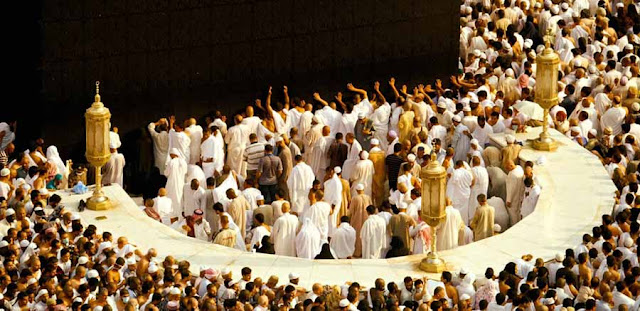
The significance of Tawaf is to extol the hallowed Ka^bah. It symbolizes the solidarity among Muslims, and their relentlessness in obeying Allah, the one and only deserving of love. Individuals circumambulate the sacrosanct House, the Holy Ka^bah, with extreme accommodation to Allah as though saying:

"O Lord, No matter how often we circumambulate and turn, we have no place to go however to look for shelter with You."

Circumambulating the Ka^bah does not imply that Allah abides in it. The conviction of all Muslims is that Allah needn't bother with the ka^bah, different spots, or any of his manifestations. Allah exists without a place, and doesn't take after any of His manifestations. Allah is not a body or a shape. Whatever one envisions in one's mind Allah is unique in relation to it.

Dear siblings in Islam the genuine achievement is in grasping the right conviction, the statement of faith of the Prophet peace be upon him and his buddies.

May Allah give us the capacity to play out the journey and ^umrah and the respect of going to Prophet Muhammad's grave. Ameen.

Want To Perform Umrah with Britishhajtravel.com Then Here Are some Important Umrah packages for you:

Golden Umrah Package     Deluxe Umrah Package      Economic Umrah Package

Super Deluxe Umrah Package     Umrah Package      Ramadan Umrah Package

Thursday, 13 October 2016

Restrictions for a person in the state of Ihraam

Restrictions for a person in the state of Ihraam

Restrictions for a person in the state of Ihraam


Restrictions for a person in the state of Ihraam is a person who made intention and entered into one of the two sacred rituals, Hajj or 'Umrah, accompanied by the removal of normal clothing and putting on special clothing and then reciting the Talbiyah.
There are certain restrictions that apply to the one who assumes this state.

The following are the acts that are not permitted:

Sexual intercourse and all matters leading to it:
Sexual intercourse and all matters leading to it such as kissing, touching and similar things nullify the Hajj or 'Umrah completely and the one who does so must sacrifice a camel. If he cannot find one, he must fast ten days, and along with that, he must make up (for the Hajj) another year. However, it is still mandatory to continue with it (i.e. the remaining acts of Hajj or 'Umrah) until it is complete.

Ali, 'Umar and Abu Hurayrah, may Allah be pleased with them, issued a verdict concerning a man who had sexual intercourse with his wife in the state of Ihraam. In this verdict, they said: "They both continue to perform (the remaining Hajj rites) for their own face (i.e. to save them embarrassment) until they complete their Hajj. Then they must perform Hajj (again) in the future and they must sacrifice an animal"

As for the things that lead to sexual intercourse, the one who does them must sacrifice an animal, meaning to slaughter a sheep.

Disputing, arguing or fighting with people:
Allah Says (what means): {…Whosoever intends to perform Hajj (therein by assuming Ihraam), then he should not have sexual relations (with his wife), nor commit sin, nor dispute unjustly during the Hajj…} [Quran 2:197]

On the authority of Abu Hurayrah, may Allah be pleased with him, the Prophet sallallaahu `alayhi wa sallam ( may Allaah exalt his mention ) said: "He who performs Hajj, committing no obscenity, nor wickedness, nor wrangling, will return home free of sins as the day his mother bore him." [Al-Bukhari and Muslim]

In this case, as well as the rest of the sins, like backbiting, gossiping and everything that enters under the wording "Al-Fusooq" (wickedness or sin), the person must repent and seek Allah’s forgiveness. This is because there’s nothing reported in Islam that has made any expiation for them other than repentance and seeking Allah’s forgiveness.

Wearing any form-fitting garment:
Such as a shirt, hooded robes, cloak, underpants or wrapping anything around the head, a cap or a fez, etc.
The one who does it must make a compensation, which is fasting three days, or feeding six poor people with a Mudd (750 grams) of fine wheat each, or slaughtering a sheep. This is due to Allah’s saying (which means): {So whoever among you is ill or he has an ailment on his head (i.e. his hair), then he must make a cimoensation of fasting or giving charity or sacrificing (an animal).} [Quran; 2:196]

Ibn 'Umar, may Allah be pleased with him, reported that the Prophet sallallaahu `alayhi wa sallam ( may Allaah exalt his mention ) said: "A person in the state of Ihraam is not allowed to wear a form-fitting shirt, a turban, a hooded robe, underpants, […] shoes or sewn slippers, unless one is unable to find regular unsewn slippers, then one may wear his shoes provided one cuts them down to the ankles."  [Al-Bukhari and Muslim] These restrictions apply to men only.
As for a woman, she may wear all of the above. But she is forbidden to use perfumed clothes, a veil that covers the face (tied around it), or gloves.

Ibn 'Umar, may Allah be pleased with him, reported: "Allah's Messenger sallallaahu `alayhi wa sallam ( may Allaah exalt his mention ) forbade women pilgrims from wearing gloves, Niqaab (veils tied on the face) […]. Besides these, they may wear anything else, any color, silk clothes, ornaments, trousers, or a shirt or shoes." [Abu Daawood, Al-Bayhaqi and Al-Haakim]

The Prophet sallallaahu `alayhi wa sallam ( may Allaah exalt his mention ) said: "A pilgrim woman must neither cover her face nor wear gloves." [Al-Bukhari and Ahmad] This proves that a woman in the state of Ihraam should not cover her face and hands. The scholars, however, say that there is no harm if she covers her face with something other than a Niqaab. She may also use an umbrella or similar item as a screen between men and herself. But if she is afraid of tempting others she must cover her face by drawing a veil down from her head.

'Aa’ishah, may Allah be pleased with her, said: "Men on camels used to pass by us while we were with the Prophet sallallaahu `alayhi wa sallam ( may Allaah exalt his mention ) and in the state of Ihraam. We would cover our faces by drawing veils down from our heads when they passed by us, and then uncover them again." [Abu Daawood and Ibn Maajah]

Contracting a marriage, or acting on behalf of others, or acting as a guardian for someone:
Such a marriage contract is invalid, null and void, and is not binding. The Prophet sallallaahu `alayhi wa sallam ( may Allaah exalt his mention ) said: "A person in the state of Ihraam must not contract marriage, nor help others contract marriage, nor get engaged for marriage." [Muslim]

In this case, the person must repent and seek Allah’s forgiveness. There’s nothing reported in Islam that has made any expiation other than repentance and seeking Allah’s forgiveness.

5 Star Hajj Packages & 5 star Umrah Packages: For over a period of 15 years, British Hajj Travel is consistently offering top quality Hajj and Umrah tour packages.

Golden Umrah Package     Deluxe Umrah Package      Economic Umrah Package

Super Deluxe Umrah Package     Umrah Package      Ramadan Umrah Package

Source: islamweb.net

Thursday, 6 October 2016

Allah; The Light of Heavens and Earth

Allah; The Light of Heavens and Earth
 source: saudigazette.com.sa

Allah; The Light of Heavens and Earth

The word “light” carries a popular meaning; that which lightens dark bodies so that we can see them. So by light, things become apparent and visible. This is the first meaning to which the word light was initially identified. Light itself is basically obvious and visible; there is nothing else that lightens it.

The word “light” has been used over 30 times in the Qur’an. In some verses it means faith, in others it means Islam or Qur’an or justice or Prophet Muhammad (peace be upon him).

It also implies more meanings, such as in the verse, {Allah is the Light of the Heavens and Earth. The example of His light is like a nice within which is a lamp; the lamp is within glass, the glass as if it were a pearly [white] star lit from [the oil of] a blessed olive tree, neither of the east nor of the west, whose oil would almot glow even if untouched by fire. Light upon light. Allah guides to His light whom He wills. And Allah presents example for the people, and Allah is Knowing of all things.} [Chapter 24, verse 35]

According to the scholars, the meaning of the verse is that Allah has lit the Heavens and the Earth. So all the light, which is in the Heavens and the Earth and on the Day of Judgment is from the Light of Allah.

Light is of two kinds: the created light and the uncreated light. The created light is found in the world, like the light of the sun, moon and stars, the light from electricity and fire. Likewise, the light in the Hereafter and in Paradise, these are all created and they are a creation of Allah.
The uncreated light is an Attribute of Allah. Allah is far exalted and praised with all His Attributes and He is the Creator unlike His creation. So, the Light of Allah is uncreated, rather it is one of His Lofty Attributes. This is the Magnificent Nur (light) with which He has described Himself in the verse in the Qur’an and it is not created. It is an Attribute of Allah like His Hearing, Sight, Hand and other Lofty Attributes.
This verse falls under the category of allegory, to explain the parable to reach the intellective sense of people.

Ibn Kathir has also explained this parable based on the narrations and descriptions of earlier generation of scholars.

{Allah is the light of the heavens and the earth} means that He is a Guide to the inhabitants of the Heavens and the Earth (Ibn Abbas)

The light in the verse is ‘light that illuminates the Heavens and the Earth’ (Ismaeel Ibn Abdur-Rahmaan Ibn Abu Kareemah, also known as As-Suddi)

“There is no night or day with your Lord; the Light of the Throne comes from the Light of His Face.” (As narrated by Ibn Masud)

The “lamp” in the verse refers to the light that in turn refers to the Qur’an and the faith that is in a believer’s heart. (Ubayy bin Kaab).

{Light upon Light} refers to the faith and the deeds that are based on that faith. (Ibn Abbas)

{Light upon Light} refers to the light of the Qur’an combined with the light of the faith. (Ismaeel Ibn Abdur-Rahmaan Ibn Abu Kareemah, also known as As-Suddi)

Ubayy ibn Ka`b said that the similitude of His light [takes place in] the Muslim’s heart. [Ibn Kathir, 3:464] This light, which Allah has placed in the hearts of the believers, comes from the awareness, love, faith, and the remembrance of Allah. It is the light that He has sent down to people. Its origin is in their hearts, but then Allah strengthens and increases that light until it appears upon their faces. Have you ever met a person whose face was just illuminating with the radiance and light that comes from faith in Allah? People of this nature perceive the light of Allah.

On the Day of Judgment, the light will come forth by their faith, and hasten before them in the darkness of the bridge or sirat, so that they might cross it. They will proceed in proportion to either its strength or its weakness in their hearts during their life in the world.

Allah is the only provider of the light in the universe, whether it is physical light or the light of guidance. Everything in this universe is dependent on the guidance given by Allah for its operation and for maintaining its balance and symmetry necessary for its optimal performance. Then the verse describes the quality of the light of guidance provided by Allah, it is the most superb kind of soft light that shines through, without blinding with brightness or being hazy with dimness. The lives of those who follow His guidance by believing in Him and remaining conscious of His presence are so well illuminated that they clearly see the path to ultimate success without being distracted or confused by the alleys and detours that may lead them astray.

That Sublime Existence who encompasses all the stations of perfection at once; His sacred Light embraces the entirety of existence and illuminates the Heavens and the Earth. He is the all-Knowing Creator whose eternal radiance infuses life in the creation and bestows assistance to them. He controls, nurtures, and completes them through His power. The Light of His existence shines forth and is clearly manifest across the expanse of existence.
Source: saudigazette.com.sa

Tuesday, 20 September 2016

A successful Haj

A successful Hajsource: whatisislamabout.com

A successful Haj

THE 2016 Haj season recently concluded with the pilgrims and officials alike terming it a safe, convenient and successful Haj— all the ingredients that go into the recipe called success. All pilgrims performed their fifth pillar rituals in peace and security. It was by far a very smooth Haj that concluded with no accidents. The sight of 1.8 million pilgrims traveling in unison to the holy sites at specified times, gathering and praying to Allah, was breathtaking. We all wish these pilgrims a safe journey back home and we are looking forward to host millions of pilgrims to perform their rituals in peace next year.

What was amazing about this year’s Haj, which is a seamless continuation of last year’s edition, the year before and previous ones, is the participation of our youth to serve the guests of Allah. We have seen them in all ages, men and women, not hesitating to provide any and every help the pilgrims may need. The concept of volunteering to serve pilgrims at holy sites only shows that our youth’s sense of responsibility is growing. The hard work they displayed at the holy sites is only an indication that a bright future is awaiting this country when this generation comes of age and joins the workforce by bringing this quality of hard work to their careers. I have seen and been told by many who performed Haj this year that our scouts played an important and vital role in providing guidance to lost pilgrims, helping families to find their missing children and loved ones and transporting injured and older pilgrims on wheelchair.

Our security officers — the eyes that never sleep — should be thanked for their efforts to ensure a safe and smooth Haj. In every corner, they were there watching, round the clock, and organizing the pilgrims’ movements in sync with the established plans for various sites. Despite bound by their duty, they went beyond the call of duty to assist those in need. They even carried pilgrims on their backs if they were not able to walk. We have seen hundreds of pictures and many video clips of officers providing assistance to those in need without them knowing that they were being filmed or photographed. They seek no reward but the reward from Allah to serve His guests with honor.

We have seen tired police officers and security forces beat their exhaustion with a quick shuteye and are back on their feet for yet another round of selfless service. They rest or sleep under bridges on the hard concrete in hot weather for a brief period and come back rejuvenated before joining the line of their fellow officers to organize, guide and protect pilgrims. The scene on the last day of Haj as pilgrims were exiting Mina with the officers standing on the side of the road waving goodbye to pilgrims was a heart-rending one, especially with the pilgrims greeting the officers back and some shaking their hands. In addition many were praying to Allah that they would come back one day to perform the pilgrimage again, while officers wished them a safe journey back home.

The Health Ministry played an integral role in this year’s Haj by providing treatment for sick and infirm pilgrims and even transporting and accompanying sick pilgrims all the way across the holy sites with a complete medical team, until they completed their pilgrimage. I watched the other day a special coverage on the efforts by the Health Ministry through the Snapchat account of Fares Al-Turki, Saudi entrepreneur, who revealed the whole gamut of the ministry’s efforts in keeping the pilgrims healthy and safe. He said that heart catheterization and open-heart surgeries are taking place alongside the prompt treatment for light and sunstroke cases.
While Al-Turki was filming, a doctor said that they had performed 27 open-heart surgeries on pilgrims and 300 heart catheterization operations.
Pilgrims who come form poor countries take advantage of the free medical services provided to pilgrims to get these operations done at no cost. It is said that some of the machines installed in the heart of pilgrims cost more than SR100,000 and it is provided free to pilgrims. The government, represented by the Health Ministry here, does not ask for their nationalities or where they come from, but provide all help to keep the pilgrims safe and healthy.

We thank all the other related authorities that participated in contributing to the success of this year’s Haj, all in their posts, working diligently and selflessly. I cannot highlight the services of every individual or authority as the space for this article is limited to mention all their efforts. But we acknowledge their efforts that energized the journey of a lifetime for a pilgrim. At the same time, we feel sorry for the Iranian pilgrims, who were deprived by their own government from performing Haj this year. We wish that Iran would come to its senses, if they have any, and finally understand that Haj is not a political occasion to push their ideology, but a spiritual journey of devotees and many stages of servitude in their worship of Allah.

The authorities are to be thanked that the squatting problem, which was a major one in the past, has dropped dramatically this year following a clampdown on illegal pilgrims. The numbers are also down sharply due to the awareness campaign on squatting as a problem and the tough punishment imposed on violating people.
Our aim to serve the guests of Allah will continue forever and whatever suggestions for improvement or ways to better serve pilgrims will be implemented next year. The only thing I wish is to see next year is the cost of performing Haj to drop to an affordable level. Once again all our thanks to those who participated and made sure that our guests are safe and sound.

5 Star Hajj Packages & 5 star Umrah Packages: For over a period of 15 years, British Hajj Travel is consistently offering top quality Hajj and Umrah tour packages.

Golden Umrah Package     Deluxe Umrah Package      Economic Umrah Package

Super Deluxe Umrah Package     Umrah Package      Ramadan Umrah Package

Source: saudigazette.com.sa

Tuesday, 6 September 2016

Universal Lessons of Hajj

Universal Lessons of Hajj
islamicity.org

Universal Lessons of Hajj

The current state of affairs both within and outside the Muslim world greatly increases the relevance of some of the spiritual and universal messages inherent in the Hajj.


Millions of pilgrims from all over the world will be converging on Mecca in the coming days. They will retrace the footsteps of millions who have made the spiritual journey to the valley of Mecca since the time of Adam.

Hajj literally means, “to continuously strive to reach one’s goal.” It is the last of the five pillars of Islam (the others include a declaration of faith in one God, five daily prayers, offering regular charity, and fasting during the month of Ramadan). Pilgrimage is a once-in-a-lifetime obligation for those who have the physical and financial ability to undertake the journey.

The Hajj is essentially a re-enactment of the rituals of the great prophets and teachers of faith. Pilgrims symbolically relive the experience of exile and atonement undergone by Adam and Eve after they were expelled from Heaven, wandered the earth, met again and sought forgiveness in the valley of Mecca. They also retrace the frantic footsteps of the wife of Abraham, Hagar, as she ran between the hills of Safa and Marva searching for water for her thirsty baby (which according to Muslim tradition, God answered with the well of Zam Zam). Lastly, the pilgrims also commemorate the willingness of Abraham to sacrifice his son for the sake of God. God later substituted a ram in place of his son.

Yet, the Hajj is more than these elaborate rituals. The faithful hope that it will bring about a deep spiritual transformation, one that will make him or her a better person. If such a change within does not occur, then the Hajj was merely a physical and material exercise devoid of any spiritual significance.

As all great religions teach, we are more than mere physical creatures in that we possess an essence beyond the material world. Indeed, this is why all great religions have a tradition of pilgrimage. In the Islamic tradition, Hajj encapsulates this spiritual journey toward this essence.

As Islamic scholar Ebrahim Moosa asks rhetorically: “after paying homage to the two women Eve and Hagar in the rites of pilgrimage, how can some Muslims still violate the rights and dignity of women in the name of Islam? Is this not a contradiction?”

Indeed, the Qur’an teaches: “I shall not lose sight of the labor of any of you who labors in my way, be it man or woman; each of you is equal to the other.” (Quran 3:195)

Clearly, the white sea of men and women side by side performing tawaf (circling) around the Kaaba (the stone building Muslims believe was originally built by Adam and rebuilt by Abraham and his son Ishmael) should lay to rest any claim that Islam — as opposed to some Muslims — degrades women.

The fact that millions of Muslims transcending geographical, linguistic, level of practice, cultural, ethnic, color, economic and social barriers converge in unison on Mecca, attests to the universality of the Hajj. It plants the seed to celebrate the diversity of our common humanity. Pilgrims return home enriched by this more pluralistic and holistic outlook and with a new appreciation for their own origins.

One of the most celebrated Western Hajjis (one who has completed the Hajj) is none other than African-American civil rights leader El-Hajj Malik El Shabbaz, more commonly known as Malcolm X. The man who was renowned for preaching that whites were “devils” — especially the blond, blue-eyed ones — profoundly reassessed these views during the Hajj. This transformation, of course, sealed his break with the Black nationalist movement of the Nation of Islam.

Contrary to the teachings of the Nation, he concluded that Islam encompassed all of humanity and transcended race and culture. Malcolm X later said, “In my 39 years on this Earth, the holy city of Mecca had been the first time I had ever stood before the Creator of all and felt like a complete human.”

In Mecca, he discovered himself mixing with, “fellow Muslims, whose eyes were the bluest of blue, whose hair was the blondest of blond, and whose skin was whitest of white.” Malcolm X was so inspired by what he witnessed, that, in letters to friends and relatives, he wrote, “America needs to understand Islam, because this is the one religion that erases from its society the race problem.”

Upon returning to America, he embarked on a mission to enlighten both blacks and whites with his new views. Malcolm X understood that in order to truly learn from the Hajj, its inherent spiritual lessons must extend beyond the fraternal ties of Muslims to forging a common humanity with others.

In fact, as part of the spiritual experience, the pilgrimage links people across religions through a past shared by several Abrahamic traditions. This combined with the Islamic teaching of the common origin of humanity holds out much hope. Indeed, the Qur’an teaches: “We created you from a single pair of a male and female (Adam and Eve), and made you into nations and tribes that ye may know each other and not that you might despise each other. The most honored of you in the sight of God is the most righteous of you” (Quran 49:13). This is a great celebration of the differences and at the same time unity of all of humanity.

Another essential spiritual message of the Hajj is one of humility to God and His supremacy and control over all that we know. The multitude of people and their inner beliefs and practices are all to be judged by God and God alone in His infinite wisdom and full knowledge. Indeed, as the Qur’an insists, “Let there be no compulsion in matters of faith, truth stands out clear from error.” (Quran 2:256)

The result of a successful Hajj is a rich inner peace, which is manifested outwardly in the values of justice, honesty, respect, generosity, kindness, forgiveness, mercy and empathy. And it is these values – all attributes of God almighty — that are indispensable to us all if we are just to get along in this world.

5 Star Hajj Packages & Umrah Packages: For over a period of 15 years, British Hajj Travel is consistently offering top quality Hajj and Umrah tour packages.

Golden Umrah Package   Deluxe Umrah Package    Economic Umrah Packages

Super Deluxe Umrah Package     Umrah Package     Ramadan Umrah Packages

Source: islamicity.org

Friday, 2 September 2016

Ten blessed days of Dul Hijjah

Ten blessed days of Dul Hijjah arabnews.com

Ten blessed days of Dul Hijjah

IT is the time of the year again when we see millions of people from every corner of the world gathering in Makkah for Haj, which is the largest annual religious gathering that humanity knows. It is not just the number of people, but also the diversity that is stunning. Indeed, the heart of every believer soars with joy and the eyes well up when they watch the live transmissions being aired from the holy sites and every single one of them wishes that he/she was one of the blessed ones performing Haj.

It all started when Allah commanded Prophet Ibrahim (peace be upon him) to build His House, purify it and then call people to it for pilgrimage. Allah talks about this, in Surah Al Haj and says: “And when We designated for Ibraheem the site of the House, [saying], ‘Do not associate anything with Me and purify My House for those who perform Tawaf and those who stand [in prayer] and those who bow and prostrate. And proclaim to the people the Haj; they will come to you on foot and on every lean camel; they will come from every distant pass.’” (Qur’an 22:26-27)

Ibn Katheer said in his commentary on these verses: “This means: Allah says, Proclaim (O Ibrahim) the Haj to the people, calling them to come on pilgrimage to this House which We have commanded you to build. It was mentioned that Ibrahim said, “O Lord, how can I proclaim it to the people when my voice does not reach them?” He said, “Call and We will convey it.” So he stood in his maqaam (Station of Ibraheem) — or it was said, on the rock, or on Al-Safa, or on Abu-Qubays (a mountain) — and said: “O people, your Lord has taken a House, so come to it on pilgrimage.”

Praise be to the One Who has made His House "a place of return for the people and (a place of) security." (2:125). The hearts of those who love Allah are naturally attached to the House of the Beloved. Every time they see its image from afar they long for it and every time they are away from it they want to return. Although this narration amazes us, it also saddens many who are unable to undertake this amazing journey, either due to financial reasons, family obligations, or any other reason that may exist. Allah knows the state of hearts and He is especially Merciful toward His believing slaves when He decrees that whenever one resolves to do an act of worship but he is unable to do it because of some excuse, he will be granted the reward of one who does it.

This is proven by the incident when the Messenger (peace be upon him) came back from the campaign of Tabook and when he drew close to Madinah he said: “In Madinah there are some people who, whenever you marched or crossed a valley, were with you (gaining similar rewards).” The companions said: “O Messenger of Allah, but they were in Madinah.” He said, “They were in Madinah because some excuse kept them back.” (Al-Bukhari-4423)

We can also get the ultimate rewards of Haj, right from where we are. According to a Hadith, whoever prays Fajr prayer in congregation, then sits and remembers Allah until the sun rises, and then prays 2 rakahs of voluntary prayer (Al-ishraq), he will gain a reward equal to that of performing a perfect, perfect, perfect Haj and Umrah. (Al-Albaani, Saheeh Al-Jaami’-6346)

Furthermore, Allah has made the month of Haj, Dul Hijjah blessed, and the first ten days of this month have been made the best ten days of the year so all good deeds done in this season carry extra rewards.

The evidence of this has been reported in both the Qur’an and the Sunnah. Allah says: “By the dawn. And by the ten nights.” (Qur’an 89:1-2) The ten nights refer to the first ten days of Dul-Hijjah according to Ibn Abbas, Mujahid and others. (Tafsir Ibn Katheer)

The Messenger (peace be upon him) said, “There are no days in which righteous actions are more beloved to Allah than these ten days...” (Al-Bukhari, 2/457)

Therefore, for those of us who are unable to be in Makkah right now for Haj, let’s value these special days of the year and maximize our efforts to excel in various good deeds. We can:
u Pray all obligatory prayers on time and try to pray extra voluntary prayers for extra reward.

u Fast as the Prophet (peace be upon him) used to fast on the first nine days of Dul-Hijjah. (Saheeh Abi Dawood-2/462). And when the Prophet (peace be upon him) was asked about fasting on the 9th — The Day of ‘Arafah, he said: “It expiates (sins) for the past year and the coming year.” (Muslim-1162)

u Keep our tongues moist with Takbeer (Allahu-Akbar), Tahmeed (Alhamdulillaah), Tahleel (La ilaha ill-Allah) and Tasbeeh (SubhanAllah)

u Try to read the Qur'an as much as possible as ‘every letter earns us more than ten rewards’ (Tirmidhi-2910).

u Increase in our worship, repentance and dua during the day and during the night.

u Give charity and help those who are less fortunate to prepare for Eid.

u Restrain our tempers and our tongues from evil or idle talk, try being patient in upholding ties with relatives even if they are rude to us.

u Share sacrificial meat with the poor and be cheerful with everyone.

These ten days are truly special days of great gains and profits. The smart trader is the one who makes the most of this special season to increase his profits and seek nearness to His Master, whether he is at Makkah or not. May Allah guide us to be of the wise ones who do their best to get the maximum reward. Ameen.

British haj travel announced 3,4 and 5 star hajj Packages 2016 visit our website & select your own hajj packages 2016. www.britishhajtravel.com/hajj-packages

VIP Hajj Package        Platinum Hajj Package        Golden Hajj Package        Deluxe Hajj Package

Source:arabnews.com

Friday, 19 August 2016

Amazing facts in the Holy Qur’an

Amazing facts in the Holy Qur’an

Amazing facts in the Holy Qur’an

Amazing facts in the Holy Qur’anThe guidelines to live by which were revealed in the Holy Qur’an, in essence, are for the protection and preservation of our health and wellbeing.


The Holy Qur’an is a book of guidance to mankind; to help us lead a balanced, healthy, and righteous life, to connect to the Creator, and to build harmonious societies.

In the Holy Qur’an is guidance, healing, glad tidings to the believers, stories of the past, stories of the prophets, but also scientific and medical facts that have amazed scientists and researchers.

Dr. Mohammad Jamil Habbal, consultant physician at Procare Hospital in Al-Khobar, has extensively studied the Holy Qur’an, analyzing the verses that mention scientific phenomena which have been discovered by modern day scientists. In his research, Dr. Habbal found that the medical sciences were referred to in the Holy Qur’an 416 times, astronomy and cosmology was referred to 105 times, and geography 98 times.

According to Dr. Habbal, “There are around 70 verses praising science and scientists, encouraging them to be involved in discovering the universe for the good of humanity. The first five verses revealed to Prophet Muhammad (peace be upon him) ordered him to read and learn.”

For example, the following verse encourages mothers to breastfeed their newborns.

{Mothers may nurse [i.e. breastfeed] their children two complete years for whoever wishes to complete the nursing [period]}. (Chapter 2, verse 233)
According to a report by the World Health Organization, breastfeeding is the optimal way of providing young infants with the nutrients they need for healthy growth and development. Colostrum, the yellowish, sticky breast milk produced at the end of pregnancy, is recommended by the World Health Organization as the perfect food for the newborn, and feeding should be initiated within the first hour after birth. Exclusive breastfeeding is recommended up to 6 months of age, with continued breastfeeding along with appropriate complementary foods up to two years of age or beyond.

The development of the human embryo was described with precision in the Holy Qur’an.

{Then We placed him as a sperm-drop in a firm lodging [i.e. the womb]. Then We made the sperm-drop into a clinging clot, and We made the clot into a lump [of flesh], and We made [from] the lump, bones, and We covered the bones with flesh; then We developed him into another creation. So blessed is Allah, the best of creators.} (Chapter 23, verses 13-14)

If a sperm cell penetrates the egg, fertilization results. The fertilized egg divides rapidly and attaches to the lining of the uterus. The internal organs are developed, and the development of the bone structure begins in the third week. By the end of the fifth week, the embryo has doubled in size and has grown a tail-like structure. Images of the embryo in this stage are so different from what the infant looks like at birth. Indeed, when the infant emerges it looks like another creature, as mentioned in the above verse.

The anatomy of the brain was mentioned in a verse of the Holy Qur’an, which alludes to the fact that the area of the brain where lying takes place is in the frontal lobe of the brain.

{A lying, sinning nasiyah [ forelock]} (Chapter 96, verse 16)
The nasiyah in Arabic is the forehead or forelock. The part of the brain called the prefrontal cortex is situated just behind the forehead or forelock.

Over the last decade, scientists have used functional magnetic resonance imaging (MRI) to more accurately locate regions of the brain that change when a person lies. This technique measures changes in blood flow in the brain — a reflection of neural activity — as people answer questions while inside the scanner. The resulting images pinpoint brain activity in specific regions during the lie.

The most consistent finding across multiple MRI studies is that activity in the prefrontal cortex increases when people lie.

The verse in the Qur’an that addresses the prohibition of alcohol in Islam points to the fact that there may be some health benefit in wine, but its detrimental effects on human health far outweigh the small good that it may contain.

{They ask you about wine and gambling. Say, “In them is great sin and [yet, some] benefit for people. But their sin is greater than their benefit.”} (Chapter 2, verse 219)

After establishing that drinking wine is harmful to human health, another verse in the Holy Qur’an was revealed which shows the prohibition of alcohol.

{O you who have believed, indeed, intoxicants, gambling [sacrificing on] stone altars [to other than Allah], and divining arrows
are but defilement from the work of Satan, so avoid it that you may be successful} (Chapter 5, verse 90)

Although some studies may have indicated that red wine may be heart healthy, the Chief Medical Officer in the UK has issued new guidelines for alcohol consumption which warn that drinking any amount of alcohol increases the risk of a number of types of cancer, including breast cancer.

Alcohol interferes with the brain’s communication pathways, and can affect the way the brain looks and works. These disruptions can change mood and behavior, and make it harder to think clearly and move with coordination.

In addition, alcohol consumption over time can lead to the development of chronic diseases including high blood pressure, heart disease, stroke, liver disease, and digestive problems. It also increases the risk for cancer of the breast, mouth, throat, esophagus, liver, and colon. It can lead to memory problems and mental health problems such as depression and anxiety.

The Holy Qur’an was a miracle during the time of Prophet Muhammad (peace be upon him) and will continue to be a miracle to the end of time. The word day is repeated in the Holy Qur’an 365 times, and the word month is found in the Qur’an 12 times.

British haj travel announced 3,4 and 5 star hajj Packages 2016 visit our website & select your own hajj packages 2016. www.britishhajtravel.com/hajj-packages

VIP Hajj Package            Platinum Hajj Package            Golden Hajj Package            Deluxe Hajj Package 

Source: saudigazette.com.sa

Thursday, 24 March 2016

Kingdom to focus on Haj and Umrah for revenue

Kingdom to focus on Haj and Umrah for revenue

Kingdom to focus on Haj and Umrah for revenue

JEDDAH — Saudi Arabia will strengthen its Haj and Umrah service sector as part of a diversification strategy and reduce dependence on falling oil revenue.

Analysts have emphasized that Haj/Umrah is the second most important economic sector after oil and gas.

Economists consider Haj and Umrah as vital sectors with significant growth potential and ability to create more job opportunities for young Saudi men and women.

The tourism sector contributes SR85 billion to the gross domestic product (GDP) with Haj and Umrah providing a whopping SR45 billion.

With the completion of expansion projects at the two holy mosques in Makkah and Madinah, the revenue from the sector is expected to double.

Saudi Arabia currently receives nearly two million foreign Haj pilgrims annually. The figure is expected to reach 2.7 million by 2020.

It also receives more than six million Umrah pilgrims in nine months of the year. The figure is meager compared to the Kingdom’s potentials.

The tourism sector was instrumental in creating more than 100,000 jobs for Saudis within a short span.

Revenue from the tourism, Umrah and Haj sector is expected to grow by SR35 billion during the next five years through cultural, historical and medical tourism.

Abdul Ghani Al-Ansari, a member of the National Tourism Committee, emphasized the need to restructure the sector to make it a major contributor to the national economy.

There are 49 Saudi companies that are licensed to provide Umrah services. There are a similar number of Haj service firms in addition to 3,000 foreign agents. The total number of pilgrims who come for Haj and Umrah is estimated at between 7.3 million to 7.5 million, contributing SR57 billion to the GDP. This figure is likely to increase in the coming years, he said.

“The total capacity of hostels and furnished apartments in Makkah and Madinah is not fully utilized due to lack of good planning,” Al-Ansari told Okaz/Saudi Gazette.

Makkah can now accommodate 12 million pilgrims while Madinah can house only 230,000 visitors. “This shows there is big gap when we compare the two holy cities,” he pointed out.

He called for the establishment of a center to discuss revenues generated from Haj and Umrah.

He urged authorities to increase the number of Umrah service firms to more than 100 to bring more pilgrims from all over the world.

The Ministry of Haj can meet its annual budget on its own without any need to depend on government funds to implement its projects, he said.

Economist Abdullah Katib estimated the annual revenue from the Haj season at SR20-23 billion on the basis of the number of Hajis, which had fallen during the past five years as a result of expansion works at the Grand Mosque in Makkah.

“About 40 percent of this revenue comes from housing, 15 percent from gifts, 10 percent from food and the remaining from other services,” Katib said.

“As a result of ongoing expansion projects, the number of Haj and Umrah pilgrims is expected to increase by not less than 30 percent during the next five years. This demands construction of more hotels and housing units. This will enable the housing sector alone to generate SR9-12 billion during the same period,” he explained.

He said the annual increase should be balanced in order for the holy sites to accommodate the Hajis.

Easter umrah packages 2016       Umrah packages 2016        hajj packages 2016

Ramadan umrah packages           December umrah packages 2016

Article by: saudigazette.com.sa

Wednesday, 16 March 2016

Effect of Hajj on Perfecting Tawheed

Effect of Hajj on Perfecting Tawheed

Effect of Hajj on Perfecting Tawheed

Every year, the Islamic Ummah (nation) lives this blessed season and these special days which combine between the honor of place and time. It is the occasion of Hajj to the Sacred House of Allaah The Almighty. Pilgrims, the guests of Allaah, from all corners of the earth come together hoping to attain the Forgiveness and Pleasure of Allaah The Almighty. Their ears enjoy hearing the Talbiyah and their hearts feel tranquil and humble due to achieving goals and hopes. They head for the Ancient House of Allaah, the Ka‘bah, to which people’s hearts long for and return. Allaah The Almighty Says (what means): {And [mention] when We Made the House a place of return for the people and [a place of] security.} [Quran 2:125]

Hence, there should be a benefit from the universal congregation at this time and the proper means to found and perfect Tawheed of the pilgrims during their stay in this purified country that is established on a solid base of sound creed since it was unified by King ‘Abdul-‘Azeez until the present time. From that time until now, this land has judged according to Sharee‘ah (Islamic legislation) in the various affairs of life and carefully applies its teachings. It continually tries to unite Muslims and does its best to spread the sound creed via its various facilities whether they are related to Da‘wah (invitation to Islam), the media, education or culture.

Its effective role is clear during Hajj when Muslims come from all over the world, to know each other, love each other and study the matters of their religion. Undoubtedly, this gathering is a chance for Muslims to become closer to each other and remove the image of disunity and aversion. It is also a power that disappoints the Muslims' enemies. It is a meeting on the straight Path of Allaah The Almighty and His sound methodology. The knowledgeable person towards the way of Allaah The Almighty, guides people to the right path, and teaches them. On the other hand, the ignorant person seeks guidance and asks about whatever confuses him; whereas the person who has doubts asks about doubtful matters and seeks the clear answers that go along with the Sharee‘ah (Islamic legislation) of Allaah The Almighty and the Sunnah (tradition) of His Prophet, sallallaahu `alayhi wa sallam ( may Allaah exalt his mention ).

The Hajj gathering is also a chance to remove the doubts and innovations in religion that are practiced by some Muslim sects that the pilgrim may not realize in his country. This is because steering away from religious innovations and adhering to the guidance of the Prophet, sallallaahu `alayhi wa sallam ( may Allaah exalt his mention ), are among the main reasons for perfecting Tawheed and following the sound methodology which was approved by Allaah The Almighty for His slaves as Allaah The Almighty Says (what means): {And, this is My path, which is straight, so follow it; and do not follow [other] ways, for you will be separated from His way.} [Quran, 6:153]

Therefore, pilgrims should offer a sincere Hajj for the sake of Allaah The Almighty in conformity with the Sunnah of the Prophet, sallallaahu `alayhi wa sallam ( may Allaah exalt his mention ), without any increase or decrease or negligence. They should follow the example of the Prophet, sallallaahu `alayhi wa sallam ( may Allaah exalt his mention ), who said: “Learn your rituals (of Hajj) from me.” They should not let any other matter distract them from their rituals. They should ask the people of knowledge about any difficult or confusing matter. Allaah The Almighty Says (what means): {So ask the people of the message if you do not know.} [Quran 16:43]

There is no doubt that the scholars of this country have a leading role in advising people during the season of Hajj whether in terms of their rituals or morals, dealing with other people and inculcating the true creed in their souls. Despite the few days spent during Hajj in this country, pilgrims have a great chance to meet the scholars there and benefit from their Khutbahs (sermons), lectures and Fatwas (rulings).

The Kingdom of Saudi Arabia – under the leadership of the Custodian of the Two Holy Mosques – is considered the leader of the Islamic world and the caretaker of sound Islamic principles. Every year, it receives hundreds of thousands of pilgrims from within it and beyond its borders. It gathers all its material and human powers to organize the affairs of Hajj, serving the pilgrims of the Sacred House, facilitating their transportation and all other services so that they could so easily perform their Hajj without any annoying or distracting matters.

Pilgrims and residents of Saudi Arabia should benefit from the lessons, lectures and Fatwas of scholars there. They must adopt the sound creed of Tawheed and tolerant Islamic teachings and raise their children according to the correct Islamic upbringing away from deviation, extremism, or following the destructive streams and schools of thought which are propagated by the enemies of Islam.

Pilgrims should make the most of the school of Hajj in order to return to their homes carrying the correct message of this religion and its sound, pure creed and achieving the great goal of Hajj, which is to worship Allaah The Almighty Alone.
Article by: www.islamweb.net

Thursday, 10 March 2016

Hajj: A Once in a Lifetime Obligation

Hajj: A Once in a Lifetime Obligation

Hajj: A Once in a Lifetime Obligation


Acts of worship vary in relation to time. An act of worship is either an annual obligation such as fasting the month of Ramadan, or a weekly obligation such as the Friday prayer, or a daily obligation such as the five prayers, or it is obligatory only once in a lifetime, and that is Hajj.

When a person tries to figure out the reasons behind imposing Hajj only once in a lifetime, he may wonder whether this is only for the sake of facilitation or for another reason. Facilitation may be the reason, however what is certain is that Hajj involves many lessons and great teachings and if the Muslim understood them well, they would be sufficient for him and he would not need to perform Hajj again. That is why one is not obliged to perform Hajj over and over again as long as the first time is sufficient if it was performed as Allaah The Almighty wishes and likes. Nevertheless, it is recommended that the Muslim perform Hajj after that as many times as possible to internalize these lessons and such teachings in his soul until they become like inborn traits. In such a case, Allaah The Almighty would encompass His slave in His Mercy and engulf him in His Bounty.
 
The ultimate purpose of Hajj is to achieve untainted Tawheed (monotheism):
 
Devotion to Allaah The Almighty and acknowledging His Oneness is the essence of Hajj as explicitly stated in the Hadeeth in which the Prophet, sallallaahu `alayhi wa sallam ( may Allaah exalt his mention ), said: “Whoever performs Hajj for the Sake of Allaah…”, i.e. when one performs Hajj, he does so for the Sake of Allaah The Almighty to provide proof of the deep-rooted monotheism in his heart. One can easily recognize that confirmation of monotheism is the essence of Hajj since its legislation at the time of Ibraaheem (Abraham) may Allaah exalt his mention and throughout all its rites from beginning to end. Allaah The Exalted Says (what means): {And [mention, O Muhammad], when We designated for Abraham the site of the House, [saying], "Do not associate anything with Me and purify My House for those who perform Tawaaf...} [Quran 22:26]

Al-Qurtubi may Allaah have mercy upon him commented on this verse saying, "This verse rebukes the polytheists who live in the neighborhood of the Sacred House, because adherence to and preservation of monotheism was the condition that was imposed on their father and his offspring, including you, but you did not meet this condition; and instead associated others with Allaah The Almighty."

Therefore, the polytheists are forbidden from approaching the Holy House, as Allaah The Exalted Says (what means): {O you who have believed, indeed the polytheists are unclean, so let them not approach al-Masjid al-Haram after this, their [final] year. And if you fear privation, Allaah will enrich you from His bounty if He wills. Indeed, Allaah is Knowing and Wise.} [Quran 9:28]

The pilgrim commences his Hajj by acknowledging Tawheed (Oneness of Allaah The Almighty) when he says Talbiyah: “Labbayka Allaahuma Labbayk, Labbayka La Shareeka Laka Labbayk, Inna Al-hamda wan-Ni‘mata, Laka wal-mulk, La Sharika Lakk (Here I am, O Allaah! Here I have come. Here I have come; there is no partner with You. Verily, praise, blessing and Kingdom are Yours. There is no partner with You).”

The Muslim is also required to make frequent Thikr, Talbiyah and Tahleel (saying, “Laa Ilaaha Illa Allaah (There is none truly worthy of worship but Allaah)”). He should also make Takbeer while throwing the Jamaraat (pebbles). When he intends to return to his country after finishing Hajj, he should return to the Sacred House to perform the Farewell Tawaaf along with making Thikr, supplication, Tahleel and Takbeer as much as possible. Hence, the pilgrim starts Hajj by acknowledging the Oneness of Allaah The Almighty and concludes with the same thing.
Then comes devotion, i.e. to make this act of worship sincerely for the sake of Allaah The Almighty, far removed from ostentation, seeking fame or good reputation. The Prophet, sallallaahu `alayhi wa sallam ( may Allaah exalt his mention ), said: “Allaahumma haathihi hijjatun la riyaa’a feeha wa la sum‘ah (O Allaah, this is a pilgrimage in which there is no showing off or seeking reputation).”
 
Things that invalidate and blemish Hajj:
 
Sexual intercourse and sins adversely affect the desired reward of Hajj. Sexual intercourse invalidates Hajj, and so does foreplay, kissing, and sexual speech in the presence of women.

Allaah The Exalted Says (what means): {so whoever has madeHajj obligatory upon himself therein [by entering the state of Ihraam], there is [to be for him] no sexual relations and no disobedience and no disputing during Hajj.} [Quran 2:197]

Abu Bakr Al-Jassaas may Allaah have mercy upon him commented on this verse saying,

In this verse, Allaah The Almighty commanded the pilgrim to guard his private parts and tongue from all sins and acts of disobedience. Indeed, sins are prohibited before entering the state of Ihraam, but Allaah The Almighty Stated that they are especially prohibited during Ihraam to stress the great status of the state of Ihraam and to confirm that the punishment of the sins that are committed during the state of Ihraam are more severe.
The greatness of Hajj cannot be compatible with committing sins or vices by the pilgrim. Hence, the pilgrim must purify himself by refraining from committing any sin so as to refine his soul and habituate it to abandon its bad habits. In this way, the pilgrim will emancipate himself from evil desires, and will perfect his soul with noble manners and good behavior.

The reward of the pilgrim:
 
What a great reward it is to receive forgiveness of all sins! The Muslim would return sinless after performing Hajj as legislated and directed by Allaah The Almighty and His Messenger, sallallaahu `alayhi wa sallam ( may Allaah exalt his mention ). He will return to his house after performing Hijrah and Jihaad, and after disassociating himself from the polytheists, and showing kindness to the poor and the needy. He will be far from sins just as he was on the day his mother gave birth to him, a clear white slate untainted by any blemish. Ibn Hajar may Allaah have mercy upon him said, “The words ‘as he was on the day his mother gave birth to him,’ mean without any sin. Apparently, this means forgiveness of minor and major sins and their consequences.”

This great gift is indeed more valuable than the whole earth full of gold, as it means that the pilgrim has been secured from the repercussions of his previous sins and misdeeds. Thus, the pilgrim should prepare himself for the future to make sure that his record of deeds remains clean. Allaah The Almighty Says (what means): {The Day every soul will find what it has done of good present [before it]} [Quran 3:30]

Article by: www.islamweb.net

Monday, 7 March 2016

Hajj and Inner Peace

Hajj and Inner Peace

Hajj and Inner Peace


When Allaah The Almighty bestows upon a believing slave the blessing of calling him to perform the obligation of Hajj, this slave who loves Allaah The Exalted feels an overwhelming happiness, combined with awe and humble submission. He is conscious of the great responsibility that he should assume and the trust that must be discharged. He prostrates in humble submission and loves to praise and thank Allaah The Almighty for His great favor upon him, asking Allaah The Almighty to accept his Hajj and to help him safeguard it.

Hajj is a great responsibility before Allaah The Almighty; it requires sincerity, truthfulness in words and deeds, purity of the soul and inner peace.

Preparation for the journey of Hajj requires special behavior. The believing slave determines to travel to perform the obligation of Hajj being peaceful, chaste and pure with no impurity in his heart, overwhelmed by love for Allaah The Almighty, hoping to attain His mercy and seeking His pleasure.

The sincere slave who loves Allaah The Almighty starts his preparation for the Hajj journey with a peaceful mind; he purifies himself and elevates his heart, spirit and self to the highest levels of inner peace. He starts taking himself to account for his deeds, and to recall the incidents of his life, to take his actions towards himself and others into consideration. If he had ever abused or wronged someone, or was a reason for hurting someone, he should immediately seek the pardon of Allaah The Almighty first, and then ask for forgiveness from the one whom he wronged or hurt.

Complete forgiveness and perfect repentance depends upon the issue of preserving the rights of slaves. Allaah The Exalted quotes Nooh may Allaah exalt his mention as saying to his people (what means): {Worship Allaah, fear Him and obey me. Allaah will forgive you of your sins.} [Quran 71:3-4]

Allaah The Almighty does not Say "forgive all your sins", rather, He Says: {Forgive you of your sins}. That is to say that the forgiveness of some sins will remain suspended till the rights of slaves are fulfilled. Such sins are not pardoned by Allaah The Almighty except after fulfilling the rights of His slaves, or if they pardon orwaive them.

What is injustice? Many people mistakenly believe that a person may do whatever he wishes, then perform the obligation of Hajj and return as he was on the day he was delivered by his mother: without sin or error.

How can one allow himself to wrong others and become the cause of hurting or abusing them in any form whatsoever? Then, merely after performing the obligation of Hajj, he returns and feels as if he has not committed any mistakes. Where is the right of the people he wronged?

The Noble Quran denounced injustice in the strongest terms and threatened wrongdoers with painful torture. Moreover, just as it threatened wrongdoers, it promised those wronged, with victory and support.

In addition, it calmed them as it prohibited the public mention of evil, except by the one who has been wronged. Allaah The Exalted granted the right of public mention of evil to those who have been wronged because He knows the extent of the anguish and troubled feelings within the wronged person.

A wrongdoer is someone whose heart is afflicted with the disease of pride. He is selfish, arrogant and domineering to an unhealthy extent. He does not see anyone other than himself and is concerned only with achieving his own interests, even if the price is to transgress on the interests and rights of others and to hurt their humanity, dignity and pride. He is someone who has forgotten Allaah The Almighty, so Allaah The Almighty made him forget himself.

There are three types of injustice:

*   Injustice between man and Allaah The Almighty: it is injustice pertaining to the right of Allaah The Exalted. It is intended to mean disbelief, Shirk (polytheism) and hypocrisy with Allaah The Almighty. This type of injustice is considered great for Allaah The Exalted Says (what means): {Indeed, association [with Him] is great injustice.} [Quran 31:13]

This type of injustice is not forgiven by Allaah The Almighty, because Allaah The Almighty forgives all the sins of whoever He wishes, except the sin of associating anything with Him.

*   Another type of injustice is between a man and himself: it is injustice towards the right of the human self, where the slave neglects and takes the obligations that Allaah The Almighty ordered him to fulfill lightly, such as being lazy when performing acts of worship. This is how man wrongs himself. Allaah The Exalted Says (what means): {among them is he who wrongs himself.}[Quran 35:32]

Allaah The Almighty forgives this kind of injustice to whom He wills.

*   Injustice between a man and people: it constitutes injustice towards the rights of others, such as unjustly consuming the rights of others, wronging them with a false testimony or wrongfully using power and authority to abuse and humiliate people.
Article by: www.islamweb.net

Friday, 26 February 2016

Why ours is a different religion

Why ours is a different religion image by:saudigazette

Why ours is a different religion

Islam is a religion without any mythology. Its teachings are simple and intelligible. It is free from superstitions and irrational beliefs. The oneness of God, the prophethood of Muhammad (peace be upon him) and the concept of life after death are the basic articles of its faith. They are based on reason and sound logic. All of the teachings of Islam flow from those basic beliefs and are simple and straightforward. There is no hierarchy of priests, no farfetched abstractions, no complicated rites or rituals.

Everybody may approach the Qur’an directly and translate its dictates into practice. Islam awakens in man the faculty of reason and exhorts him to use his intellect. It enjoins him to see things in the light of reality. The Qur’an advises him to seek knowledge and invoke God to expand his awareness: “Say ‘O, my Lord! Advance me in knowledge’.” (Qur’an, 20: 114)

God also says: “Are those who know equal with those who know not? But only men of understanding will pay heed.” (Qur’an, 39: 9)

It is reported that the Prophet (may the mercy and blessings of God be upon him) said that: “He who leaves his home in search of knowledge (walks) in the path of God.” (At-Tirmidhi) and that, “Seeking knowledge is obligatory upon every Muslim.” (Ibn Majah and Al-Baihaqi)

This is how Islam brings man out of the world of superstition and darkness and initiates him into the world of knowledge and light.

Again, Islam is a practical religion and does not allow indulgence in empty and futile theorizing. It says faith is not a mere profession of beliefs, but rather that it is the very mainspring of life. Righteous conduct must follow belief in God. Religion is something to be practiced and not an object of mere lip service. The Qur’an says: “Those who believe and act righteously, joy is for them, and a blissful home to return to.” (Qur’an, 13: 29)

The Prophet is also reported to have said: “God does not accept belief if it is not expressed in deeds, and does not accept deeds if they do not conform to belief.” (At-Tabarani)

Unity of matter and spirit

A unique feature of Islam is that it does not divide life into watertight compartments of matter and spirit. It stands not for denial of life but for the fulfillment of life. Islam does not believe in asceticism. It does not ask man to avoid material things. It holds that spiritual elevation is to be achieved by living piously in the rough and tumble of life, not by renouncing the world. The Qur’an advises us to pray as follows:

“Our Lord! Give us something fine in this world as well as something fine in the Hereafter.” (Qur’an, 2:201)

But in making use of life luxuries, Islam advises man to be moderate and keep away from extravagance, God says: “…and eat and drink and be not extravagant; surely He does not love the extravagant.” (Qur’an 7:31)

On this aspect of moderation, the Prophet (peace be upon him) said: “Observe fasting and break it (at the proper time) and stand in prayer and devotion (in the night) and have sleep, for your body has its right over you, and your eyes have rights over you, and your wife has a claim upon you and the person who pays a visit to you has a claim upon you.”

Thus, Islam does not admit any separation between “material” and “moral,” “mundane” and “spiritual” life, and enjoins man to devote all of his energies to the reconstruction of life on healthy moral foundations. It teaches him that moral and material powers must be welded together and that spiritual salvation can be achieved by using material resources for the good of man in the service of just ends and not by living a life of asceticism or by running away from the challenges of life.

The world has suffered at the hands of the one-sidedness of many other religions and ideologies. Some have laid emphasis on the spiritual side of life but have ignored its material and mundane aspects. They have looked upon the world as an illusion, a deception, and a trap. On the other hand, materialistic ideologies have totally ignored the spiritual and moral side of life and have dismissed it as fictitious and imaginary. Both of these attitudes have resulted in disaster, for they have robbed mankind of peace, contentment, and tranquility.

Even today, the imbalance is manifest in one or the other direction. The French scientist, Dr. De Brogbi rightly says: “The danger inherent in too intense a material civilization is to that civilization itself; it is the disequilibria which would result if a parallel development of the spiritual life were to fail to provide the needed balance.”

Christianity erred on one extreme, whereas modern western civilization, in both of its variants of secular capitalistic democracy and Marxist socialism has erred on the other. According to Lord Snell: “We have built a nobly-proportioned outer structure, but we have neglected the essential requirement of an inner order; we have carefully designed, decorated and made clean the outside of the cup; but the inside was full of extortion and excess; we used our increased knowledge and power to administer to the comforts of the body, but we left the spirit impoverished.”

Islam seeks to establish equilibrium between these two aspects of life — the material and the spiritual. It says that everything in the world is for man, but man was created to serve a higher purpose: the establishment of a moral and just order that will fulfill the will of God. Its teachings cater for the spiritual as well as the temporal needs of man. Islam enjoins man to purify his soul and to reform his daily life – both individual and collective — and to establish the supremacy of right over might and of virtue over vice. Thus Islam stands for the middle path and the goal of producing a moral man in the service of a just society.

Islam, a complete way of life

Islam is not a religion in the common and distorted sense, for it does not confine its scope to one’s private life. It is a complete way of life and is present in every field of human existence. Islam provides guidance for all aspects of life – individual and social, material and moral, economic and political, legal and cultural, and national and international. The Qur’an enjoins man to embrace Islam without any reservation and to follow God’s guidance in all areas of life.

In fact, it was an unfortunate day when the scope of religion was confined to the private life of man and its social and cultural role was reduced to naught, as has happened in this century. No other factor, perhaps, has been more important in causing the decline of religion in the modern age than its retreat into the realm of private life. In the words of a modern philosopher: “Religion asks us to separate things of God from those of Caesar. Such a judicial separation between the two means the degrading of both the secular and the sacred ... That religion is worth little if the conscience of its followers is not disturbed when war clouds are hanging over us all and industrial conflicts are threatening social peace. Religion has weakened man’s social conscience and moral sensitivity by separating the things of God from those of Caesar.”

Islam totally denounces this concept of religion and clearly states that its objectives are the purification of the soul and the reform and reconstruction of society. As we read in the Qur’an: “We verily sent Our messengers with clear proofs, and revealed with them the Scripture and the Balance, that mankind may observe right measure; and He revealed iron, wherein is mighty power and (many) uses for mankind, and that God may know him who helpeth Him and His messengers, though unseen. Lo! God is Strong, Almighty.” (Qur’an, 57: 25)

God also says: “The decision rests with God only, Who hath commanded you that ye worship none save Him. This is the right religion, but most men know not.” (Qur’an, 12: 40)

Thus even a cursory study of the teachings of Islam shows that it is an all-embracing way of life and does not leave out any field of human existence to become a playground for the forces of evil.
Article by: islamreligion.com