Showing posts with label Umrah London. Show all posts

Thursday, 24 March 2016

Kingdom to focus on Haj and Umrah for revenue

Kingdom to focus on Haj and Umrah for revenue

Kingdom to focus on Haj and Umrah for revenue

JEDDAH — Saudi Arabia will strengthen its Haj and Umrah service sector as part of a diversification strategy and reduce dependence on falling oil revenue.

Analysts have emphasized that Haj/Umrah is the second most important economic sector after oil and gas.

Economists consider Haj and Umrah as vital sectors with significant growth potential and ability to create more job opportunities for young Saudi men and women.

The tourism sector contributes SR85 billion to the gross domestic product (GDP) with Haj and Umrah providing a whopping SR45 billion.

With the completion of expansion projects at the two holy mosques in Makkah and Madinah, the revenue from the sector is expected to double.

Saudi Arabia currently receives nearly two million foreign Haj pilgrims annually. The figure is expected to reach 2.7 million by 2020.

It also receives more than six million Umrah pilgrims in nine months of the year. The figure is meager compared to the Kingdom’s potentials.

The tourism sector was instrumental in creating more than 100,000 jobs for Saudis within a short span.

Revenue from the tourism, Umrah and Haj sector is expected to grow by SR35 billion during the next five years through cultural, historical and medical tourism.

Abdul Ghani Al-Ansari, a member of the National Tourism Committee, emphasized the need to restructure the sector to make it a major contributor to the national economy.

There are 49 Saudi companies that are licensed to provide Umrah services. There are a similar number of Haj service firms in addition to 3,000 foreign agents. The total number of pilgrims who come for Haj and Umrah is estimated at between 7.3 million to 7.5 million, contributing SR57 billion to the GDP. This figure is likely to increase in the coming years, he said.

“The total capacity of hostels and furnished apartments in Makkah and Madinah is not fully utilized due to lack of good planning,” Al-Ansari told Okaz/Saudi Gazette.

Makkah can now accommodate 12 million pilgrims while Madinah can house only 230,000 visitors. “This shows there is big gap when we compare the two holy cities,” he pointed out.

He called for the establishment of a center to discuss revenues generated from Haj and Umrah.

He urged authorities to increase the number of Umrah service firms to more than 100 to bring more pilgrims from all over the world.

The Ministry of Haj can meet its annual budget on its own without any need to depend on government funds to implement its projects, he said.

Economist Abdullah Katib estimated the annual revenue from the Haj season at SR20-23 billion on the basis of the number of Hajis, which had fallen during the past five years as a result of expansion works at the Grand Mosque in Makkah.

“About 40 percent of this revenue comes from housing, 15 percent from gifts, 10 percent from food and the remaining from other services,” Katib said.

“As a result of ongoing expansion projects, the number of Haj and Umrah pilgrims is expected to increase by not less than 30 percent during the next five years. This demands construction of more hotels and housing units. This will enable the housing sector alone to generate SR9-12 billion during the same period,” he explained.

He said the annual increase should be balanced in order for the holy sites to accommodate the Hajis.

Easter umrah packages 2016       Umrah packages 2016        hajj packages 2016

Ramadan umrah packages           December umrah packages 2016

Article by: saudigazette.com.sa

Wednesday, 16 March 2016

Effect of Hajj on Perfecting Tawheed

Effect of Hajj on Perfecting Tawheed

Effect of Hajj on Perfecting Tawheed

Every year, the Islamic Ummah (nation) lives this blessed season and these special days which combine between the honor of place and time. It is the occasion of Hajj to the Sacred House of Allaah The Almighty. Pilgrims, the guests of Allaah, from all corners of the earth come together hoping to attain the Forgiveness and Pleasure of Allaah The Almighty. Their ears enjoy hearing the Talbiyah and their hearts feel tranquil and humble due to achieving goals and hopes. They head for the Ancient House of Allaah, the Ka‘bah, to which people’s hearts long for and return. Allaah The Almighty Says (what means): {And [mention] when We Made the House a place of return for the people and [a place of] security.} [Quran 2:125]

Hence, there should be a benefit from the universal congregation at this time and the proper means to found and perfect Tawheed of the pilgrims during their stay in this purified country that is established on a solid base of sound creed since it was unified by King ‘Abdul-‘Azeez until the present time. From that time until now, this land has judged according to Sharee‘ah (Islamic legislation) in the various affairs of life and carefully applies its teachings. It continually tries to unite Muslims and does its best to spread the sound creed via its various facilities whether they are related to Da‘wah (invitation to Islam), the media, education or culture.

Its effective role is clear during Hajj when Muslims come from all over the world, to know each other, love each other and study the matters of their religion. Undoubtedly, this gathering is a chance for Muslims to become closer to each other and remove the image of disunity and aversion. It is also a power that disappoints the Muslims' enemies. It is a meeting on the straight Path of Allaah The Almighty and His sound methodology. The knowledgeable person towards the way of Allaah The Almighty, guides people to the right path, and teaches them. On the other hand, the ignorant person seeks guidance and asks about whatever confuses him; whereas the person who has doubts asks about doubtful matters and seeks the clear answers that go along with the Sharee‘ah (Islamic legislation) of Allaah The Almighty and the Sunnah (tradition) of His Prophet, sallallaahu `alayhi wa sallam ( may Allaah exalt his mention ).

The Hajj gathering is also a chance to remove the doubts and innovations in religion that are practiced by some Muslim sects that the pilgrim may not realize in his country. This is because steering away from religious innovations and adhering to the guidance of the Prophet, sallallaahu `alayhi wa sallam ( may Allaah exalt his mention ), are among the main reasons for perfecting Tawheed and following the sound methodology which was approved by Allaah The Almighty for His slaves as Allaah The Almighty Says (what means): {And, this is My path, which is straight, so follow it; and do not follow [other] ways, for you will be separated from His way.} [Quran, 6:153]

Therefore, pilgrims should offer a sincere Hajj for the sake of Allaah The Almighty in conformity with the Sunnah of the Prophet, sallallaahu `alayhi wa sallam ( may Allaah exalt his mention ), without any increase or decrease or negligence. They should follow the example of the Prophet, sallallaahu `alayhi wa sallam ( may Allaah exalt his mention ), who said: “Learn your rituals (of Hajj) from me.” They should not let any other matter distract them from their rituals. They should ask the people of knowledge about any difficult or confusing matter. Allaah The Almighty Says (what means): {So ask the people of the message if you do not know.} [Quran 16:43]

There is no doubt that the scholars of this country have a leading role in advising people during the season of Hajj whether in terms of their rituals or morals, dealing with other people and inculcating the true creed in their souls. Despite the few days spent during Hajj in this country, pilgrims have a great chance to meet the scholars there and benefit from their Khutbahs (sermons), lectures and Fatwas (rulings).

The Kingdom of Saudi Arabia – under the leadership of the Custodian of the Two Holy Mosques – is considered the leader of the Islamic world and the caretaker of sound Islamic principles. Every year, it receives hundreds of thousands of pilgrims from within it and beyond its borders. It gathers all its material and human powers to organize the affairs of Hajj, serving the pilgrims of the Sacred House, facilitating their transportation and all other services so that they could so easily perform their Hajj without any annoying or distracting matters.

Pilgrims and residents of Saudi Arabia should benefit from the lessons, lectures and Fatwas of scholars there. They must adopt the sound creed of Tawheed and tolerant Islamic teachings and raise their children according to the correct Islamic upbringing away from deviation, extremism, or following the destructive streams and schools of thought which are propagated by the enemies of Islam.

Pilgrims should make the most of the school of Hajj in order to return to their homes carrying the correct message of this religion and its sound, pure creed and achieving the great goal of Hajj, which is to worship Allaah The Almighty Alone.
Article by: www.islamweb.net

Thursday, 10 March 2016

Hajj: A Once in a Lifetime Obligation

Hajj: A Once in a Lifetime Obligation

Hajj: A Once in a Lifetime Obligation


Acts of worship vary in relation to time. An act of worship is either an annual obligation such as fasting the month of Ramadan, or a weekly obligation such as the Friday prayer, or a daily obligation such as the five prayers, or it is obligatory only once in a lifetime, and that is Hajj.

When a person tries to figure out the reasons behind imposing Hajj only once in a lifetime, he may wonder whether this is only for the sake of facilitation or for another reason. Facilitation may be the reason, however what is certain is that Hajj involves many lessons and great teachings and if the Muslim understood them well, they would be sufficient for him and he would not need to perform Hajj again. That is why one is not obliged to perform Hajj over and over again as long as the first time is sufficient if it was performed as Allaah The Almighty wishes and likes. Nevertheless, it is recommended that the Muslim perform Hajj after that as many times as possible to internalize these lessons and such teachings in his soul until they become like inborn traits. In such a case, Allaah The Almighty would encompass His slave in His Mercy and engulf him in His Bounty.
 
The ultimate purpose of Hajj is to achieve untainted Tawheed (monotheism):
 
Devotion to Allaah The Almighty and acknowledging His Oneness is the essence of Hajj as explicitly stated in the Hadeeth in which the Prophet, sallallaahu `alayhi wa sallam ( may Allaah exalt his mention ), said: “Whoever performs Hajj for the Sake of Allaah…”, i.e. when one performs Hajj, he does so for the Sake of Allaah The Almighty to provide proof of the deep-rooted monotheism in his heart. One can easily recognize that confirmation of monotheism is the essence of Hajj since its legislation at the time of Ibraaheem (Abraham) may Allaah exalt his mention and throughout all its rites from beginning to end. Allaah The Exalted Says (what means): {And [mention, O Muhammad], when We designated for Abraham the site of the House, [saying], "Do not associate anything with Me and purify My House for those who perform Tawaaf...} [Quran 22:26]

Al-Qurtubi may Allaah have mercy upon him commented on this verse saying, "This verse rebukes the polytheists who live in the neighborhood of the Sacred House, because adherence to and preservation of monotheism was the condition that was imposed on their father and his offspring, including you, but you did not meet this condition; and instead associated others with Allaah The Almighty."

Therefore, the polytheists are forbidden from approaching the Holy House, as Allaah The Exalted Says (what means): {O you who have believed, indeed the polytheists are unclean, so let them not approach al-Masjid al-Haram after this, their [final] year. And if you fear privation, Allaah will enrich you from His bounty if He wills. Indeed, Allaah is Knowing and Wise.} [Quran 9:28]

The pilgrim commences his Hajj by acknowledging Tawheed (Oneness of Allaah The Almighty) when he says Talbiyah: “Labbayka Allaahuma Labbayk, Labbayka La Shareeka Laka Labbayk, Inna Al-hamda wan-Ni‘mata, Laka wal-mulk, La Sharika Lakk (Here I am, O Allaah! Here I have come. Here I have come; there is no partner with You. Verily, praise, blessing and Kingdom are Yours. There is no partner with You).”

The Muslim is also required to make frequent Thikr, Talbiyah and Tahleel (saying, “Laa Ilaaha Illa Allaah (There is none truly worthy of worship but Allaah)”). He should also make Takbeer while throwing the Jamaraat (pebbles). When he intends to return to his country after finishing Hajj, he should return to the Sacred House to perform the Farewell Tawaaf along with making Thikr, supplication, Tahleel and Takbeer as much as possible. Hence, the pilgrim starts Hajj by acknowledging the Oneness of Allaah The Almighty and concludes with the same thing.
Then comes devotion, i.e. to make this act of worship sincerely for the sake of Allaah The Almighty, far removed from ostentation, seeking fame or good reputation. The Prophet, sallallaahu `alayhi wa sallam ( may Allaah exalt his mention ), said: “Allaahumma haathihi hijjatun la riyaa’a feeha wa la sum‘ah (O Allaah, this is a pilgrimage in which there is no showing off or seeking reputation).”
 
Things that invalidate and blemish Hajj:
 
Sexual intercourse and sins adversely affect the desired reward of Hajj. Sexual intercourse invalidates Hajj, and so does foreplay, kissing, and sexual speech in the presence of women.

Allaah The Exalted Says (what means): {so whoever has madeHajj obligatory upon himself therein [by entering the state of Ihraam], there is [to be for him] no sexual relations and no disobedience and no disputing during Hajj.} [Quran 2:197]

Abu Bakr Al-Jassaas may Allaah have mercy upon him commented on this verse saying,

In this verse, Allaah The Almighty commanded the pilgrim to guard his private parts and tongue from all sins and acts of disobedience. Indeed, sins are prohibited before entering the state of Ihraam, but Allaah The Almighty Stated that they are especially prohibited during Ihraam to stress the great status of the state of Ihraam and to confirm that the punishment of the sins that are committed during the state of Ihraam are more severe.
The greatness of Hajj cannot be compatible with committing sins or vices by the pilgrim. Hence, the pilgrim must purify himself by refraining from committing any sin so as to refine his soul and habituate it to abandon its bad habits. In this way, the pilgrim will emancipate himself from evil desires, and will perfect his soul with noble manners and good behavior.

The reward of the pilgrim:
 
What a great reward it is to receive forgiveness of all sins! The Muslim would return sinless after performing Hajj as legislated and directed by Allaah The Almighty and His Messenger, sallallaahu `alayhi wa sallam ( may Allaah exalt his mention ). He will return to his house after performing Hijrah and Jihaad, and after disassociating himself from the polytheists, and showing kindness to the poor and the needy. He will be far from sins just as he was on the day his mother gave birth to him, a clear white slate untainted by any blemish. Ibn Hajar may Allaah have mercy upon him said, “The words ‘as he was on the day his mother gave birth to him,’ mean without any sin. Apparently, this means forgiveness of minor and major sins and their consequences.”

This great gift is indeed more valuable than the whole earth full of gold, as it means that the pilgrim has been secured from the repercussions of his previous sins and misdeeds. Thus, the pilgrim should prepare himself for the future to make sure that his record of deeds remains clean. Allaah The Almighty Says (what means): {The Day every soul will find what it has done of good present [before it]} [Quran 3:30]

Article by: www.islamweb.net

Friday, 26 February 2016

Why ours is a different religion

Why ours is a different religion image by:saudigazette

Why ours is a different religion

Islam is a religion without any mythology. Its teachings are simple and intelligible. It is free from superstitions and irrational beliefs. The oneness of God, the prophethood of Muhammad (peace be upon him) and the concept of life after death are the basic articles of its faith. They are based on reason and sound logic. All of the teachings of Islam flow from those basic beliefs and are simple and straightforward. There is no hierarchy of priests, no farfetched abstractions, no complicated rites or rituals.

Everybody may approach the Qur’an directly and translate its dictates into practice. Islam awakens in man the faculty of reason and exhorts him to use his intellect. It enjoins him to see things in the light of reality. The Qur’an advises him to seek knowledge and invoke God to expand his awareness: “Say ‘O, my Lord! Advance me in knowledge’.” (Qur’an, 20: 114)

God also says: “Are those who know equal with those who know not? But only men of understanding will pay heed.” (Qur’an, 39: 9)

It is reported that the Prophet (may the mercy and blessings of God be upon him) said that: “He who leaves his home in search of knowledge (walks) in the path of God.” (At-Tirmidhi) and that, “Seeking knowledge is obligatory upon every Muslim.” (Ibn Majah and Al-Baihaqi)

This is how Islam brings man out of the world of superstition and darkness and initiates him into the world of knowledge and light.

Again, Islam is a practical religion and does not allow indulgence in empty and futile theorizing. It says faith is not a mere profession of beliefs, but rather that it is the very mainspring of life. Righteous conduct must follow belief in God. Religion is something to be practiced and not an object of mere lip service. The Qur’an says: “Those who believe and act righteously, joy is for them, and a blissful home to return to.” (Qur’an, 13: 29)

The Prophet is also reported to have said: “God does not accept belief if it is not expressed in deeds, and does not accept deeds if they do not conform to belief.” (At-Tabarani)

Unity of matter and spirit

A unique feature of Islam is that it does not divide life into watertight compartments of matter and spirit. It stands not for denial of life but for the fulfillment of life. Islam does not believe in asceticism. It does not ask man to avoid material things. It holds that spiritual elevation is to be achieved by living piously in the rough and tumble of life, not by renouncing the world. The Qur’an advises us to pray as follows:

“Our Lord! Give us something fine in this world as well as something fine in the Hereafter.” (Qur’an, 2:201)

But in making use of life luxuries, Islam advises man to be moderate and keep away from extravagance, God says: “…and eat and drink and be not extravagant; surely He does not love the extravagant.” (Qur’an 7:31)

On this aspect of moderation, the Prophet (peace be upon him) said: “Observe fasting and break it (at the proper time) and stand in prayer and devotion (in the night) and have sleep, for your body has its right over you, and your eyes have rights over you, and your wife has a claim upon you and the person who pays a visit to you has a claim upon you.”

Thus, Islam does not admit any separation between “material” and “moral,” “mundane” and “spiritual” life, and enjoins man to devote all of his energies to the reconstruction of life on healthy moral foundations. It teaches him that moral and material powers must be welded together and that spiritual salvation can be achieved by using material resources for the good of man in the service of just ends and not by living a life of asceticism or by running away from the challenges of life.

The world has suffered at the hands of the one-sidedness of many other religions and ideologies. Some have laid emphasis on the spiritual side of life but have ignored its material and mundane aspects. They have looked upon the world as an illusion, a deception, and a trap. On the other hand, materialistic ideologies have totally ignored the spiritual and moral side of life and have dismissed it as fictitious and imaginary. Both of these attitudes have resulted in disaster, for they have robbed mankind of peace, contentment, and tranquility.

Even today, the imbalance is manifest in one or the other direction. The French scientist, Dr. De Brogbi rightly says: “The danger inherent in too intense a material civilization is to that civilization itself; it is the disequilibria which would result if a parallel development of the spiritual life were to fail to provide the needed balance.”

Christianity erred on one extreme, whereas modern western civilization, in both of its variants of secular capitalistic democracy and Marxist socialism has erred on the other. According to Lord Snell: “We have built a nobly-proportioned outer structure, but we have neglected the essential requirement of an inner order; we have carefully designed, decorated and made clean the outside of the cup; but the inside was full of extortion and excess; we used our increased knowledge and power to administer to the comforts of the body, but we left the spirit impoverished.”

Islam seeks to establish equilibrium between these two aspects of life — the material and the spiritual. It says that everything in the world is for man, but man was created to serve a higher purpose: the establishment of a moral and just order that will fulfill the will of God. Its teachings cater for the spiritual as well as the temporal needs of man. Islam enjoins man to purify his soul and to reform his daily life – both individual and collective — and to establish the supremacy of right over might and of virtue over vice. Thus Islam stands for the middle path and the goal of producing a moral man in the service of a just society.

Islam, a complete way of life

Islam is not a religion in the common and distorted sense, for it does not confine its scope to one’s private life. It is a complete way of life and is present in every field of human existence. Islam provides guidance for all aspects of life – individual and social, material and moral, economic and political, legal and cultural, and national and international. The Qur’an enjoins man to embrace Islam without any reservation and to follow God’s guidance in all areas of life.

In fact, it was an unfortunate day when the scope of religion was confined to the private life of man and its social and cultural role was reduced to naught, as has happened in this century. No other factor, perhaps, has been more important in causing the decline of religion in the modern age than its retreat into the realm of private life. In the words of a modern philosopher: “Religion asks us to separate things of God from those of Caesar. Such a judicial separation between the two means the degrading of both the secular and the sacred ... That religion is worth little if the conscience of its followers is not disturbed when war clouds are hanging over us all and industrial conflicts are threatening social peace. Religion has weakened man’s social conscience and moral sensitivity by separating the things of God from those of Caesar.”

Islam totally denounces this concept of religion and clearly states that its objectives are the purification of the soul and the reform and reconstruction of society. As we read in the Qur’an: “We verily sent Our messengers with clear proofs, and revealed with them the Scripture and the Balance, that mankind may observe right measure; and He revealed iron, wherein is mighty power and (many) uses for mankind, and that God may know him who helpeth Him and His messengers, though unseen. Lo! God is Strong, Almighty.” (Qur’an, 57: 25)

God also says: “The decision rests with God only, Who hath commanded you that ye worship none save Him. This is the right religion, but most men know not.” (Qur’an, 12: 40)

Thus even a cursory study of the teachings of Islam shows that it is an all-embracing way of life and does not leave out any field of human existence to become a playground for the forces of evil.
Article by: islamreligion.com

Friday, 19 February 2016

I embraced Islam by reading Qur’an

I embraced Islam by reading Qur’an

 I embraced Islam by reading Qur’an

Al-Haj Ibrahim Khalil Ahmad, formerly Ibrahim Khalil Philobus, was an Egyptian Coptic priest who studied theology and obtained a high degree from Princeton University. He studied Islam to find gaps to attack it; instead he embraced Islam with his children, one of whom is now a brilliant professor in Sorbonne University, Paris. He speaks about himself in this concluding narrative:

I TOOK my final decision. In the morning I spoke with my wife from whom I have three sons and one daughter. But no sooner than she felt that I was inclined to embrace Islam than she cried and asked for help from the head of the mission. His name was Monsieur Shavits from Switzerland.

He was a very cunning man. When he asked me about my true attitude, I told him frankly what I really wanted and then he said: Regard yourself out of job until we discover what has befallen you. Then I said: This is my resignation from my job. He tried to convince me to postpone it, but I insisted. So he made a rumor among the people that I became mad. Thus I suffered a very severe test and oppression until I left Aswan for good and returned to Cairo.

In Cairo, I was introduced to a respectable professor who helped me overcome my severe trial, and this he did without knowing anything about my story. He treated me as a Muslim, for I introduced myself to him as such although until then I did not embrace Islam officially. That was Dr. Muhammad Abdul Moneim Al-Jamal, the then undersecretary of treasury. He was highly interested in Islamic studies and wanted to make a translation of the Holy Qur’an to be published in America. He asked me to help him because I was fluent in English since I had got my M.A. from an American University. He also knew that I was preparing a comparative study of the Qur’an, the Torah and the Bible. We cooperated in this comparative study and in the translation of the Qur’an.

When Dr. Jamal knew that I had resigned from my job in Aswan and that I was then unemployed, he helped me with a job in Standard Stationery Company in Cairo. So I was well established after a short while. I did not tell my wife about my intention to embrace Islam, thus she thought that I had forgotten the whole affair, and that it was nothing but a transitory crisis that no more existed. But I knew quite well that my official conversion to Islam needs long complicated measures, and it was in fact a battle, which I preferred to postpone for some time until I became well off and after I completed my comparative study.

In 1955 I did complete my study and my material and living affairs became well established. I resigned from the company and set up a training office for importing stationery and school articles. It was a successful business from which I gained much more money than I needed. Thus I decided to declare my official conversion to Islam. On Dec. 25, 1959, I sent a telegram to Dr. Thompson, head of the American Mission in Egypt informing him that I had embraced Islam. When I told my true story to Dr. Jamal he was completely astonished. When I declared my conversion to Islam, new troubles began. Seven of my former colleagues in the mission had tried their best to persuade me to cancel my declaration, but I refused. They threatened to separate me from my wife and I said: “She is free to do as she wishes.” They threatened to kill me. But when they found me to be stubborn they left me alone and sent to me an old friend of mine who was also a colleague of mine in the mission. He wept very much in front of me. So I recited before him the following verses from the Qur’an: “And when they listen to the revelation received by the Messenger, thou wilt see their eyes overflowing with tears, for they recognize the truth: They pray: ‘Our Lord! We believe, write us down among the witnesses. What cause can we have not to believe in God and the truth which has come to us, seeing that we long for our Lord to admit us to the company of the righteous?’” (Qur’an, 5:83-84)

I said to him: “You should have wept in humiliation to God on hearing the Qur’an; and believe in the truth which you know but you refuse. He stood up and left me as he saw no use. My official conversion to Islam was in January 1960.

My wife left me at that time and took with her all the furniture of our house. But all my children joined me and embraced Islam. The most enthusiastic among them was my eldest son Isaac who changed his name to Osman, then my second son Joseph and my son Samuel, whose name is Jamal, and daughter Majida who is now called Najwa. Osman is now a doctor of philosophy working as a professor in Sorbonne University in Paris teaching oriental studies and psychology. He also writes in ‘Le Monde’ magazine. As regards to my wife, she left the house for six years and agreed to come back in 1966, provided that she keeps her religion. I accepted this, because in Islam there is no compulsion in religion. I said to her: I do not want you to become a Muslim for my sake but only after you are convinced. She feels now that she believes in Islam but she cannot declare this for fear of her family, but we treat her as a Muslim woman, and she fasts in Ramadan because all my children pray and fast. My daughter Najwa is a student in the Faculty of Commerce, Joseph is a doctor pharmacologist and Jamal is an engineer.

Since 1961, I have been able to publish a number of books on Islam. In 1973, I performed Haj and I am doing activities preaching Islam. I hold seminars in the universities and charitable societies.

My faith in Islam has been brought about through reading the Holy Qur’an and the biography of Prophet Muhammad, may the mercy and blessings of God be upon him. I no longer believed in the misconceptions against Islam, and I am especially attracted by the concept of unity of God, which is the most important feature of Islam. God is only One. Nothing is like Him. This belief makes me the servant of God only and of no one else. Oneness of God liberates man from servitude to any human being and that is true freedom.
Article by: www.arabnews.com

Tuesday, 16 February 2016

Performing 'Umrah During the Hajj Months

Performing 'Umrah During the Hajj Months

Performing 'Umrah During the Hajj Months

Allaah Says (what means): {And when you are secure, then whoever performs 'Umrah [during the Hajj months] followed by Hajj [offers] what can be obtained with ease of sacrificial animals}[Quran 2:196]

After mentioning what the person in the state of Ihraam (sacral state) who was prevented from performing (or completing) Hajj or 'Umrah, must do, Allaah mentioned what he should do when he is secure. Allaah mentioned the ruling of Tamattu` during the Hajj days, which means performing both 'Umrah and Hajj during the Hajj season [there are additional details in this regard which was explained by the Islamic jurists].

We will only discuss the part of the verse which states when the pilgrim who has completed the rites of Hajj, whether he commenced his state of Ihraam with the intention of performing both 'Umrah and Hajj (Qiraan Hajj) or performing 'Umrah and then Hajj after finishing the 'Umrah (Tamattu` Hajj). The person performing any of these two types must offer a sacrificial animal (as Hady). This sacrificial animal must be a sheep at least, according to the preponderant opinion of scholars. However, a camel or cow suffices for seven.
‘Imraan bin Husayn may Allaah be pleased with him said, “The verse of Tamattu` Hajj  (i.e. {then whoever performs 'Umrah [during the Hajj months] followed by Hajj …}) was revealed in the Book of Allaah, and we performed Hajj accordingly withthe Messenger of Allaah sallallaahu `alayhi wa sallam ( may Allaah exalt his mention ) then nothing was revealed in the Quran prohibiting it, nor did the Prophet sallallaahu `alayhi wa sallam ( may Allaah exalt his mention ) prohibit it until he died.”[Al-Bukhaari and Muslim]

This Hadeeth proves that Tamattu` Hajj, i.e. performing 'Umrah during the months of Hajj followed by Hajj is permissible.

It is noticed that the Arabic word “Tamattu`” that came in the verse was used in its linguistic meaning which is “benefiting”. The verse also referred to what the Islamic jurists call “Tamattu`” and “Qiraan”, which are two forms of Hajj in the Islamic Sharee‘ah (legislation) that invalidated the legislation of Jaahiliyyah (the pre Islamic era) in this regard.

According to the Islamic jurists, Tamattu` means that a pilgrim commences the state of Ihraam with the intention of performing 'Umrah only, during the Hajj season. Then, after finishing his 'Umrah and ending the state of Ihraam, he commences the state of Ihraam again and performs Hajj during the Hajj season of the same year before returning to his country. With regard to Qiraan Hajj, it means that a pilgrim commences the state of Ihraam with the intention of performing both 'Umrah and Hajj with one Ihraam (i.e. without terminating the state of Ihraam after finishing his 'Umrah).

Allaah Says (what means): {And whoever cannot find [or afford such an animal] - then a fast of three days during Hajj and of seven when you have returned [home]. Those are ten complete [days].}[Quran 2:196] This sentence of the verse is conjoined to the sentence {whoever performs ‎‎'Umrah [during the‏Hajj months] followed by Hajj}. The meaning:

‎Whoever performs both 'Umrah and Hajj, must offer a ‎sacrificial animal. If he could not, then he has to fast ten days; ‎three days during Hajj and seven when he returns home

Scholars say that it is better for such a pilgrim to fast the ‎three days during the first ten days of Thul-Hijjah before the Day of ‘Arafah. However, scholars of Tafseer (exegesis) mentioned other opinions regarding the best time for fasting these three days.

Allaah made fasting a substitute for the sacrificial animal and a further concession and facilitation. That is why they were divided into two groups three days during Hajj and seven after returning home‎.

Allaah Says (what means): {Those are ten complete [days]}[Quran 2:196] Scholars interpreted this verse in different ways:

-  Some of them said that it is meant for stressing and confirming the meaning, the same as the verse in which Allaah says (what means): {or bird that flies with its wings …} [Quran 6:38] Also, the same as when the Arabs say, “I saw with my own eyes.” or “I heard with my own ears”.
-  Other scholars said that “complete” here means that these days must be completed and fulfilled. At-Tabari may Allaah have mercy upon him adopted this opinion.
-   Others said that “complete” here means that these days serve as a complete substitute for the sacrificial animal. 


Some scholars said:

Fasting was ordained partially (three days) during the Hajj to perform part of the worship immediately upon occurrence of its cause (inability to offer a sacrificial animal). The ten days were divided into two groups consisting of three days and seven days, because those two numbers ( three and seven) were used a lot for regulating other religious and jurisprudential matters.


 Allaah Says (what means): {This is for those whose family is not in the area of Al-Masjid Al-Haraam.}[Quran 2:196] The word “This” refers to the sacrificial animal or its substitute of fasting.

{“Those whose family is not in the area of Al-Masjid Al-Haraam”}i.e. those who are not residents of Makkah. The meaning of this part of the verse is:

Offering the sacrificial animal is obligatory upon those who are not residents of Makkah, because the permissibility of offering 'Umrah at the time of Hajj relieves them from travelling again to perform 'Umrah. However, this is not the case with the people of Makkah, who do not face any difficulty in making 'Umrah at any time.


Allaah concluded this verse saying (what means): {And fear Allaah and know that Allaah is Severe in penalty}[Quran 2:196]

Allaah commanded us to fear Him after stating the rulings of Hajj, which must include exertion and effort, in order to warn against negligence regarding them. Hence, the meaning of this part of the verse is:

Fear Allaah in all what He commanded and forbade. Allaah affirmed the observance of fearing Him when He Says (what means): {and know} in order to draw people’s attention to what He will say next, and affirming the fact that whoever violates His commands or commits whatever He has forbidden him from will thus be severely punished.

Article by: www.islamweb.net

Monday, 15 February 2016

The Hajj and Women's Dress

Hajj and Women's Dress image by: flickr

 The Hajj and Women's Dress

I am not particularly religious but when you’re arriving in a country that has strict codes for women, stipulating what they should wear you have no choice but to abide by them. I have never worn an abaya, a long black coat like garment worn over your clothes, with a matching headscarf before and it’s been a really interesting experience.

A colleague recommended a shop in downtown Cairo, where I am based, and when I arrived all of the women in the store were wearing a hijab. Feeling out of place, I sheepishly told them about our upcoming coverage of the Hajj and was immediately pointed in the direction of some bejeweled abayas. I quickly learnt that just because you have to cover up doesn’t necessarily mean you have to look like you’re wearing a tent. So, needless to say, I bought three of them, all had different designs. Apparently, in some countries in the Arabian Gulf, there are designer ones on offer.

As soon as we landed at Jeddah airport and before disembarking the plane, I, for the first time, put on an abaya. I was not prepared for the heat and because the cloth is black, I was soon perspiring. I began, and still am, having issues with the headscarf. I have not found a way to secure it on my head, the sheer cloth keeps slipping off forcing me to keep fiddling with it. I have been told to invest in some safety pins to keep it in place.

The real test came on the day we were shooting outside the Al Haram mosque in the holy city of Mecca. With the sun beating down and running around talking to people, I was more than ready to scream. There’s a sense of helplessness and some frustration because there was nothing I could do about it, orders are orders and you have to respect the culture and beliefs of the country you are working in especially when you’re on the grounds of a holy site. As I looked around and saw that all the women, young and old, were wearing one and performing the grueling rituals of the Hajj pilgrimage, it put the issue in perspective and I continued with my work.

I have now grown accustomed to it and funnily enough, it alleviates the pain of wearing a matching outfit and certainly answers the question I am faced every morning -- what do I don today? In Jeddah, it doesn’t matter because no one can see what you’re wearing under your abaya.
article by: blogs.abcnews.com

Wednesday, 10 February 2016

The Conference Legislated by Allaah

The Conference Legislated by Allaah

The Conference Legislated by Allaah

When Muslims sight the crescent of the month of Thul-Hijjah, they leave for the House of Allaah from every distant place and remote country. They come on foot, riding camels, by ships and planes in order to witness the divine Islamic conference that Allaah has prescribed witnessing once in one's life in order to bring hearts together for His sake, fraternize among people who are upon the truth, and strengthen people’s relations every year through kindness and solidarity. It revives hope and determination. It unites the various complaints of the people stricken by material politics, an automated civilization and colonial aspirations. They chant their complaints in one supplication that is echoed in the desert and the sky.

Muslims today badly need to witness this conference as the colonialists have long confined them in their extorted lands and cut relations and communications among them and separated them from their inspiring past and promising future through obliterating their history, destroying their language, and extinguishing the torch of religion. Muslims have had no opportunity to gather except in the Hajj season if they could. However, there have been overt and covert schemes that resulted in Hajj not culminating in the wisdom that is intended behind the Hajj and thus many Muslims did not obtain the expected benefit from Hajj.

This was the case when Muslims were disunited, disagreeing, and under foreign occupation. Now that the colonial powers and invaders have been evacuated and Muslims have assumed the reigns of the Arab countries, only geographic and political lines separate Muslims in the east and west of the Arab lands without separating their hearts, hands, tongues, or brotherhood. These borders do not impede them from meeting in Makkah to mention the name of Allaah The Exalted in known days. They thank Allaah for His favors upon them including Islam, faith, answering the supplication of Ibraaheem (Abraham) may Allaah exalt his mention ransoming Ismaa‘eel (Ishmael) may Allaah exalt his mention and the prophethood of Muhammad sallallaahu `alayhi wa sallam ( may Allaah exalt his mention ) , the final Messenger of Allaah.

Hajj and Zakaah (obligatory charity) are the two social pillars of the religion. Upon these two pillars, there is a relation between the individual and other individuals and between the individual and society. The other three pillars of Islam focus on the relationship between the individual, his Lord and his heart. Zakaah establishes the social system upon sympathy and mercy. Hajj, on the other hand, establishes it upon the basis of acquaintance and familiarity. Hence, Zakaah achieves the meaning of fraternity by preventing undutifulness while Hajj establishes equality by removing differences.

Fraternity and equality are mottos of Islam, the rule of peace, the head of freedom, the meaning of true civilization and the spirit of sound egalitarianism.

Hajj was and still is the purifier of worldly life through clearing it from the fetters of desires and the filth of materialism.

Hajj was and still is the spring of safety that cools down exhausted nerves and hearts.

Hajj was and still is the place of security where souls feel at ease in the land of revelation, where the conscience becomes tranquil in the birthplace of creed and where feelings delight in the divine blessings of this heavenly land.

Hajj was and still is the meeting for Muslims from all over the world at ‘Arafah, sincerely loving each other, equally standing before Allaah with a modest appearance and humble souls, and raising hands invocating Allaah with similar words. Their supplications rise like incense and perfume. Muslims stand in this worldly gathering where the Prophet, his Companions, Muslim kings and princes and millions of pilgrims  from different places speaking in different languages stood. Muslims commemorate this event with Thikr (mentioning Allaah) and reflecting on how the religion, in a certain age, was revealed in this land, and how the heavens here made contact with the earth, and how in this arid desert grew gardens and fruits - in the east and the west.

Each spot in the land of Hijaaz has a quality for sacrifice and heroism. Hajj to this land is an inspiration of pride, a motivation to dignity, an urging of liberty and a reminder of unity. There is the Cave of Hiraa’, the first place where revelation descended; there is the House of Al-Arqam, which is a symbol of sacrifice; The Cave of Thawr, which is the rise of glory; and there is the house where Abu Bakr, ‘Umar, ‘Ali, ‘Amr, Sa‘d and Khaalid may Allaah be pleased with them were sitting. Then there is Bat'haa’, whose sands had the footprints of world leaders and the guiding lamps of humanity.

Allaah The Almighty Says (what means): {And [due] to Allaah from the people is a pilgrimage to the House - for whoever is able to find thereto a way.} [Quran 3:97] Nowadays, a lot of people meet the conditions of ability due to welfare and security. You can perform Hajj with a small amount of money in a short time by car, ship or plane without jeopardizing your life, wealth or health.

Due to the extreme hardships of Hajj in the past, it was almost confined to the labor class of farmers and artisans and the opulent and gentle people of authority did not think about it. So, the benefit of Hajj was seen as slight and did not exceed the limits of performing rituals.

But what prevents the Arab and Muslim leaders now from setting an appointment to meet at Hajj in order to achieve the goal of Hajj where they could sincerely discuss worldly and religious affairs and common causes?

Were they to perform Hajj year after year, they would raise the status of the religion, encourage people to perform this obligatory act of worship, and unite the Muslim word. The Ancient House, from which light spread and from whose heaven revelation came down, is still a beacon of light for the Ummah (Muslim nation) and the place from which its glorious and joyous future will rise!
article by: islamweb.net

Tuesday, 26 January 2016

‘Wish I could stay at Grand Mosque forever’

Wish I could stay at Grand Mosque forever

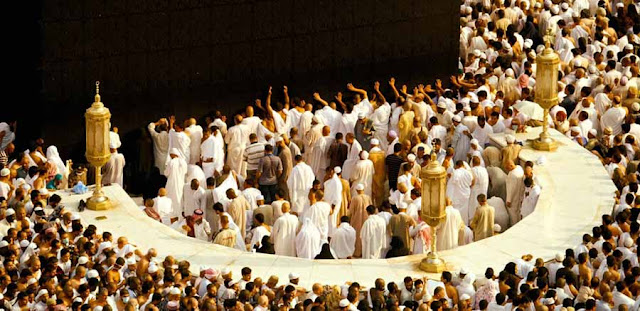
MADINAH: Performing tawaf (circumambulation) around the Kaaba was “a dream come true” for Algerian pilgrim Ahmed Al-Qairawani, who is in the Kingdom for the first time.
“It cannot be described in words. I cried once I entered the Grand Mosque and saw the sacred Kaaba, where pilgrims circumambulate around it raising their hands seeking Allah’s forgiveness,” he told Arab News.
“I saw the black stone and Abraham’s shrine for the first time. I wish to stay at the Grand Mosque for the rest of my life,” he said.
Al-Qairawani praised the expansion projects at the Two Holy Mosques in Makkah and in Madinah, including the mataf expansion.
He said the Kingdom’s role in serving pilgrims and providing them with all possible facilities, right from the entry to the country until departure is exemplary.
Speaking about what he did in Madinah, Al-Qairawani said that he visited the Prophet’s Mosque where he got the chance to greet him (peace be upon him) as well as he visited the King Fahd Complex for Printing the Holy Qur’an, Islamic mosques and other historical sites in the holy city.
Article by: arabnews.com

Monday, 25 January 2016

Faith is my life so wonderful and beautiful


Aminah Assilmi is a former Christian based in the US. She tried to convert Muslims to Christianity, but herself embraced Islam when she read the Qur’an and other books on Islam. In this concluding part of her narrative, she describes how her Shahadah proved a solid footing on the ladder to spiritual knowledge and closeness to God.

IN all this, the first light was my grandmother. She approved of my choice and joined me. What a surprise! I always knew she had a lot of wisdom, but this! She died soon after that. The day she pronounced Shahadah, all her misdeeds had been erased, while her good deeds were preserved. She died so soon after accepting Islam that I knew her ‘book’ was bound to be heavy on the good side. It fills me with such joy!
As my knowledge grew and I was better able to answer questions, many things changed. But, it was the changes made in me as a person that had the greatest impact. A few years after I went public with my Islam, my mother called me and said she did not know what this ‘Islam thing’ was, but she hoped I would stay with it.
She liked what it was doing for me. A couple of years after that she called again and asked what a person had to do to be a Muslim. I told her that all person had to do was know that there was only One God and Muhammad was His Messenger. Her response was: “Any fool knows that. But what do you have to do?” I repeated the same information and she said: “Well, OK. But let’s not tell your father just yet.”
Little did she know that he had gone through the same conversation a few weeks before that. My real father (the one who thought I should be killed) had done it almost two months earlier. Then, my sister, the mental health person, she told me that I was the most ‘liberated’ person she knew. Coming from her that was the greatest compliment I could have received.
Rather than try to tell you about how each person came to accept Islam, let me simply say that more members of my family continue to find Islam every year. I was especially happy when a dear friend, Brother Qaiser Imam, told me that my ex-husband took Shahadah. When Brother Qaiser asked him why, he said it was because he had been watching me for 16 years and he wanted his daughter to have what I had. He came and asked me to forgive him for all he had done. I had forgiven him long before that.
Now my oldest son, Whitney, has called, as I am writing this book, and announced that he also wants to become Muslim. He plans on taking the Shahadah as the ISNA Convention in a couple of weeks. For now, he is learning as much as he can. God is the most merciful.
Over the years, I have come to be known for my talks on Islam, and many listeners have chosen to be Muslim. My inner peace has continued to increase with my knowledge and confidence in the Wisdom of God. I know that God is not only my Creator but, my dearest friend. I know that God will always be there and will never reject me. For every step I take toward God, He takes 10 toward me. What a wonderful knowledge.
True, God has tested me, as was promised, and rewarded me far beyond what I could ever have hoped for. A few years ago, the doctors told me I had cancer and it was terminal. They explained that there was no cure, it was too far advanced, and proceeded to help prepare me for my death by explaining how the disease would progress. I had maybe one year left to live. I was concerned about my children, especially my youngest. Who would take care of him? Still I was not depressed. We must all die. I was confident that the pain I was experiencing contained blessings.
I remembered a good friend, Kareem Al-Misawi, who died of cancer when he was still in his 20’s. Shortly before he died, he told me that God was truly Merciful. This man was in unbelievable anguish and radiating with God’s love. He said: “God intends that I should enter heaven with a clean book.” His death experience gave me something to think about. He taught me of God’s love and mercy. This was something no one else had ever really discussed. God’s love!
I did not take me long to start being aware of His blessings. Friends who loved me came out of nowhere. Even more importantly, I learned how very important it was for me to share the Truth of Islam with everyone. It did not matter if people, Muslim or not, agreed with me or even liked me.
The only approval I needed was from God. The only love I needed was from God. Yet, I discovered more and more people, who for no apparent reason, loved me. I rejoiced, for I remembered reading that if God loves you, He causes others to love you. I am not worthy of all the love. That means it must be another gift from God. God is the Greatest!
There is no way to fully explain how my life changed. Alhamdulillah (All praise is due to God)! I am so very glad that I am a Muslim. Islam is my life. Islam is the beat of my heart. Islam is the blood that courses through my veins. Islam is my strength. Islam is my life so wonderful and beautiful. Without Islam, I am nothing, and should God ever turn His magnificent face from me, I could not survive.
“O God! let my heart have light, and my sight have light, and my hearing (senses) have light, and let me have light on my right, and let me have light on my left, and let me have light above me, and have light under me, and have light in front of me, and have light behind me; and let me have light.” (Sahih Al-Bukhari)
Article by: arabnews.com

Friday, 22 January 2016

Some Mistakes of Pilgrims


All praise is due to Allah, Lord of the Worlds, and prayers and peace of Allah be upon the Seal of Prophets and Messengers, our Prophet, Muhammad, and upon all his family and Companions.

Hajj (Pilgrimage) carry fruitful acts, as Allah, Glorified be He, has made it a mean for expiating wrongdoing and forgiving sins. The Prophet (Prayers and peace of Allah be upon him) said,

"Whoever performs Hajj and does not commit any obscenity or commit any evil will return (free of) sin as on the day his mother bore him". [Agreed upon]
متفق عليه«من حج فلم يرفث ولم يفسق رجع من ذنوبه كيوم ولدته أمه»

He also said,

"From one Hajj to the next Hajj is an expiation for whatever (sins) committed between them, so long as major sins are avoided".
«الحج إلى الحج كفارة لما بينهما ما اجتنبت الكبائر»
Since validity of worship depends on sincerity to Allah, Exalted be He, and following of his Prophet (Prayers and peace of Allah be upon him), it is necessary for an observant Muslim to well consider such fundamentals, so that his worship may become perfect. Allah, Exalted be He, says, {And they were commanded not, but that they should worship Allâh, and worship none but Him Alone (abstaining from ascribing partners to Him)} [Al-Bayyinah 98:5].
البينة: 5{وَمَآ أُمِرُوٓا۟ إِلَّا لِيَعْبُدُوا۟ ٱللَّـهَ مُخْلِصِينَ لَهُ ٱلدِّينَ}

Transliteration: Wa Ma Umiru Illa liya`budu Allaha Mukhlisina lahu ad-din.

He also says, {Indeed in the Messenger of Allâh (Muhammad صلى الله عليه وسلم) you have a good example to follow for him who hopes for (the Meeting with) Allâh and the Last Day, and remembers Allâh much.} [Al-Ahzab 33:21].
{لَّقَدْ كَانَ لَكُمْ فِى رَسُولِ ٱللَّـهِ أُسْوَةٌ حَسَنَةٌ لِّمَن كَانَ يَرْجُوا۟ ٱللَّـهَ وَٱلْيَوْمَ ٱلْـَٔاخِرَ وَذَكَرَ ٱللَّـهَ كَثِيرًا} الأحزاب: 21

Transliteration: Laqad kana lakum fi rasuli Allahi Uswatun Hasanatun Liman kana Yarju Allaha wa al-Yawma Al-Akhira Wa Thakara Allaha kathira.

In addition, He says, {….And whatsoever the Messenger (Muhammad صلى الله عليه وسلم) gives you, take it; and whatsoever he forbids you, abstain (from it). And fear Allâh; verily, Allâh is Severe in punishment.} [Al-Hashr 59:7].
الحشر: 7{وَمَآ ءَاتَىٰكُمُ ٱلرَّسُولُ فَخُذُوهُ وَمَا نَهَىٰكُمْ عَنْهُ فَٱنتَهُوا۟}

Transliteration: Wa Maatakumu Ar-Rasulu fa khuthuhu Wa Ma Nahakum `Anhu fa Intahu)

These are just examples of the Qur'anic texts in this regard.

Hajj to Allah's Sacred House is one of the Five Pillars of Islam that is obligatory only on the part of those who can physically and financially afford it. Its rituals and rulings were fully clarified by the Prophet (Prayers and peace of Allah be upon him), through verbal explanation, actual performance, and silent consent. Companions watched the Prophet carefully to well learn Hajj practices, in observance of his command,

"Take from me your rituals (of Hajj)" [Reported by Muslim].
رواه مسلم«لتأخذوا مناسككم»

Then, they passed to us what they have learnt, as clear as could be.

Despite all such clarification and demonstration, some people do deviate from the Prophetic guidance, by either leaving some commendable supererogatory ritual or falling in an act of Bid`ah (i.e., innovation in religion) or disobedience, out of ignorance, misconception, or imitation of unreliable persons.

Sheikh Saleh Al-Fawzan has discussed some mistakes and errors commonly committed by pilgrims.

Mistakes in Ihram

1. Some pilgrims coming by air delay their Ihram (i.e., state of consecration to Hajj or `Umrah) until they reach Jeddah Airport and then assume Ihram there or at any other point nearer to Makkah, thus surpassing the Miqat (i.e., site of assuming Ihram) on their way. The Prophet (Prayers and peace of Allah be upon him) described Miqats saying, "They are for the people at those very places and besides for those who come through those places". [Reported by Al-Bukhari]
رواه البخاري«هن لهن ولمن أتى عليهن من غير أهلهن»

Thus, everyone who passes by or becomes parallel to a Miqat on his way, whether by air or on land, while he has the intention to perform Hajj or `Umrah (i.e., Lesser Pilgrimage) should assume Ihram at that Miqat. If he surpasses it and assumes Ihram at a place closer to Makkah, then he will have missed one of the obligatory rituals of Hajj and should offer a sacrificial animal in expiation. It is noteworthy that Jeddah is not a Miqat for those who do not live in it and those who assume Ihram in it.

2. Some pilgrims take souvenir photos after assuming Ihram and keep them and show them to their friends and acquaintances. This is wrong in two ways:

a) Taking photos in itself is haram and an act of disobedience, based on hadiths that prohibit it and show punishment for doing it. A pilgrim is consecration himself to worship, and thus it is not suitable to start that worship with an act of disobedience.

b) This falls under dissimulation and false pretension; liking to show others one's photo in the state and garments of Ihram is a dissimulation, and dissimulation annuls good deeds. It is a form of "minor polytheism", and it is one of the distinctive features of hypocrites.

3. Some pilgrims think that they should bring with them their shoes, money, and all other belongings that they might need on their journey and that it is impermissible for them to use anything that they had not brought with them before assuming Ihram. This is a big mistake and stark ignorance: They should not, and it is not haram to use any personal stuff not brought before Ihram. They can purchase and use anything they need, and they can replace Ihram garments, shoes, etc. They should avoid only the known prohibitions of Ihram.

4. Some men in the state of Ihram uncover their right shoulders, which is impermissible unless during circumambulation on arrival and circumambulation of `Umrah. Otherwise, both shoulders should be covered with the garment all the time.

5. Some women think that they should wear a specific color when on Ihram, such as green. This is wrong. There is no particular color that should be worn by women during Ihram. They can assume Ihram in their ordinary clothes, excluding clothes that are dandifying, tight, or transparent, which are impermissible whether on Ihram or not.

6. Some women in the state of Ihram put on a turban-like headdress so that burka does not touch the face, which is wrong and needless, and there is no evidence on its legitimacy. In a hadith narrated by `A'isha (may Allah be pleased with her), we are told that women on Ihram did cover their faces when in front of men but did not wear turbans or burka carriers. There is no problem if the burka touches the face.

7. Some women who get their period while on their way to Miqat with the intention of performing Hajj or `Umrah may abstain from assuming Ihram, thinking that ritual purification from menstruation is a prerequisite to Ihram. This is evidently wrong: Menstruation does not invalidate Ihram, and menstruating women can assume Ihram and perform all rituals of Hajj except for circumambulation around the Ka'ba, which is to be delayed until menstruation stops, as clarified in the Prophetic Sunnah. If a menstruating pilgrim goes beyond the Miqat without assuming Ihram, she should go back and assume Ihram at the Miqat. If she assumes Ihram from a point nearer than the Miqat, she should offer a sacrificial animal to compensate for leaving a Hajj duty.

Mistakes in Circumambulation

1. Many pilgrims restrict themselves to specific supplications that they read from handbooks during circumambulation, and sometimes they form groups that repeat together supplications after a recite. This is wrong in two ways:

a) The pilgrims stick to supplications that were not specified for that very event; the Prophet (Prayers and peace of Allah be upon him) was not reported to utter particular supplications during circumambulation.

b) Congregational supplication is a Bid`ah, and it disturbs other pilgrims. Typically, every pilgrim should utter whatever supplications he himself chooses to say, silently or in a low voice.

2. Some pilgrims kiss Ar-Rukn Al-Yamani (i.e., the Ka'ba corner to the direction of Yemen), which is wrong - it is just to be held with hands, without kissing. The Black Stone can be kissed, held with hands, or pointed at in case of crowd. Ar-Rukn Al-Yamani, however, is to be held with hands, but not to be kissed or pointed at from a distance. Other corners are neither to be kissed nor to be held.

3. Some people jostle through the crowds to hold and kiss the Black Stone. This is impermissible, since it is very difficult, can do harm to others as well as the jostler himself, and causes bodily contact with women. Normally, the Black Stone is to be held and kissed only when possible; otherwise, it is to be pointed at from a distance, to avoid jostling, doing harm, and touching women's bodies. Acts of worship are based on easiness. Holding and kissing the Black Stone is supererogatory and conditional on ability, and the option of pointing at it is to be used in case of inability to hold and kiss it. Also, jostling and pushing may lead to haram things - then how come that a haram is committed in order to perform a supererogatory act?

Mistakes in Haircutting

Some pilgrims cut only a few hairs of their heads, which is not sufficient for the ritual to be properly done. The point is to shorten hair in all parts of the head; on the basis that shortening replaces shaving, and since shaving is for the whole head, so is shortening. Allah, Exalted be He, says, {(some) having your heads shaved, and (some) having your head hair cut short, having no fear.} [Al-Fat-h 48:27].
الفتح: 27{مُحَلِّقِينَ رُءُوسَكُمْ وَمُقَصِّرِينَ لَا تَخَافُونَ}

Transliteration: Muhalliqina Ruusakum Wa Muqassirina la Takhafun)

When one shortens some part of his head, it is not the same as shortening all his hair.

Mistakes in Stay at `Arafa

1. Some pilgrims do not check where they stay and do not follow the signposts indicating the boundaries of `Arafa, thus erroneously staying outside the mountain. If they continue to be where they are and do not enter the area of `Arafa itself all through the Shar`i stay time, then their Hajj will be invalid. Pilgrims should make sure to be within the perimeter of `Arafa during the Shar`i stay time.

2. Some pilgrims think that during stay at `Arafa, they should see or climb the Mountain of Ar-Rahmah, and to do so, they impose on themselves huge difficulty and danger. There is no need to overdo it: All is needed is just to be present anywhere in `Arafa, as the Prophet (Prayers and peace of Allah be upon him) said, "And all of `Arafah is the place of standing, and avoid the Valley of `Uranah". [Authenticated by Al-Albani]
صححه الألباني«عرفة كلها موقف، و ارتفعوا عن بطن عرنة»

It makes no difference to see the mountain itself or not. Also, some turn their faces to the Mountain of `Arafa when supplicating, while they should do so to the Ka`ba.

3. Some pilgrims leave `Arafa before sunset, which is impermissible. Leaving time is defined as the sunset, and whoever leaves `Arafa before that time and does not return will be missing a Hajj duty and should thus offer a sacrifice and show repentance to Allah. The Prophet (Prayers and peace of Allah be upon him) remained at `Arafa till sunset, and he had already said, "Take from me your rituals (of Hajj)". [Authenticated by Al-Albani]
صححه الألباني«خذوا عني مناسككم»

Mistakes at Muzdalifah

Upon reaching Muzdalifah, a pilgrim should perform Salahs of Al-Maghrib and Al-`Isha' combined, spend the night there, pray Salah of Al-Fajr, supplicate just before sunrise, and leave to Mina. It is permissible for people who have excuses - especially women, the elderly, and children - and those who take care of them to leave after midnight. Mistakenly, some do not make sure to be staying within the boundaries of Muzdalifah, and some leave before midnight. Whoever does not spend the whole night at Muzdalifah with no excuse will be omitting a Hajj duty that should be compensated for by sacrificing an animal and repenting to Allah.

Mistakes in Pebble Throwing

In the duty of pebble throwing, a pilgrim is to throw at `Aqabah on the Eid day (it is permissible to do so as of the midnight of the Eid day) and then throw at the other three sites of throwing following the noon of the three Days of Tashriq (i.e., 11th, 12th, and 13th of Dhul-Hijjah), respectively. However, some pilgrims commit the following errors in that ritual:

1. Some throw at a wrong time - i.e., throw at `Aqabah before midnight of Eid day or at the other three sites before the noon of the Days of Tashriq. Such throwing is invalid, since it is not done at the specified times. It is just like performing a Salah before its due time starts.

2. Some miss the order of throwing at the three sites, starting with the second or last one. The right order is to start with the Small, then the Middle, and finally the greater.

3. Sometimes, thrown pebbles do not hit the throwing target (i.e., the stone column) or hit it so strongly that they bounce back and fall outside the stone column basin. Such throwing is invalid, since the pebbles have not fallen inside the basin. This mistake occurs due to ignorance, hastiness, or carelessness.

4. Some perform the throwing of the last two days in advance along with the throwing of the first day or appoint a proxy to perform the remaining two times of throwing on behalf of them, to be able to travel back home early before completing Hajj. This is an act of manipulation of Hajj activities and temptation from the Devil. A person spends much effort and money to perform Hajj, and when he is just a few steps away from finalizing it, he falls under the influence of the Devil and errs on several Hajj duties, which are:

(1) Dropping the last two times of throwing,
(2) Not staying at Mina all through the three Days of Tashriq,
(3) Doing Farewell Circumambulation at a wrong time (as it should be done after the elapse of all hajj days and activities).

It would have been better if such a person had not gone to do Hajj in the first place and save himself the waste of effort and money. Allah says, {And perform properly (i.e. all the ceremonies according to the ways of Prophet Muhammad صلى الله عليه وسلم), the Hajj and 'Umrah (i.e. the pilgrimage to Makkah) for Allâh} [Al-Baqarah 2:196].
البقرة: 196{وَأَتِمُّوا۟ ٱلْحَجَّ وَٱلْعُمْرَةَ لِلَّـهِ}

Transliteration: Wa Atimmu al-Hajja Wa al-`Umrata lillah.

That is to say, all activities of Hajj and `Umrah should be done in a Shar`i manner by those who assume Ihram for either of them, with sincere intention devoted to Allah, Exalted be He.

5. Some pilgrims misunderstand the meaning of hastening in the Qur'anic verse: {But whosoever hastens to leave in two days, there is no sin on him and whosoever stays on, there is no sin on him} [Al-Baqarah 2:203].
البقرة: 203{فَمَن تَعَجَّلَ فِى يَوْمَيْنِ فَلَآ إِثْمَ عَلَيْهِ وَمَن تَأَخَّرَ فَلَآ إِثْمَ عَلَيْهِ}

Transliteration: Fa Manta`Ajjala fi Yawmayni fa la Ithma `Alayhi wa man ta'akhkhara fa la Ithma `Alayh.

They think that the two days refer to the Eid day and the day following it (i.e., 11th of Thul-Hijjah), and consequently they assume to be hastening and leave on the 11th day. This is a fatal mistake that is committed out of ignorance. The two days here follow the Eid day (11th and 12th), and there is nothing wrong either to hasten to leave upon throwing pebbles after the noon of the 12th or to stay and throw after the noon of the 13th and then leave - the latter will be better and more recommendable.

Prayers and peace of Allah be upon Muhammad and upon his family and Companions.
Article by: en.islamway.net

Wednesday, 20 January 2016

Etiquette of Hajj and 'Umrah


"The Hajj (pilgrimage) is (in) the well-known (lunar year) months (i.e. the 10th month, the 11th month and the first ten days of the 12th month of the Islamic calendar, i.e. two months and ten days). So whosoever intends to perform Hajj therein (by assuming Ihraam), then he should not have sexual relations (with his wife), nor commit sin, nor dispute unjustly during the Hajj. And whatever good you do, (be sure) Allaah knows it. And take a provision (with you) for the journey, but the best provision is At-Taqwa (piety, righteousness). So fear Me, O men of understanding!" [al-Baqarah 2:197]

People should perform the rituals of Hajj with respect, veneration, love and submission to Allaah the Lord of the Worlds, in a tranquil and dignified manner, following the Messenger of Allaah (peace and blessings of Allaah be upon him).

These great rituals should be filled with dhikr (remembering Allaah), takbeer (proclaiming Allaah's greatness by saying Allaahu akbar), tasbeeh (glorifying Allaah by saying Subhaan-Allaah), tahmeed (praising Allaah by saying al-hamdu Lillaah) and istighfaar (seeking Allaah's forgiveness by saying Astaghfir-Allaah), because he is in a state of worship from the moment he enters ihraam until he exits it; Hajj is not a time for idle talk and play or doing whatever you want with no restrictions, as we see some people do, so we see them playing and laughing and making fun of people and other reprehensible actions, as if Hajj were prescribed for joking and playing.

The pilgrim and others should regularly observe the things that Allaah has enjoined such as praying in congregation on time, and enjoining what is good and forbidding what is evil.

The pilgrim should strive to benefit the Muslims and treat them kindly by guiding them, helping them when needed, and being compassionate towards the weak, especially in places where such compassion is appropriate, such as in crowded places. Showing compassion to people brings mercy from the Creator, for Allaah shows mercy to those of His slaves who are merciful.

He should avoid obscenity, immorality, sin and arguing that does not support the truth. With regard to debating in support of the truth, this is obligatory when it is appropriate. He should avoid being aggressive towards people or annoying them, so he should avoid backbiting, malicious gossip, cursing, swearing, hitting, and looking at non-mahram women, for these things are haraam whether one is in ihraam or not, but they are even more haraam when one is in ihraam.

He should avoid things that many people do, such as saying words that do not befit the rituals. For example, when stoning the jamaraat, some of them say, "We are stoning the Shaytaan" and they may curse the site or hit it with shoes etc., which is contrary to the idea of humility and worship, and defeats the purpose of stoning the jamaraat, which is to carry out the commands of Allaah.
 Article by: en.islamway.net