Showing posts with label 2016 umrah visa conditions. Show all posts

Thursday, 28 July 2016

The Intention for Ihram (Integral)

The Intention for Ihram (Integral)

The Intention for Ihram (Integral)

The first integral step for the person intending to travel to Makkah to perform the Pilgrimage (Hajj) is to establish the intention in his heart to enter into the actions of Pilgrimage (Hajj or Umrah).

 It is this intention and not just donning the clothes of ihram which causes one to become in that state. Going into the state of ihram means intending to enter into the actions of Hajj or Umrah during which certain things are obligatory on one to do and certain other things are prohibited for one to do.

Establishing this intention and going into the state of ihram must be done before the person crosses the miqat (The miqat is the place that a person must cross while having the intention of performing Hajj or Umrah), and may be done from one’s hometown. However, once the person establishes the intention and goes into the state of ihram, he must avoid all those things which are prohibited for him to do while in this state. Crossing beyond these miqats or what aligns with them before first entering into the state of ihram is unlawful (sinful) and requires an expiation.

These miqats were established by the Prophet and depend on the person’s route of travel to Makkah. The miqat for the people coming by route of al-Madinah is Dhul-Hulayfah (Abar ^Aliyy), a location less then ten (10) miles outside the city of al-Madinah, where the pilgrim may wash, change his clothes, pray, and make the intention.

It is sunnah to perform a purificatory bath (ghusl) before making the intention to enter into the state of ihram and to put perfume on the body, but not on the clothes intended for wearing for the ihram. It is sunnah to wear white clothes, and either new ones or clean used ones. One must take care to refrain from wearing the clothes forbidden for him to wear once he becomes in the state of ihram. The man wears an izar (what covers the lower part of the body) and a rida’ (what covers the upper part of the body)—without either being sewn or felted to fit the body—like a huge towel or shawl. The man must take care also not to wear shoes sewn to fit the foot, rather hewears shoes that uncover the toes and the back of the feet. The man may put on a belt to hold up his clothing. The woman may wear sewn clothes, and must cover all her ^awrah. She may not wear gloves to cover her hands though her sleeves may be long enough to do so. She may not cover her face with anything which touches the skin of her face.

Before one makes the intention of ihram it is sunnah to pray two (2) rak'ahs, with the intention of performing this sunnah for ihram, and to recite Surat al-Kafirun in the first rak'ah after the Fatihah, and Surat al-Ikhlas in the second rak'ah after reciting the Fatihah. Then, one faces the Qiblah and says to oneself: I now start the actions of Hajj, (I now engage in the actions of Hajj.)
Then to say out loud:


دخلت فى عمل الحج

O Allah, I now perform Hajj to obey You in answering Your order.


لبيك اللهم بحج


Then the man says the following statement out loud (the woman with a low voice). It is called the talbiyah: O Allah, I obey Your Order. I obey You one time after the other. O Allah, I obey Your Order. You are the One Who does not have any partner. I obey You one time after the other.

لبيك اللهم لبيك، لبيك لا شريك لك لبيك،

You are the One Who deserves to be praised and thanked. Every endowment is from You. You are the One attributed with Dominion. 

إنّ الحمد والنعمة لك والملك   

There is no partner with You.

 لا شريك لك

Then, one makes du^a’, asking Allah to raise the rank of Prophet Muhammad, and to accept one’s deeds, grant one Paradise, and protect one from Hellfire. Then, one makes other du^a’ for oneself and for whomever one wishes. It is good to repeat the talbiyah often. Should one see something which one likes or something which one dislikes, one says:

I obey You (O Allah). Surely, the valued living (meaning the living which does not have any hardships) is the living in the Hereafter (in Paradise).

لبيك إن العيشَ عيشُ الآخرة 

If one sees something which one likes, these words are reminders that the pleasures in Paradise are much, much more than the pleasures on Earth. Should one see something one dislikes, these words help one to be patient by occupying one’s mind in how to escape Hellfire and get to Paradise, where one would not be disturbed by such matters.

Source: darulfatwa.org.au

Thursday, 2 June 2016

What is Ramadan and why is it important in the Muslim faith ?

What is Ramadan and why is it important in the Muslim faith ?

What is Ramadan and why is it important in the Muslim faith ?

Ramadan   is the name of the ninth month in the Islamic lunar calendar. It is an   important month in the Islamic calendar and culture. Each day during the month   of Ramadan, Muslims around the world observe the sacred month by fasting   during day light hours (from dawn to sunset), performing nightly prayers in   addition to the daily obligatory prayers, and concluding each day’s fast over   food with family and friends.  At the end of the month is a three-day   holiday that celebrates the conclusion of the month with Eid al-Fitr and   prepares individuals to return to their regular daily routine.

Fasting   is one of the pillars of Islam. “The month of Ramadan, during which the Qur’an   was revealed, a guidance for mankind, and clear proofs of the guidance and the   criterion; and whoever of you is resident, let him fast the month” (al-Qur’an,   2:185).

Fasting   is compulsory upon every sane, adult, healthy Muslim male who is not traveling   at that time. As for a Muslim female, she must not be menstruating or having   post-childbirth bleeding. People who are insane, minors, and those who are   traveling, menstruating, or going through post-childbirth bleeding, and the   elderly and breast-feeding or pregnant women do not need to observe the   fast.

There   are those who may not fast but have to make up the missed days of fasting at a   later date.  These include those who are ill (not chronically) and   travelers. “And [for] him who is sick among you or on a journey, [the same]   number of other days.” (al-Qur’an, 2:184). Elderly men and women are exempted   from fasting; so are the chronically ill, and those who have to perform   difficult jobs under harsh circumstances and who could not find any other way   to support themselves. They are not obliged to make up the days they missed   but in turn are obliged to feed one poor person a day (for every day of   fasting that they do not perform). Pregnant and breast-feeding women who fear   for themselves or for their babies may break their fast, feed one poor person   for every day they miss, and make up the missed days at a later time. Women   who are constantly pregnant or breast-feeding are not obliged to make up the   days. Though the young are not required to fast, it is proper for their   parents or guardians to encourage them to fast so they will become accustomed   to it at an early age. They may fast as long as they are able to and then   break it.

The main   objective of fasting is to achieve piety and righteousness. This implies   becoming conscious of our Creator, increasing our awareness of His Majesty,   exalting and glorifying His names and attributes, appreciating His greatness,   recalling His blessings upon us, and being grateful and thankful for His   guidance. “O you who believe! Fasting is prescribed to you as it was   prescribed to those before you, so you may remain conscious of God”   (al-Qur’an, 2 : 183).

During  Ramadan while individuals abstain from food and drink during day light hours,   they get together over food with families and friends in the evenings. The   meal with which the fast is broken is called iftar. Usually the meal is simple   designed to provide nourishment, but may sometimes be sumptuous when there is   a large get-together of family and friends.

Abstaining from   food has great ramification on the person observing the fast, physical as well   as spiritual. It is an exercise for the discipline and control of the baser   self. One learns how to restrain one’s urges and desires. Fasting frees the   person from the bondage of lusts and desires. Abstaining from intakes also   reminds us of the less fortunate ones, the poor and the destitute. Fasting   gives us a general sense of how they feel. It boosts the morale of the poor by   knowing that even kings have to go hungry for a while. Fasting makes the rich   realize and understand what the poor goes through day after day. Fasting also   purifies one’s heart and tongue. One is urged to control himself and learn how   to abstain from vain talk, lying, and cheating. Although fasting is beneficial   to health, it is mainly a method of self-purification and self-restraint. By   cutting oneself from worldly comforts, even for a short time, a fasting person   focuses on his or her purpose in life by constantly being aware of the   presence of God.

The   month of Ramadan is not only the month of fasting. It is also the month of the   Qur’an. The Qur’an is the Muslim Scripture. “Ramadan is the (month) in which   the Qur’an was sent down, as a guide to mankind, also Clear (Signs) for   guidance and the differentiation (between right and wrong)”(al-Qur’an, 2 :   185). According to a prophetic tradition, it is believed that all Abrahamic   Scriptures including the Scrolls of Abraham, the Torah, the Gospel, the Psalms   of David, and the Qur’an were revealed in the month of Ramadan.

Practicing   Muslims congregate at mosques observing the nightly prayers (tarawih)   that start after the last prayer of the day, about an hour and a half after   sunset. The nightly prayers usually last for nearly an hour. Every night the   Imam (leader in prayer) recites an equal portion of the Qur’an so that by the   27th or the 29th night of Ramadan the entire Qur’an would have been recited by   the Imam from his memory. Reciting the Qur’an not only brings one nearer to   God, but also rejuvenates one’s spirit and soul. Reciting the Qur’an,   reflecting upon the divine words, and acting upon the divine teachings are   central to Ramadan.

As the   end of Ramadan approaches, Muslims prepare for Eid al-fitr (end of fasting   celebration), which draws Ramadan to a close. Eid is a time of giving gifts,   sharing food, gathering with family and taking a holiday.

Wednesday, 1 June 2016

Madinah gears up for Ramadan rush

Madinah gears up for Ramadan rush

Madinah gears up for Ramadan rush

MADINAH — The Madinah Mayoralty has deployed 20,000 employees to inspect hygienic condition of 8,449 shops round-the-clock as part of preparations for the holy month of Ramadan when millions of pilgrims and other worshipers will visit the city to pray at the Prophet’s Mosque.

Salamat Bin Salman Alluhaibi, spokesman of the mayoralty, said: “We have set out a comprehensive plan for improving services during Ramadan by deploying adequate number of employees and cleaning equipment following the directives of Emir Prince Faisal Bin Salman.”

He said the mayoralty has contracted with a specialized company to provide consultancy services for improving hygienic condition of the city. “Inspections will be carried out with the support of qualified staff members including 80 doctors,” he said.

Alluhaibi said the inspectors would focus on foodstuffs, licenses, slaughterhouses, general cleanliness and health protection. “We have deployed 156 inspectors to check hygienic condition in other shops,” he said, adding that they would ban street vendors in the central region of Madinah.

He said the mayoralty would intensify its efforts to clean markets and residential districts to achieve a high degree of cleanliness in streets, districts and the areas around the Prophet’s Mosque, which will be crowded with a large number of pilgrims and visitors. “We’ll deploy more than 4,000 employees to ensure cleanliness of the city and increase the number of cleaning supervisors and drivers,” Alluhaibi told Al-Madina daily.

The cleaning workers will be supported by more than 500 equipment including compressors, dump trucks, huge vacuum cleaners and waste carriers.

“The mayoralty also supervises model slaughterhouses in Madinah and manages the abettoirs in general. This includes veterinary services to protect the health of citizens and animals,” he pointed out.

Authorities ensure adequate supply of foodstuffs in the central region of Madinah during Ramadan and supervise resthouses and restaurants along the highway.
Article by: saudigazette.com.sa

Thursday, 26 May 2016

New security cameras installed in Makkah


New security cameras installed in Makkah

New security cameras installed in Makkah


MAKKAH — Security authorities have installed new 14 surveillance cameras in Makkah and around the Grand Mosque to ensure the safety of pilgrims, residents and visitors, Makkah newspaper reported.

Head of Security Affairs and Supervisor of Crises and the Disaster Management Center in Makkah Saud Bin Jelwi said the center is fully equipped with technological and human resources.

“People can contact us via 911 to report a crisis. The center will be fully functional by Ramadan. Our employees are highly trained and our equipment use state-of-the-art technologies. The quality of our security facilities rival international standards,” said Bin Jelwi.

He also said the Commission for the Development of Makkah and the Holy Sites has reequipped 150 surveillance towers to monitor the flow of crowds in Makkah.

“The commission is working on several projects to be finished before the upcoming Haj season. The commission is installing parasols to protect pedestrians from sunlight and providing chairs to allow them to sit and rest. The commission has also set a limit of 300,00 pilgrims at a time to take Al-Mashaer Train to ensure that the compartments are not overcrowded,” said Bin Jelwi.

He also said the commission has set new regulations for crowd management and for the movement of pilgrims.

“There are more roads open to reaching the Jamarat area. There will be a new pedestrian bridge on Sidqi Street connecting the Jamarat area to Al-Aziziyah. The commission has also installed 1,000 cameras in Mina,” said Bin Jelwi.
Article by: saudigazette.com.sa

Monday, 16 May 2016


Before passing the Meeqat – (the place where the Umrah starts, and one enters the state of Ihram)

  • Men to get changed into their Ihram (2 pieces of white cloth), preferably after one of the 5 daily prayers
  • Make niyyah (intention) for Umrah
4
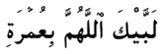
Labbaik Allaahumma ‘Umrah
(Here I am O Allah making ‘Umraah)
  • If one fears that they are likely to be subjected to illness or anything else that might obstruct their Umrah, one may add the following, by doing so if one can not complete the Umrah for whatever reason; then they simply cut their hair and do not have to pay the ransom.
5
Allaahumma mahillee haithu habastanee
(I come out of the state of Ihraam from the place You prevent me from continuing).
  • Make the Talbiyah (men to raise their voices) and continue making the Talbiyah until you reach the Kaba and start your Tawaf
6
Labbayk Allahumma labbayk, labbayka laa shareeka laka labbayk, innal-hamda wan-ni’mata laka wal-mulk, laa shareeka lak
(Here I am, O Allah, here I am. Here I am. You have no partner. Here I am. Surely all praise, grace and dominion is yours, and you have no partner.)
Article by: alqamardesigns


Friday, 13 May 2016

UMRAH GUIDE

UMRAH GUIDE

Before setting off from home

  • Make Ghusl (full body wash)
  • Trim your nails, and remove your pubic hair.
  • Whatever Salah is due at the time of travel, ensure it has been prayed in full before setting off
  • Read 2 rakaats of Travelling Salah before setting off
  • When going out of your house/hotel, say:
1
Bismillahi, Tawakkaltu, ‘a-lallahi, wa laa hawla wa laa quwatta illah billah
(In the name of Allaah, I place my trust in Allaah, and there is no might nor power except with Allaah)
  • Read Du’aa of Travelling, before setting off in car
25
Allahu Akbar, Allahu Akbar, Allahu Akbar. Subhaa-nalathee, Sakha-ra-la-naa ha-thaa wa maa kunaa, lahu muq-ri-nee-na wa innaa ilaa rabbinaa la-mun-qa-le-boon
(Allaah is the greatest x3, How perfect He is, The One Who has place this (transport) at our service, and we ourselves would not have been capable of that, and to our Lord if our final destiny.)
  • At a journey break, you may say:
32
A’uthoo bi-kalimaa tillaah-hitammaa ti-min sharri maa khalaq
(I take refuge in Allaah’s perfect words from the evil that He has created.)
  • NB.During your journey keep yourself in the remembrance of Allah (make dhikr, make dua, read quran, read Islamic Book etc). Remember this is the start of your journey to the House of Allah, and you have been given an invitation from Málik Al-Mulk (Owner and King of all Kingdoms), so Praise and Glorify Him.
  • Once you are a traveller (having left your areas of residence), and the next Salah is due, you can combine and shorten them as this is a concession from Allah.
    • Dhur (2 Rakaats) & Asr (2 Rakaats) together
    • Maghrib (3 Rakaats) & Ishaa (2 Rakaats) together
    • Read as many sunnah/nawafil as you like, there is no restriction.

 Article by: alqamardesigns


Thursday, 12 May 2016

Saudi Grand Masjid to have four floors for pilgrims circling Kaaba

Saudi Grand Masjid to have four floors for pilgrims circling Kaaba

The Grand Masjid in Makkah will have fourth floor or mataf, or circumambulation area around the Kaaba by September for Hajj and Umrah pilgrims.
Sultan al Qurashi, projects manager at the General Presidency for the Affairs of the Two Holy Mosques said the construction of the third floor has been done with an area of 76, 000 square metres and the construction is going on for the ceiling.
“We have increased the capacity of the mataaf in the Grand Mosque. It was the third phase of the King Abdullah Bin Abdulaziz Expansion Project. Pilgrims this Hajj season will have four floors to circumambulate the Kaaba,” told Al Arabiya.
The Grand Mosque has the capacity to accommodate around 114,000 pilgrims an hour.
“All construction work in the Grand Mosque will stop on Sept. 9 to allow pilgrims to enter the Grand Mosque and perform the rituals comfortably. Work will resume on Oct. 14 to construct the three main gates,” said Al-Qurashi.
“We also have ramps for pilgrims with disabilities to facilitate the movement of wheelchairs,” he added.
Article by: siasat.com

Monday, 9 May 2016

The Rites and Mustahab Acts of Hajj and Umrah 

Lots of ritual and Mustahab acts for “Hajj” and “Umrah” has been mentioned in the words of great Faqihs (Allah’s heaven be upon them) and we have brought a considerable part of them here.
But it is better to perform them with the intention of “Rija’”, which means hoping for the goodness of the act in the eyes of religion and having benefits and blessings, because some of them do not have enough proof (and we do not consider the principle of tolerance correct in the proof of traditions and Mustahab acts).
Another important point is that performing some of those Mustahab acts today, with crowd congestion, is impossible for many people. Therefore they can perform those actions which is possible, and if the Hajji wants to perform an act which is difficult to perform but have an intention of performing that, Allah will give him/her the reward according to his/her intention as it has been mentioned in hadeeth of Ma’soomin (a.s.).
It is Mustahab for a person who intends to travel to Mecca or other places to ask Allah for goodness of the travel and prepare his/her will and pay alms in order to buy his/her health with that alms and it is Mustahab to perform four Rak’ats prayer in the home when he/she is preparing for travel and recites Hamd and “قل هو الله Suras in each Rak'at and recite;
اللَّهُمَّ إنّی أتَقَرَّبُ إلَیْکَ بهِنَّ، فَاجْعَلْهُنَّ خَلیفَتی فی أهْلِی وَ مَالی .
And it is Mustahab to stand at the door of his/her house and recite Hamd Sura three times in front, right side and left side also Ayat al-Kursi (verse 255 of Baqara Sura) three times in the same way and says after that:
اَللَّهُمَّ احفَظْنى وَ احْفَظْ مَا


مَعىَ وَ سَلِّمْنی وَ سَلِّم مَا مَعِىَ وَ بَلِّغْنی وَ بَلِّغْ مَا مَعِىَ ببَلاغِکَ الحَسَنِ الجَمیلِ.
  article by:al-islam.org


Friday, 29 April 2016

Rings fastening the Kiswa to the base of Kaaba get gold coating

Rings fastening the Kiswa to the base of Kaaba get gold coating

Rings fastening the Kiswa to the base of Kaaba get gold coating


MAKKAH — The General Administration for Projects in the Presidency for the Affairs of the Two Holy Mosques has started gilding (coating with 24 carat gold) the stainless steel rings fastening the Kiswa to the base of the Holy Kaaba.

In line with the directives of Sheikh Abdulrahman Al-Sudais, general president for the affairs of the two holy mosques, the project is being carried out in cooperation with a specialist national company.

Sultan Al-Qurashi, director general of projects, said the stainless steel rings were cleaned and polished. They were then coated with 24 carat gold in three stages and with a thickness of 5 microns.

Eleven rings are being installed on the northern side of the Holy Kaaba.

Umrah packages 2016         |        hajj packages 2016          |        Ramadan umrah packages 

December umrah packages 2016         |         5 star Makkah & Madinah Hotels

 Source: saudigazette

Thursday, 24 March 2016

Kingdom to focus on Haj and Umrah for revenue

Kingdom to focus on Haj and Umrah for revenue

Kingdom to focus on Haj and Umrah for revenue

JEDDAH — Saudi Arabia will strengthen its Haj and Umrah service sector as part of a diversification strategy and reduce dependence on falling oil revenue.

Analysts have emphasized that Haj/Umrah is the second most important economic sector after oil and gas.

Economists consider Haj and Umrah as vital sectors with significant growth potential and ability to create more job opportunities for young Saudi men and women.

The tourism sector contributes SR85 billion to the gross domestic product (GDP) with Haj and Umrah providing a whopping SR45 billion.

With the completion of expansion projects at the two holy mosques in Makkah and Madinah, the revenue from the sector is expected to double.

Saudi Arabia currently receives nearly two million foreign Haj pilgrims annually. The figure is expected to reach 2.7 million by 2020.

It also receives more than six million Umrah pilgrims in nine months of the year. The figure is meager compared to the Kingdom’s potentials.

The tourism sector was instrumental in creating more than 100,000 jobs for Saudis within a short span.

Revenue from the tourism, Umrah and Haj sector is expected to grow by SR35 billion during the next five years through cultural, historical and medical tourism.

Abdul Ghani Al-Ansari, a member of the National Tourism Committee, emphasized the need to restructure the sector to make it a major contributor to the national economy.

There are 49 Saudi companies that are licensed to provide Umrah services. There are a similar number of Haj service firms in addition to 3,000 foreign agents. The total number of pilgrims who come for Haj and Umrah is estimated at between 7.3 million to 7.5 million, contributing SR57 billion to the GDP. This figure is likely to increase in the coming years, he said.

“The total capacity of hostels and furnished apartments in Makkah and Madinah is not fully utilized due to lack of good planning,” Al-Ansari told Okaz/Saudi Gazette.

Makkah can now accommodate 12 million pilgrims while Madinah can house only 230,000 visitors. “This shows there is big gap when we compare the two holy cities,” he pointed out.

He called for the establishment of a center to discuss revenues generated from Haj and Umrah.

He urged authorities to increase the number of Umrah service firms to more than 100 to bring more pilgrims from all over the world.

The Ministry of Haj can meet its annual budget on its own without any need to depend on government funds to implement its projects, he said.

Economist Abdullah Katib estimated the annual revenue from the Haj season at SR20-23 billion on the basis of the number of Hajis, which had fallen during the past five years as a result of expansion works at the Grand Mosque in Makkah.

“About 40 percent of this revenue comes from housing, 15 percent from gifts, 10 percent from food and the remaining from other services,” Katib said.

“As a result of ongoing expansion projects, the number of Haj and Umrah pilgrims is expected to increase by not less than 30 percent during the next five years. This demands construction of more hotels and housing units. This will enable the housing sector alone to generate SR9-12 billion during the same period,” he explained.

He said the annual increase should be balanced in order for the holy sites to accommodate the Hajis.

Easter umrah packages 2016       Umrah packages 2016        hajj packages 2016

Ramadan umrah packages           December umrah packages 2016

Article by: saudigazette.com.sa

Wednesday, 16 March 2016

Effect of Hajj on Perfecting Tawheed

Effect of Hajj on Perfecting Tawheed

Effect of Hajj on Perfecting Tawheed

Every year, the Islamic Ummah (nation) lives this blessed season and these special days which combine between the honor of place and time. It is the occasion of Hajj to the Sacred House of Allaah The Almighty. Pilgrims, the guests of Allaah, from all corners of the earth come together hoping to attain the Forgiveness and Pleasure of Allaah The Almighty. Their ears enjoy hearing the Talbiyah and their hearts feel tranquil and humble due to achieving goals and hopes. They head for the Ancient House of Allaah, the Ka‘bah, to which people’s hearts long for and return. Allaah The Almighty Says (what means): {And [mention] when We Made the House a place of return for the people and [a place of] security.} [Quran 2:125]

Hence, there should be a benefit from the universal congregation at this time and the proper means to found and perfect Tawheed of the pilgrims during their stay in this purified country that is established on a solid base of sound creed since it was unified by King ‘Abdul-‘Azeez until the present time. From that time until now, this land has judged according to Sharee‘ah (Islamic legislation) in the various affairs of life and carefully applies its teachings. It continually tries to unite Muslims and does its best to spread the sound creed via its various facilities whether they are related to Da‘wah (invitation to Islam), the media, education or culture.

Its effective role is clear during Hajj when Muslims come from all over the world, to know each other, love each other and study the matters of their religion. Undoubtedly, this gathering is a chance for Muslims to become closer to each other and remove the image of disunity and aversion. It is also a power that disappoints the Muslims' enemies. It is a meeting on the straight Path of Allaah The Almighty and His sound methodology. The knowledgeable person towards the way of Allaah The Almighty, guides people to the right path, and teaches them. On the other hand, the ignorant person seeks guidance and asks about whatever confuses him; whereas the person who has doubts asks about doubtful matters and seeks the clear answers that go along with the Sharee‘ah (Islamic legislation) of Allaah The Almighty and the Sunnah (tradition) of His Prophet, sallallaahu `alayhi wa sallam ( may Allaah exalt his mention ).

The Hajj gathering is also a chance to remove the doubts and innovations in religion that are practiced by some Muslim sects that the pilgrim may not realize in his country. This is because steering away from religious innovations and adhering to the guidance of the Prophet, sallallaahu `alayhi wa sallam ( may Allaah exalt his mention ), are among the main reasons for perfecting Tawheed and following the sound methodology which was approved by Allaah The Almighty for His slaves as Allaah The Almighty Says (what means): {And, this is My path, which is straight, so follow it; and do not follow [other] ways, for you will be separated from His way.} [Quran, 6:153]

Therefore, pilgrims should offer a sincere Hajj for the sake of Allaah The Almighty in conformity with the Sunnah of the Prophet, sallallaahu `alayhi wa sallam ( may Allaah exalt his mention ), without any increase or decrease or negligence. They should follow the example of the Prophet, sallallaahu `alayhi wa sallam ( may Allaah exalt his mention ), who said: “Learn your rituals (of Hajj) from me.” They should not let any other matter distract them from their rituals. They should ask the people of knowledge about any difficult or confusing matter. Allaah The Almighty Says (what means): {So ask the people of the message if you do not know.} [Quran 16:43]

There is no doubt that the scholars of this country have a leading role in advising people during the season of Hajj whether in terms of their rituals or morals, dealing with other people and inculcating the true creed in their souls. Despite the few days spent during Hajj in this country, pilgrims have a great chance to meet the scholars there and benefit from their Khutbahs (sermons), lectures and Fatwas (rulings).

The Kingdom of Saudi Arabia – under the leadership of the Custodian of the Two Holy Mosques – is considered the leader of the Islamic world and the caretaker of sound Islamic principles. Every year, it receives hundreds of thousands of pilgrims from within it and beyond its borders. It gathers all its material and human powers to organize the affairs of Hajj, serving the pilgrims of the Sacred House, facilitating their transportation and all other services so that they could so easily perform their Hajj without any annoying or distracting matters.

Pilgrims and residents of Saudi Arabia should benefit from the lessons, lectures and Fatwas of scholars there. They must adopt the sound creed of Tawheed and tolerant Islamic teachings and raise their children according to the correct Islamic upbringing away from deviation, extremism, or following the destructive streams and schools of thought which are propagated by the enemies of Islam.

Pilgrims should make the most of the school of Hajj in order to return to their homes carrying the correct message of this religion and its sound, pure creed and achieving the great goal of Hajj, which is to worship Allaah The Almighty Alone.
Article by: www.islamweb.net

Thursday, 10 March 2016

Hajj: A Once in a Lifetime Obligation

Hajj: A Once in a Lifetime Obligation

Hajj: A Once in a Lifetime Obligation


Acts of worship vary in relation to time. An act of worship is either an annual obligation such as fasting the month of Ramadan, or a weekly obligation such as the Friday prayer, or a daily obligation such as the five prayers, or it is obligatory only once in a lifetime, and that is Hajj.

When a person tries to figure out the reasons behind imposing Hajj only once in a lifetime, he may wonder whether this is only for the sake of facilitation or for another reason. Facilitation may be the reason, however what is certain is that Hajj involves many lessons and great teachings and if the Muslim understood them well, they would be sufficient for him and he would not need to perform Hajj again. That is why one is not obliged to perform Hajj over and over again as long as the first time is sufficient if it was performed as Allaah The Almighty wishes and likes. Nevertheless, it is recommended that the Muslim perform Hajj after that as many times as possible to internalize these lessons and such teachings in his soul until they become like inborn traits. In such a case, Allaah The Almighty would encompass His slave in His Mercy and engulf him in His Bounty.
 
The ultimate purpose of Hajj is to achieve untainted Tawheed (monotheism):
 
Devotion to Allaah The Almighty and acknowledging His Oneness is the essence of Hajj as explicitly stated in the Hadeeth in which the Prophet, sallallaahu `alayhi wa sallam ( may Allaah exalt his mention ), said: “Whoever performs Hajj for the Sake of Allaah…”, i.e. when one performs Hajj, he does so for the Sake of Allaah The Almighty to provide proof of the deep-rooted monotheism in his heart. One can easily recognize that confirmation of monotheism is the essence of Hajj since its legislation at the time of Ibraaheem (Abraham) may Allaah exalt his mention and throughout all its rites from beginning to end. Allaah The Exalted Says (what means): {And [mention, O Muhammad], when We designated for Abraham the site of the House, [saying], "Do not associate anything with Me and purify My House for those who perform Tawaaf...} [Quran 22:26]

Al-Qurtubi may Allaah have mercy upon him commented on this verse saying, "This verse rebukes the polytheists who live in the neighborhood of the Sacred House, because adherence to and preservation of monotheism was the condition that was imposed on their father and his offspring, including you, but you did not meet this condition; and instead associated others with Allaah The Almighty."

Therefore, the polytheists are forbidden from approaching the Holy House, as Allaah The Exalted Says (what means): {O you who have believed, indeed the polytheists are unclean, so let them not approach al-Masjid al-Haram after this, their [final] year. And if you fear privation, Allaah will enrich you from His bounty if He wills. Indeed, Allaah is Knowing and Wise.} [Quran 9:28]

The pilgrim commences his Hajj by acknowledging Tawheed (Oneness of Allaah The Almighty) when he says Talbiyah: “Labbayka Allaahuma Labbayk, Labbayka La Shareeka Laka Labbayk, Inna Al-hamda wan-Ni‘mata, Laka wal-mulk, La Sharika Lakk (Here I am, O Allaah! Here I have come. Here I have come; there is no partner with You. Verily, praise, blessing and Kingdom are Yours. There is no partner with You).”

The Muslim is also required to make frequent Thikr, Talbiyah and Tahleel (saying, “Laa Ilaaha Illa Allaah (There is none truly worthy of worship but Allaah)”). He should also make Takbeer while throwing the Jamaraat (pebbles). When he intends to return to his country after finishing Hajj, he should return to the Sacred House to perform the Farewell Tawaaf along with making Thikr, supplication, Tahleel and Takbeer as much as possible. Hence, the pilgrim starts Hajj by acknowledging the Oneness of Allaah The Almighty and concludes with the same thing.
Then comes devotion, i.e. to make this act of worship sincerely for the sake of Allaah The Almighty, far removed from ostentation, seeking fame or good reputation. The Prophet, sallallaahu `alayhi wa sallam ( may Allaah exalt his mention ), said: “Allaahumma haathihi hijjatun la riyaa’a feeha wa la sum‘ah (O Allaah, this is a pilgrimage in which there is no showing off or seeking reputation).”
 
Things that invalidate and blemish Hajj:
 
Sexual intercourse and sins adversely affect the desired reward of Hajj. Sexual intercourse invalidates Hajj, and so does foreplay, kissing, and sexual speech in the presence of women.

Allaah The Exalted Says (what means): {so whoever has madeHajj obligatory upon himself therein [by entering the state of Ihraam], there is [to be for him] no sexual relations and no disobedience and no disputing during Hajj.} [Quran 2:197]

Abu Bakr Al-Jassaas may Allaah have mercy upon him commented on this verse saying,

In this verse, Allaah The Almighty commanded the pilgrim to guard his private parts and tongue from all sins and acts of disobedience. Indeed, sins are prohibited before entering the state of Ihraam, but Allaah The Almighty Stated that they are especially prohibited during Ihraam to stress the great status of the state of Ihraam and to confirm that the punishment of the sins that are committed during the state of Ihraam are more severe.
The greatness of Hajj cannot be compatible with committing sins or vices by the pilgrim. Hence, the pilgrim must purify himself by refraining from committing any sin so as to refine his soul and habituate it to abandon its bad habits. In this way, the pilgrim will emancipate himself from evil desires, and will perfect his soul with noble manners and good behavior.

The reward of the pilgrim:
 
What a great reward it is to receive forgiveness of all sins! The Muslim would return sinless after performing Hajj as legislated and directed by Allaah The Almighty and His Messenger, sallallaahu `alayhi wa sallam ( may Allaah exalt his mention ). He will return to his house after performing Hijrah and Jihaad, and after disassociating himself from the polytheists, and showing kindness to the poor and the needy. He will be far from sins just as he was on the day his mother gave birth to him, a clear white slate untainted by any blemish. Ibn Hajar may Allaah have mercy upon him said, “The words ‘as he was on the day his mother gave birth to him,’ mean without any sin. Apparently, this means forgiveness of minor and major sins and their consequences.”

This great gift is indeed more valuable than the whole earth full of gold, as it means that the pilgrim has been secured from the repercussions of his previous sins and misdeeds. Thus, the pilgrim should prepare himself for the future to make sure that his record of deeds remains clean. Allaah The Almighty Says (what means): {The Day every soul will find what it has done of good present [before it]} [Quran 3:30]

Article by: www.islamweb.net

Thursday, 3 March 2016

It’s not weakness to remain silent

It’s not weakness to remain silent

It’s not weakness to remain silent

A man reviled Abu Bakr in the presence of Prophet Muhammad (peace be upon him). The Prophet remained seated. He looked pleased and smiled. He insulted Abu Bakr twice, but Abu Bakr controlled himself and remained silent. He insulted him for a third time, and Abu Bakr then let his tongue loose and responded back. At that, the Messenger of Allah got up and left.

Abu Bakr followed after the Prophet and said: “Messenger of Allah! He insulted me and you just sat there. Then when I responded to some of what he said, you became angry and got up.” The Prophet said: “There was an angel with you who was responding to his insults on your behalf.”

Then the Prophet said: “Abu Bakr, (keep in mind) three things which are always true, one of which is that whenever a person is subjected to an injustice but leaves the matter to Allah, then Allah will come to his aid… .” (Musnad Ahmad)

It is not a weakness to remain silent. It takes real strength. What others say will only hurt you if you let it. Construct within yourself a “refuse treatment plant” and try to turn other people’s insults into something constructive and positive that you can use for your own betterment and the betterment of others.

Prophet Muhammad (peace be upon him) told us a story about a baby who spoke in its infancy. While the baby was suckling on its mother’s breast, a man on an expensive, magnificent horse rode by. The mother said: “O Allah! Make my son turn out to be like that man.”

At that point, the baby left off his mother’s breast, looked at the man, and said: “O Allah! Do not make me like him.”

The mother carrying her child then came across a young servant girl who was being stoned by a crowd shouting out at her that she was an adulteress and a thief. The mother said: “O Allah! Do not let my son turn out like that woman.”

The baby stopped suckling again and looked at the servant girl and said: “O Allah! Let me turn out like her.” The mother asked the baby why he said those things. He replied: “That man you saw was a wicked tyrant, and that servant girl who was accused of committing fornication and stealing neither committed fornication nor stole anything. That is why I asked Allah to make me like her.” (Sahih Al-Bukhari and Sahih Muslim) There are a lot of well-known stories about people who kept quiet in the face of accusations and insults. Some people do not feel the need to defend themselves and clear their names.

One of these stories pertains to the celebrated Japanese philosopher Hakuin Ekaku. His neighbor’s teenage daughter fell pregnant, and when her enraged parents confronted her about it, she said that Hakuin was the father. News of the shameful deed spread far and wide, even overseas, and the philosophers’ reputation was ruined. However, it did not trouble him in the least, though people stopped coming to see him.

When the baby was born, they brought it to him and said: “You are its father, so you have to look after it.” He took the child and cared for it. A year later, wracked by feelings of guilt, the girl admitted that the real father was the young man who worked at the shop.

The girl’s parents went back to the philosopher full of apologies. They said: “We have come to take back the baby.” He returned the child to them without saying a word.

There is a similar story in the Muslim world, that of Jurayj the Pious.

When someone criticizes you, insults you, or calls you names, do not respond. Do not try to defend yourself. Allow yourself to appear at a loss. See the positive effect that this has on you. As Allah said to Mary when she gave birth to Jesus: “And if you see any person, say: Lo! I have vowed a fast unto the Beneficent, and I may not speak this day to any mortal.” (Qur’an, 19:26)

For a few moments, let yourself feel that your stature has diminished. Then you will feel as if something mighty inside you has woken up and you will know that you have not diminished in the least.

I have many times found myself the brunt of people’s abuses. Sometimes the arrows that were aimed at me were friendly fire. I found nothing more consoling in such situations than keeping quiet and saying to myself: “Allah is sufficient for me, and He is the best one for me to trust my affairs.”

It is not good for you to get into the fray when the sides are unclear, and when those who are ignorant are mixed in with those who have knowledge. When tempers settle down, that is the time to comment on the situation.

Speaking when tensions are high and issues are unclear can simply confuse matters further. You might say things you do not mean and that you cannot easily retract. You are more likely to have your worlds misunderstood even if they are true. You are more likely to alienate and drive away the very people whom you are trying to convince.

Also keep in mind that silence can sometimes be egotistical.

This is something we need to be aware of. It can become an expression of arrogance, aloofness, and disdain for others. Do not use silence be a way to act haughtily and put other people down. Silence is a form of expression, and can be used for better or for worse, so endeavour to use it only to further goodness and truth.
Article by: www.arabnews.com

Friday, 26 February 2016

Why ours is a different religion

Why ours is a different religion image by:saudigazette

Why ours is a different religion

Islam is a religion without any mythology. Its teachings are simple and intelligible. It is free from superstitions and irrational beliefs. The oneness of God, the prophethood of Muhammad (peace be upon him) and the concept of life after death are the basic articles of its faith. They are based on reason and sound logic. All of the teachings of Islam flow from those basic beliefs and are simple and straightforward. There is no hierarchy of priests, no farfetched abstractions, no complicated rites or rituals.

Everybody may approach the Qur’an directly and translate its dictates into practice. Islam awakens in man the faculty of reason and exhorts him to use his intellect. It enjoins him to see things in the light of reality. The Qur’an advises him to seek knowledge and invoke God to expand his awareness: “Say ‘O, my Lord! Advance me in knowledge’.” (Qur’an, 20: 114)

God also says: “Are those who know equal with those who know not? But only men of understanding will pay heed.” (Qur’an, 39: 9)

It is reported that the Prophet (may the mercy and blessings of God be upon him) said that: “He who leaves his home in search of knowledge (walks) in the path of God.” (At-Tirmidhi) and that, “Seeking knowledge is obligatory upon every Muslim.” (Ibn Majah and Al-Baihaqi)

This is how Islam brings man out of the world of superstition and darkness and initiates him into the world of knowledge and light.

Again, Islam is a practical religion and does not allow indulgence in empty and futile theorizing. It says faith is not a mere profession of beliefs, but rather that it is the very mainspring of life. Righteous conduct must follow belief in God. Religion is something to be practiced and not an object of mere lip service. The Qur’an says: “Those who believe and act righteously, joy is for them, and a blissful home to return to.” (Qur’an, 13: 29)

The Prophet is also reported to have said: “God does not accept belief if it is not expressed in deeds, and does not accept deeds if they do not conform to belief.” (At-Tabarani)

Unity of matter and spirit

A unique feature of Islam is that it does not divide life into watertight compartments of matter and spirit. It stands not for denial of life but for the fulfillment of life. Islam does not believe in asceticism. It does not ask man to avoid material things. It holds that spiritual elevation is to be achieved by living piously in the rough and tumble of life, not by renouncing the world. The Qur’an advises us to pray as follows:

“Our Lord! Give us something fine in this world as well as something fine in the Hereafter.” (Qur’an, 2:201)

But in making use of life luxuries, Islam advises man to be moderate and keep away from extravagance, God says: “…and eat and drink and be not extravagant; surely He does not love the extravagant.” (Qur’an 7:31)

On this aspect of moderation, the Prophet (peace be upon him) said: “Observe fasting and break it (at the proper time) and stand in prayer and devotion (in the night) and have sleep, for your body has its right over you, and your eyes have rights over you, and your wife has a claim upon you and the person who pays a visit to you has a claim upon you.”

Thus, Islam does not admit any separation between “material” and “moral,” “mundane” and “spiritual” life, and enjoins man to devote all of his energies to the reconstruction of life on healthy moral foundations. It teaches him that moral and material powers must be welded together and that spiritual salvation can be achieved by using material resources for the good of man in the service of just ends and not by living a life of asceticism or by running away from the challenges of life.

The world has suffered at the hands of the one-sidedness of many other religions and ideologies. Some have laid emphasis on the spiritual side of life but have ignored its material and mundane aspects. They have looked upon the world as an illusion, a deception, and a trap. On the other hand, materialistic ideologies have totally ignored the spiritual and moral side of life and have dismissed it as fictitious and imaginary. Both of these attitudes have resulted in disaster, for they have robbed mankind of peace, contentment, and tranquility.

Even today, the imbalance is manifest in one or the other direction. The French scientist, Dr. De Brogbi rightly says: “The danger inherent in too intense a material civilization is to that civilization itself; it is the disequilibria which would result if a parallel development of the spiritual life were to fail to provide the needed balance.”

Christianity erred on one extreme, whereas modern western civilization, in both of its variants of secular capitalistic democracy and Marxist socialism has erred on the other. According to Lord Snell: “We have built a nobly-proportioned outer structure, but we have neglected the essential requirement of an inner order; we have carefully designed, decorated and made clean the outside of the cup; but the inside was full of extortion and excess; we used our increased knowledge and power to administer to the comforts of the body, but we left the spirit impoverished.”

Islam seeks to establish equilibrium between these two aspects of life — the material and the spiritual. It says that everything in the world is for man, but man was created to serve a higher purpose: the establishment of a moral and just order that will fulfill the will of God. Its teachings cater for the spiritual as well as the temporal needs of man. Islam enjoins man to purify his soul and to reform his daily life – both individual and collective — and to establish the supremacy of right over might and of virtue over vice. Thus Islam stands for the middle path and the goal of producing a moral man in the service of a just society.

Islam, a complete way of life

Islam is not a religion in the common and distorted sense, for it does not confine its scope to one’s private life. It is a complete way of life and is present in every field of human existence. Islam provides guidance for all aspects of life – individual and social, material and moral, economic and political, legal and cultural, and national and international. The Qur’an enjoins man to embrace Islam without any reservation and to follow God’s guidance in all areas of life.

In fact, it was an unfortunate day when the scope of religion was confined to the private life of man and its social and cultural role was reduced to naught, as has happened in this century. No other factor, perhaps, has been more important in causing the decline of religion in the modern age than its retreat into the realm of private life. In the words of a modern philosopher: “Religion asks us to separate things of God from those of Caesar. Such a judicial separation between the two means the degrading of both the secular and the sacred ... That religion is worth little if the conscience of its followers is not disturbed when war clouds are hanging over us all and industrial conflicts are threatening social peace. Religion has weakened man’s social conscience and moral sensitivity by separating the things of God from those of Caesar.”

Islam totally denounces this concept of religion and clearly states that its objectives are the purification of the soul and the reform and reconstruction of society. As we read in the Qur’an: “We verily sent Our messengers with clear proofs, and revealed with them the Scripture and the Balance, that mankind may observe right measure; and He revealed iron, wherein is mighty power and (many) uses for mankind, and that God may know him who helpeth Him and His messengers, though unseen. Lo! God is Strong, Almighty.” (Qur’an, 57: 25)

God also says: “The decision rests with God only, Who hath commanded you that ye worship none save Him. This is the right religion, but most men know not.” (Qur’an, 12: 40)

Thus even a cursory study of the teachings of Islam shows that it is an all-embracing way of life and does not leave out any field of human existence to become a playground for the forces of evil.
Article by: islamreligion.com

Friday, 19 February 2016

I embraced Islam by reading Qur’an

I embraced Islam by reading Qur’an

 I embraced Islam by reading Qur’an

Al-Haj Ibrahim Khalil Ahmad, formerly Ibrahim Khalil Philobus, was an Egyptian Coptic priest who studied theology and obtained a high degree from Princeton University. He studied Islam to find gaps to attack it; instead he embraced Islam with his children, one of whom is now a brilliant professor in Sorbonne University, Paris. He speaks about himself in this concluding narrative:

I TOOK my final decision. In the morning I spoke with my wife from whom I have three sons and one daughter. But no sooner than she felt that I was inclined to embrace Islam than she cried and asked for help from the head of the mission. His name was Monsieur Shavits from Switzerland.

He was a very cunning man. When he asked me about my true attitude, I told him frankly what I really wanted and then he said: Regard yourself out of job until we discover what has befallen you. Then I said: This is my resignation from my job. He tried to convince me to postpone it, but I insisted. So he made a rumor among the people that I became mad. Thus I suffered a very severe test and oppression until I left Aswan for good and returned to Cairo.

In Cairo, I was introduced to a respectable professor who helped me overcome my severe trial, and this he did without knowing anything about my story. He treated me as a Muslim, for I introduced myself to him as such although until then I did not embrace Islam officially. That was Dr. Muhammad Abdul Moneim Al-Jamal, the then undersecretary of treasury. He was highly interested in Islamic studies and wanted to make a translation of the Holy Qur’an to be published in America. He asked me to help him because I was fluent in English since I had got my M.A. from an American University. He also knew that I was preparing a comparative study of the Qur’an, the Torah and the Bible. We cooperated in this comparative study and in the translation of the Qur’an.

When Dr. Jamal knew that I had resigned from my job in Aswan and that I was then unemployed, he helped me with a job in Standard Stationery Company in Cairo. So I was well established after a short while. I did not tell my wife about my intention to embrace Islam, thus she thought that I had forgotten the whole affair, and that it was nothing but a transitory crisis that no more existed. But I knew quite well that my official conversion to Islam needs long complicated measures, and it was in fact a battle, which I preferred to postpone for some time until I became well off and after I completed my comparative study.

In 1955 I did complete my study and my material and living affairs became well established. I resigned from the company and set up a training office for importing stationery and school articles. It was a successful business from which I gained much more money than I needed. Thus I decided to declare my official conversion to Islam. On Dec. 25, 1959, I sent a telegram to Dr. Thompson, head of the American Mission in Egypt informing him that I had embraced Islam. When I told my true story to Dr. Jamal he was completely astonished. When I declared my conversion to Islam, new troubles began. Seven of my former colleagues in the mission had tried their best to persuade me to cancel my declaration, but I refused. They threatened to separate me from my wife and I said: “She is free to do as she wishes.” They threatened to kill me. But when they found me to be stubborn they left me alone and sent to me an old friend of mine who was also a colleague of mine in the mission. He wept very much in front of me. So I recited before him the following verses from the Qur’an: “And when they listen to the revelation received by the Messenger, thou wilt see their eyes overflowing with tears, for they recognize the truth: They pray: ‘Our Lord! We believe, write us down among the witnesses. What cause can we have not to believe in God and the truth which has come to us, seeing that we long for our Lord to admit us to the company of the righteous?’” (Qur’an, 5:83-84)

I said to him: “You should have wept in humiliation to God on hearing the Qur’an; and believe in the truth which you know but you refuse. He stood up and left me as he saw no use. My official conversion to Islam was in January 1960.

My wife left me at that time and took with her all the furniture of our house. But all my children joined me and embraced Islam. The most enthusiastic among them was my eldest son Isaac who changed his name to Osman, then my second son Joseph and my son Samuel, whose name is Jamal, and daughter Majida who is now called Najwa. Osman is now a doctor of philosophy working as a professor in Sorbonne University in Paris teaching oriental studies and psychology. He also writes in ‘Le Monde’ magazine. As regards to my wife, she left the house for six years and agreed to come back in 1966, provided that she keeps her religion. I accepted this, because in Islam there is no compulsion in religion. I said to her: I do not want you to become a Muslim for my sake but only after you are convinced. She feels now that she believes in Islam but she cannot declare this for fear of her family, but we treat her as a Muslim woman, and she fasts in Ramadan because all my children pray and fast. My daughter Najwa is a student in the Faculty of Commerce, Joseph is a doctor pharmacologist and Jamal is an engineer.

Since 1961, I have been able to publish a number of books on Islam. In 1973, I performed Haj and I am doing activities preaching Islam. I hold seminars in the universities and charitable societies.

My faith in Islam has been brought about through reading the Holy Qur’an and the biography of Prophet Muhammad, may the mercy and blessings of God be upon him. I no longer believed in the misconceptions against Islam, and I am especially attracted by the concept of unity of God, which is the most important feature of Islam. God is only One. Nothing is like Him. This belief makes me the servant of God only and of no one else. Oneness of God liberates man from servitude to any human being and that is true freedom.
Article by: www.arabnews.com

Wednesday, 10 February 2016

The Conference Legislated by Allaah

The Conference Legislated by Allaah

The Conference Legislated by Allaah

When Muslims sight the crescent of the month of Thul-Hijjah, they leave for the House of Allaah from every distant place and remote country. They come on foot, riding camels, by ships and planes in order to witness the divine Islamic conference that Allaah has prescribed witnessing once in one's life in order to bring hearts together for His sake, fraternize among people who are upon the truth, and strengthen people’s relations every year through kindness and solidarity. It revives hope and determination. It unites the various complaints of the people stricken by material politics, an automated civilization and colonial aspirations. They chant their complaints in one supplication that is echoed in the desert and the sky.

Muslims today badly need to witness this conference as the colonialists have long confined them in their extorted lands and cut relations and communications among them and separated them from their inspiring past and promising future through obliterating their history, destroying their language, and extinguishing the torch of religion. Muslims have had no opportunity to gather except in the Hajj season if they could. However, there have been overt and covert schemes that resulted in Hajj not culminating in the wisdom that is intended behind the Hajj and thus many Muslims did not obtain the expected benefit from Hajj.

This was the case when Muslims were disunited, disagreeing, and under foreign occupation. Now that the colonial powers and invaders have been evacuated and Muslims have assumed the reigns of the Arab countries, only geographic and political lines separate Muslims in the east and west of the Arab lands without separating their hearts, hands, tongues, or brotherhood. These borders do not impede them from meeting in Makkah to mention the name of Allaah The Exalted in known days. They thank Allaah for His favors upon them including Islam, faith, answering the supplication of Ibraaheem (Abraham) may Allaah exalt his mention ransoming Ismaa‘eel (Ishmael) may Allaah exalt his mention and the prophethood of Muhammad sallallaahu `alayhi wa sallam ( may Allaah exalt his mention ) , the final Messenger of Allaah.

Hajj and Zakaah (obligatory charity) are the two social pillars of the religion. Upon these two pillars, there is a relation between the individual and other individuals and between the individual and society. The other three pillars of Islam focus on the relationship between the individual, his Lord and his heart. Zakaah establishes the social system upon sympathy and mercy. Hajj, on the other hand, establishes it upon the basis of acquaintance and familiarity. Hence, Zakaah achieves the meaning of fraternity by preventing undutifulness while Hajj establishes equality by removing differences.

Fraternity and equality are mottos of Islam, the rule of peace, the head of freedom, the meaning of true civilization and the spirit of sound egalitarianism.

Hajj was and still is the purifier of worldly life through clearing it from the fetters of desires and the filth of materialism.

Hajj was and still is the spring of safety that cools down exhausted nerves and hearts.

Hajj was and still is the place of security where souls feel at ease in the land of revelation, where the conscience becomes tranquil in the birthplace of creed and where feelings delight in the divine blessings of this heavenly land.

Hajj was and still is the meeting for Muslims from all over the world at ‘Arafah, sincerely loving each other, equally standing before Allaah with a modest appearance and humble souls, and raising hands invocating Allaah with similar words. Their supplications rise like incense and perfume. Muslims stand in this worldly gathering where the Prophet, his Companions, Muslim kings and princes and millions of pilgrims  from different places speaking in different languages stood. Muslims commemorate this event with Thikr (mentioning Allaah) and reflecting on how the religion, in a certain age, was revealed in this land, and how the heavens here made contact with the earth, and how in this arid desert grew gardens and fruits - in the east and the west.

Each spot in the land of Hijaaz has a quality for sacrifice and heroism. Hajj to this land is an inspiration of pride, a motivation to dignity, an urging of liberty and a reminder of unity. There is the Cave of Hiraa’, the first place where revelation descended; there is the House of Al-Arqam, which is a symbol of sacrifice; The Cave of Thawr, which is the rise of glory; and there is the house where Abu Bakr, ‘Umar, ‘Ali, ‘Amr, Sa‘d and Khaalid may Allaah be pleased with them were sitting. Then there is Bat'haa’, whose sands had the footprints of world leaders and the guiding lamps of humanity.

Allaah The Almighty Says (what means): {And [due] to Allaah from the people is a pilgrimage to the House - for whoever is able to find thereto a way.} [Quran 3:97] Nowadays, a lot of people meet the conditions of ability due to welfare and security. You can perform Hajj with a small amount of money in a short time by car, ship or plane without jeopardizing your life, wealth or health.

Due to the extreme hardships of Hajj in the past, it was almost confined to the labor class of farmers and artisans and the opulent and gentle people of authority did not think about it. So, the benefit of Hajj was seen as slight and did not exceed the limits of performing rituals.

But what prevents the Arab and Muslim leaders now from setting an appointment to meet at Hajj in order to achieve the goal of Hajj where they could sincerely discuss worldly and religious affairs and common causes?

Were they to perform Hajj year after year, they would raise the status of the religion, encourage people to perform this obligatory act of worship, and unite the Muslim word. The Ancient House, from which light spread and from whose heaven revelation came down, is still a beacon of light for the Ummah (Muslim nation) and the place from which its glorious and joyous future will rise!
article by: islamweb.net